
Stabilize the cornea
Cross-linking aims to slow or stop progression. It does not reliably remove the need for vision correction.
A treatment plan for both corneal stability and better vision—with cross-linking, specialist contact lenses, intracorneal ring segments and transplantation when needed.
Book a keratoconus assessmentKeratoconus causes the cornea to become thinner and more irregular, sometimes bulging into a cone-like shape. This can blur or distort vision and produce ghost images. It often begins in the teens or early adulthood, and the two eyes may be affected differently.
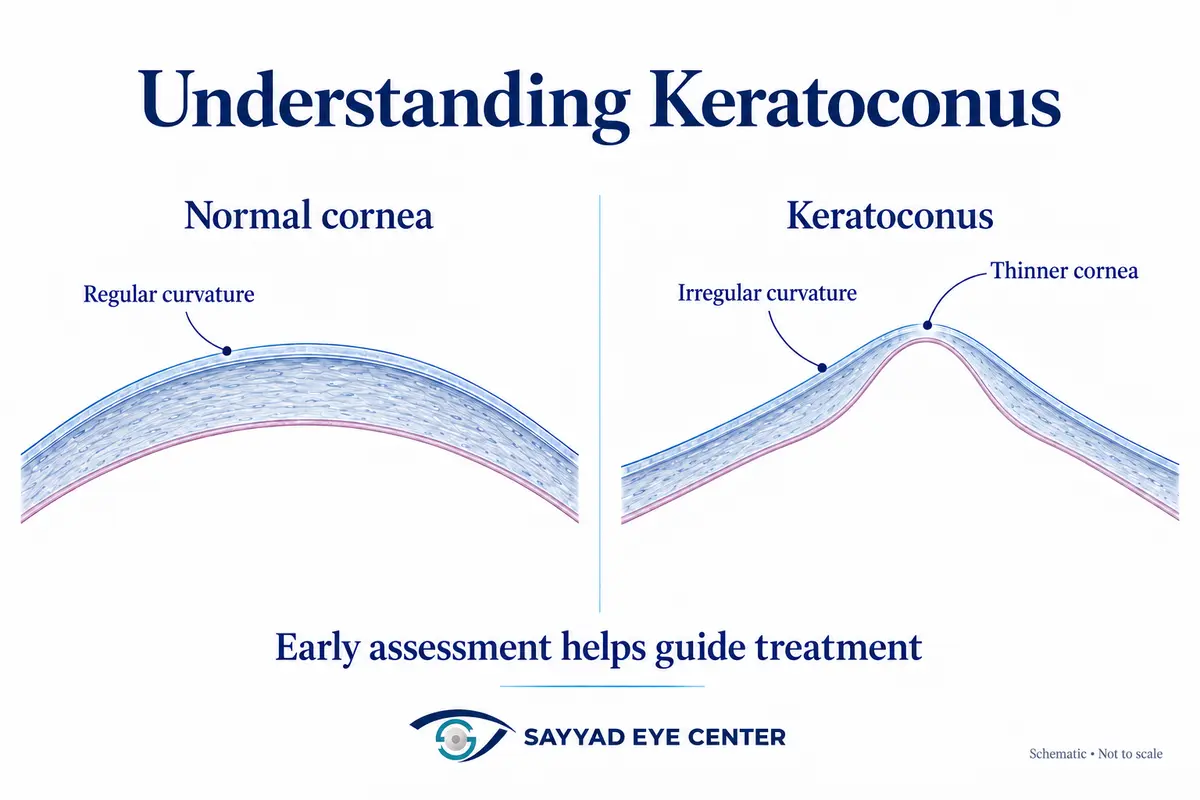
Frequent prescription changes, increasing astigmatism, ghosting around text, glare or vision that remains unclear with glasses can be signs of keratoconus. A family history is another reason to consider screening. Early assessment establishes a baseline for future comparisons.
Vision testing, refraction and slit-lamp examination are combined with corneal topography or tomography, such as Pentacam, to assess curvature, elevation and thickness. Additional imaging may help in selected cases. Comparing reliable scans over time helps identify progression; age, scarring and contact-lens tolerance also influence the plan.
Before measurements, stop wearing soft lenses for up to 1 week, soft toric lenses for up to 2 weeks and rigid gas-permeable (RGP) lenses for up to 4 weeks. Unstable measurements may require a longer break and repeat scans. Specialist lens types, including scleral lenses, need an individual preparation interval.
Cross-linking aims to slow or stop progression. It does not reliably remove the need for vision correction.
Glasses, specialist contact lenses and selected procedures address the optical effects of an irregular cornea.
| Option | Main purpose | When it may help |
|---|---|---|
| Glasses or soft lenses | Correct vision | Earlier cases with less irregularity. |
| RGP or scleral lenses | Improve optical clarity | When glasses do not correct irregular astigmatism adequately. |
| Corneal cross-linking (CXL) | Reduce progression | Progressive disease, or selected eyes at high risk of progression, with suitable measurements. |
| Intracorneal ring segments (ICRS) | Reshape the cornea | Selected eyes with suitable thickness, cone pattern and corneal clarity. |
| Corneal transplantation | Replace damaged tissue | Advanced scarring or poor functional vision despite other suitable options. |
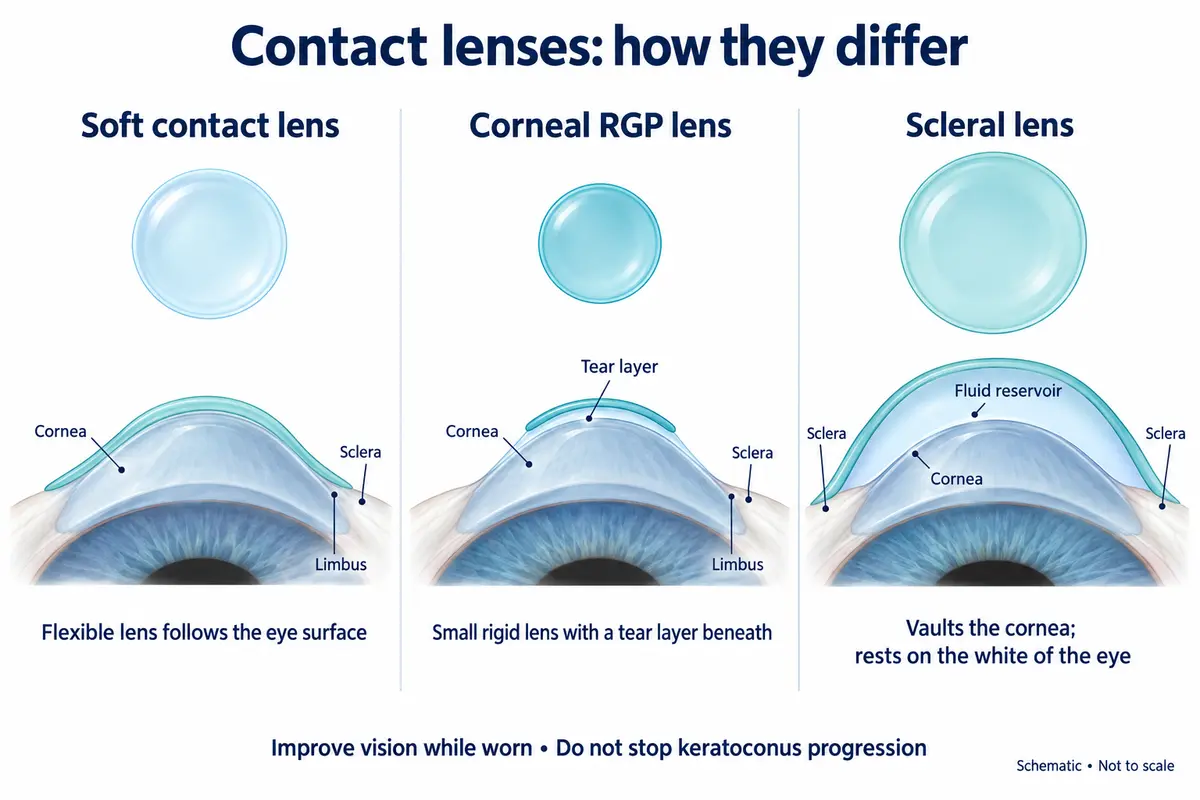
Specialist contact lenses can provide a smoother optical surface over an irregular cornea. The best fit balances clarity, comfort, corneal health and ease of handling.
Small rigid gas-permeable lenses sit on the cornea. The tear layer beneath the lens helps mask surface irregularity.
Larger rigid lenses rest on the white part of the eye and vault over the cornea. A fluid reservoir fills the space underneath. They may help when corneal RGP lenses are uncomfortable or unstable.
These lenses improve vision while worn; they do not stop keratoconus progression. Safe wear requires careful fitting, cleaning and follow-up. Scleral lenses are filled with the recommended sterile, preservative-free solution—never tap water.
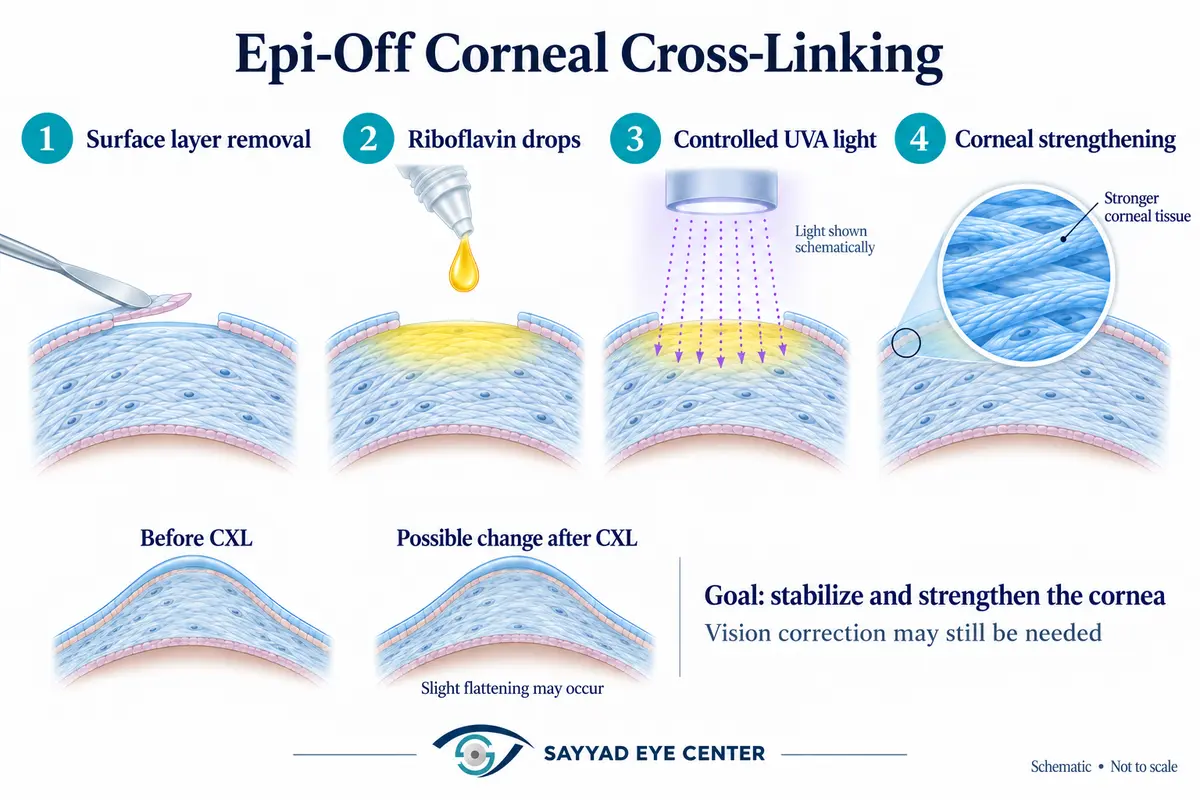
Riboflavin (vitamin B2) drops and controlled ultraviolet-A light strengthen bonds within the cornea. The main aim is to reduce further progression. Some flattening or visual improvement may occur, but neither is guaranteed.
In epi-off CXL, the surface cell layer is removed to allow riboflavin penetration, then a temporary bandage lens protects the healing surface. Epi-on approaches leave this layer in place; their protocols and evidence differ. Corneal thickness, disease behaviour and the treatment protocol determine suitability. A very thin or scarred cornea may require another approach.
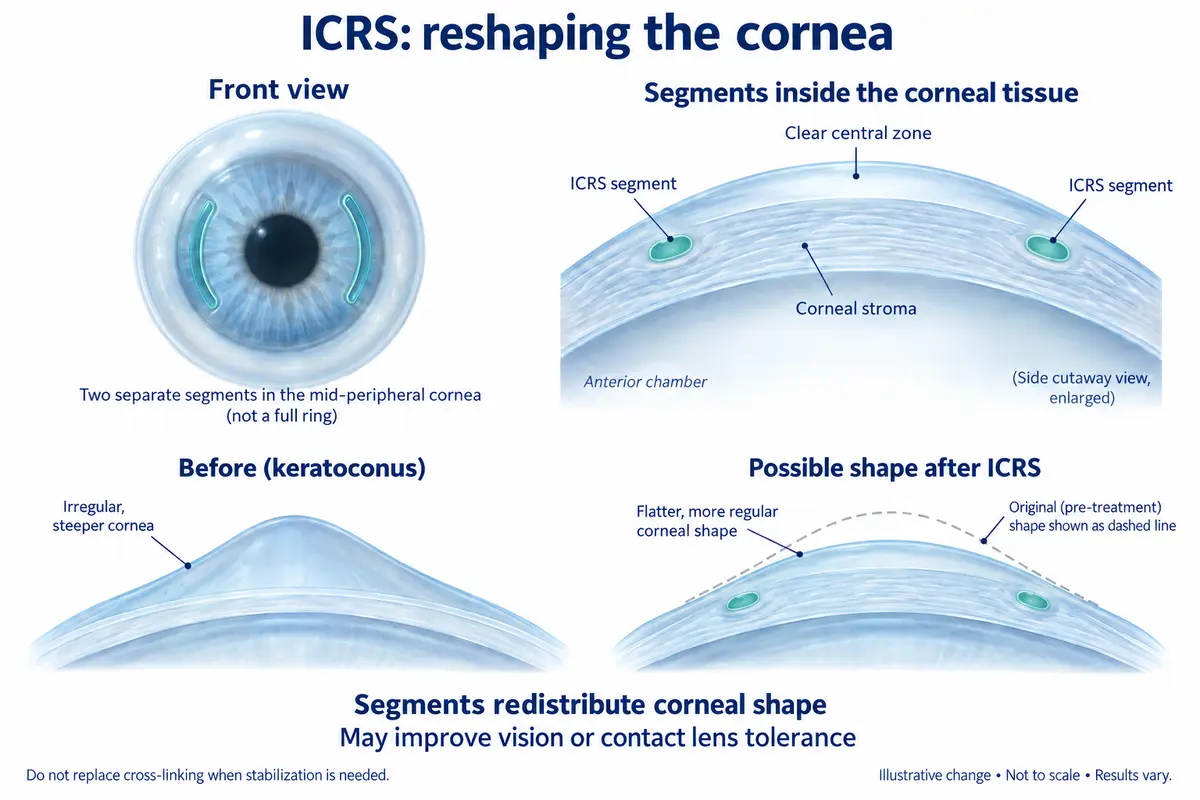
Small curved segments are placed in channels within the corneal tissue to change its shape. They may reduce irregularity and improve glasses-corrected vision or contact-lens tolerance in selected cases. Results depend on cone location, thickness and scarring.
ICRS do not replace cross-linking when stabilization is needed. Glasses or contact lenses may still be required. Possible complications include glare, infection, movement or exposure of a segment, and further surgery to adjust or remove it.
Transplantation may be considered for significant scarring, advanced distortion or inadequate vision despite a suitable specialist-lens trial. DALK replaces the front corneal layers while preserving a healthy inner lining; a full-thickness transplant (PKP) is needed in some cases. The choice depends on the affected layers and examination findings.
Explore corneal transplantationAfter epi-off CXL, pain, watering and light sensitivity are common in the first few days. Initial surface healing takes about a week, while vision can fluctuate for weeks to months. Prescribed drops, a bandage-lens check and longer-term scans support recovery and monitor stability. Recovery after ICRS or transplantation follows a different course.
CXL risks include infection, haze, delayed surface healing and reduced vision. Progression can occasionally continue after treatment, so follow-up remains necessary.
Avoid rubbing your eyes. Treat itching and allergy to reduce the urge to rub, and keep contact lenses clean. A stable glasses prescription alone does not prove the cornea is stable; repeat measurements remain important.
It aims to stabilize the cornea, rather than restore a normal shape. Glasses, contact lenses or further treatment may still be needed for vision.
No. They improve the optical surface while worn. Progression is assessed separately with scans, and cross-linking may still be needed.
Yes, selected eyes may benefit from both. Ring segments address corneal shape; cross-linking addresses progression. The order and timing depend on corneal measurements and the treatment plan.
No. Stable cases with useful vision may be managed with glasses or contact lenses and monitoring.
Routine LASIK is unsuitable because removing tissue and creating a flap can further weaken the cornea. Specialist combined treatments are a separate consideration for carefully selected eyes.
Family history increases risk, but many affected people have no known family history. Screening can detect early changes in relatives, particularly younger family members.
Not necessarily. Many people maintain useful vision with lenses and appropriate stabilization. Transplantation is reserved for cases where other options cannot provide adequate function or the cornea is significantly scarred.
Yes, progression can occur despite treatment. Repeat scans identify change; further treatment may be considered if progression is confirmed.
Bring previous corneal scans, glasses prescriptions and details of your current contact lenses.
Book a keratoconus assessment