Clear focus
Glasses correct significant long sight, short sight, astigmatism or unequal prescriptions.
Children need clear vision in each eye and coordinated eye alignment. Early assessment helps identify problems while vision is still developing.
Book an eye assessmentSquint (strabismus) means the eyes are not aligned. An eye may turn inward, outward, upward or downward, constantly or intermittently. Lazy eye (amblyopia) is reduced vision caused by abnormal visual development, often from unequal focusing, squint or an obstruction such as a childhood cataract.
A child may have either condition or both. Straightening the eyes does not automatically correct amblyopia; improving vision and improving alignment are separate treatment goals.
Glasses correct significant long sight, short sight, astigmatism or unequal prescriptions.
Amblyopia treatment encourages use of the weaker eye when glasses alone are insufficient.
Glasses, selected treatments or eye-muscle surgery address the pattern and cause of the squint.
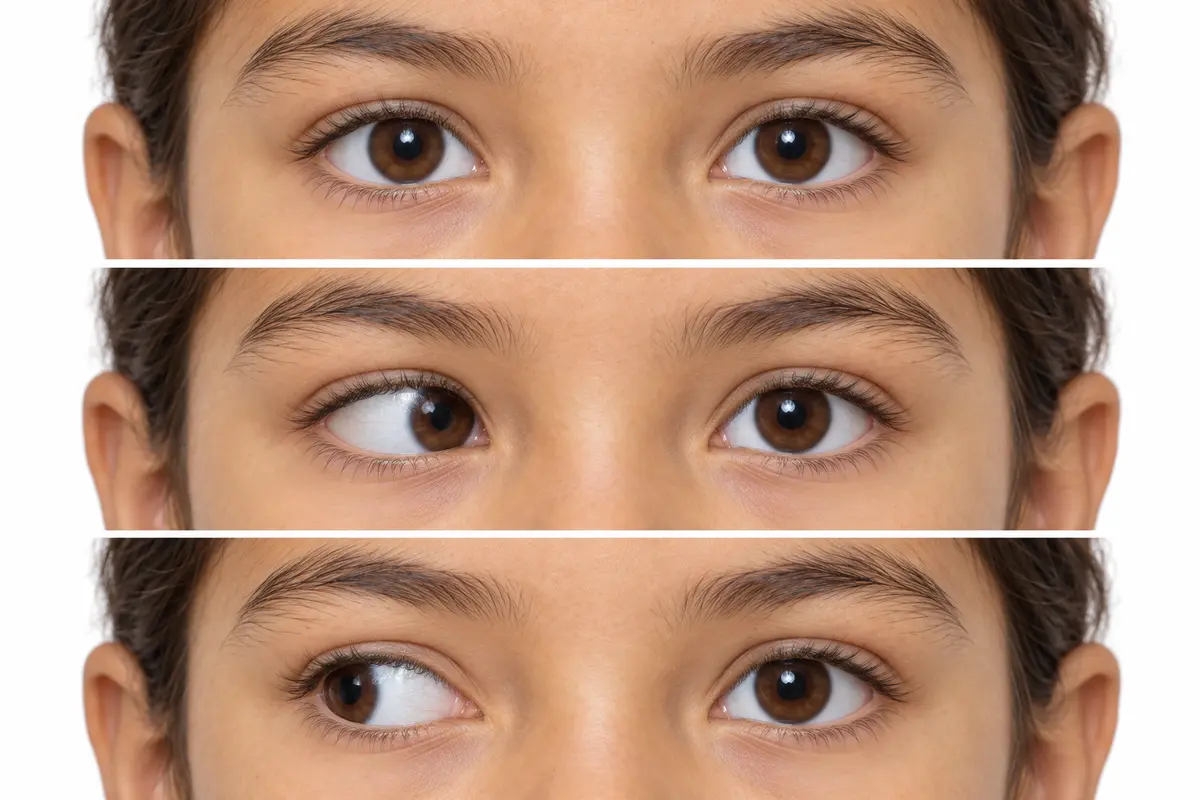
Children do not need to read letters to have their vision assessed. Testing may use looking responses, pictures or matching symbols. Assessment includes vision in each eye, alignment, eye movements and binocular function where possible.
Cycloplegic drops temporarily relax focusing to measure the prescription accurately. A dilated examination checks the internal eye structures. The drops may cause temporary blurred near vision and light sensitivity.
| Option | When it may help | What to know |
|---|---|---|
| Glasses | Correct focusing errors and may straighten accommodative inward squints. | Consistent wear can be the first step for both vision and alignment. Some squints remain partly or fully present with glasses. |
| Patching or prescribed atropine | Treat amblyopia by reducing the stronger eye’s advantage. | The dose or patching schedule depends on age and vision. Monitoring prevents excessive blurring of the stronger eye. |
| Eye-muscle surgery | Changes muscle position or tension to improve alignment. | May involve one or both eyes. Glasses and amblyopia treatment may still be needed afterwards. |
| Prisms, exercises or botulinum toxin in selected cases | Useful for specific patterns or symptoms. | Exercises are not a general cure for childhood squint; they help defined problems such as convergence insufficiency. |
An eye turn, closing one eye in bright light, a persistent head tilt, poor tracking or difficulty seeing the board can warrant assessment. A child may not complain when only one eye sees poorly.
Prematurity, a family history of childhood eye problems or a failed vision screen also support earlier examination. Persistent or recurrent misalignment should not simply be left until school age.
Children usually have surgery under general anaesthesia. The operation adjusts muscles on the outside of the eye; it does not remove the eye. Redness and temporary soreness are common during recovery.
Alignment can change with healing and growth. Under-correction, over-correction or recurrence may require further treatment; infection and serious vision complications are uncommon. Severe pain or reduced vision after surgery needs urgent review.
Vision, prescription and alignment can change as a child grows. Treatment is adjusted using measurements from each eye. The best opportunity for amblyopia treatment is in childhood, although selected older children may still improve.
No. Infant and preschool examinations use age-appropriate methods and do not require reading.
No. Glasses provide the focus needed for clear vision and development. A changing prescription reflects changes in the eyes, not damage from wearing glasses.
No. They may fully or partly correct a focusing-related inward turn. Other patterns may need observation, surgery or another targeted treatment.
Patching mainly treats amblyopia. It is not a substitute for alignment treatment when that is needed.
Usually not for common childhood squints. Exercises have a role in specific binocular problems, particularly convergence insufficiency.
Both eyes form a coordinated system. Adjusting muscles in one or both eyes can provide the required alignment change, depending on the measurements and pattern.
Yes. Growth, healing and the underlying condition can alter alignment. Some children need additional surgery or other treatment.
Often, yes. Muscle surgery changes alignment; it does not remove an underlying refractive error.
Not automatically. Timing depends on the cause, vision in each eye and potential for binocular development. Some conditions benefit from early treatment.
Bring previous eye reports, current prescriptions and a list of medicines to your appointment.
Content prepared: 9 October 2026