Refractive Surgery & Laser Vision Correction
Explore Femto-LASIK, SMILE Pro, PRK and ICL—and PRESBYOND for age-related difficulty with near vision. The right choice starts with your examination and investigations.
Book a vision correction assessmentLess dependence on glasses. A plan built around your eyes.
Refractive surgery aims to reduce dependence on glasses or contact lenses. Laser procedures reshape the cornea; ICL adds a lens inside the eye while keeping your natural lens. Your prescription, eye health and daily visual needs guide the decision.
Four main options at a glance
| Procedure | How it works | What to consider |
|---|---|---|
| Femto-LASIK | Laser-created flap; excimer laser reshapes the tissue underneath. | Often relatively quick early visual recovery; requires suitable corneal measurements. |
| SMILE Pro | A laser forms a thin piece of tissue (lenticule), removed through a small opening. | No LASIK flap; suitability depends on prescription and corneal measurements. |
| PRK | Excimer laser treats the cornea after the surface cell layer is removed. | No flap; more early discomfort and slower initial recovery than LASIK. |
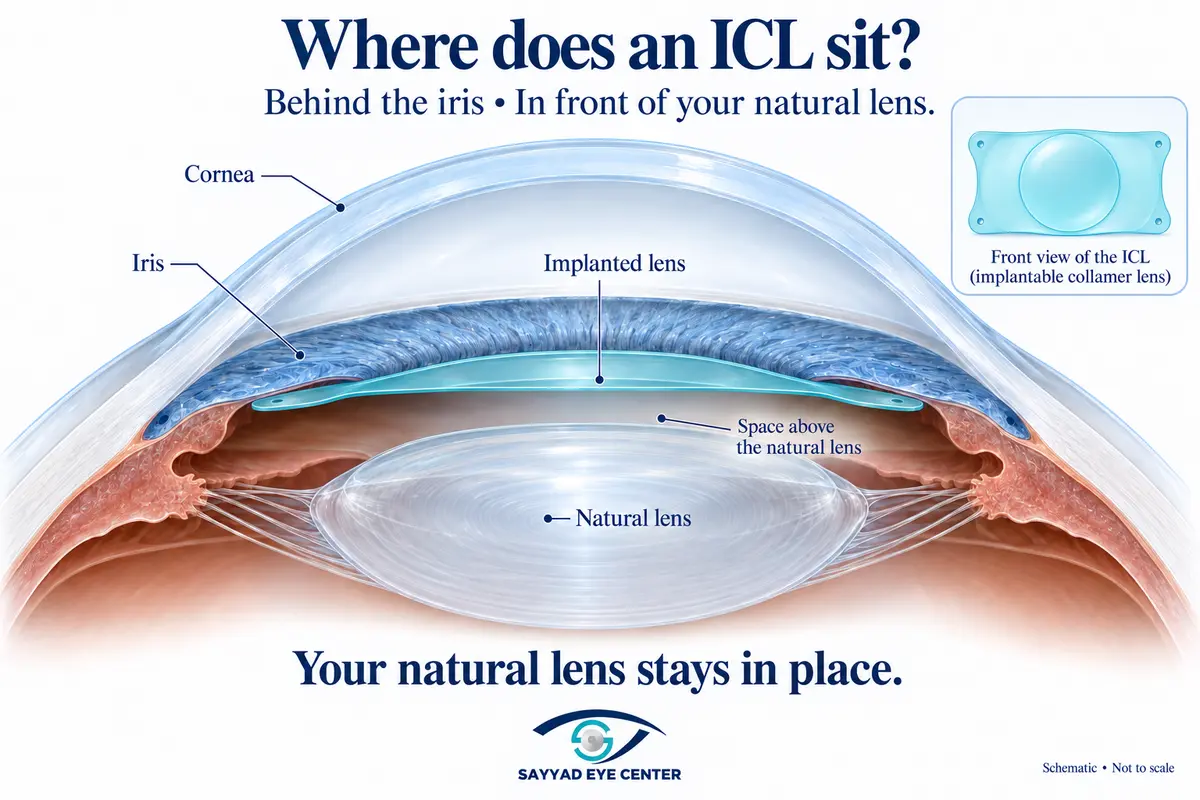
| ICL | An implant sits behind the iris and in front of the natural lens. | May suit higher prescriptions or eyes unsuitable for corneal laser; requires adequate space and healthy inner corneal cells. |
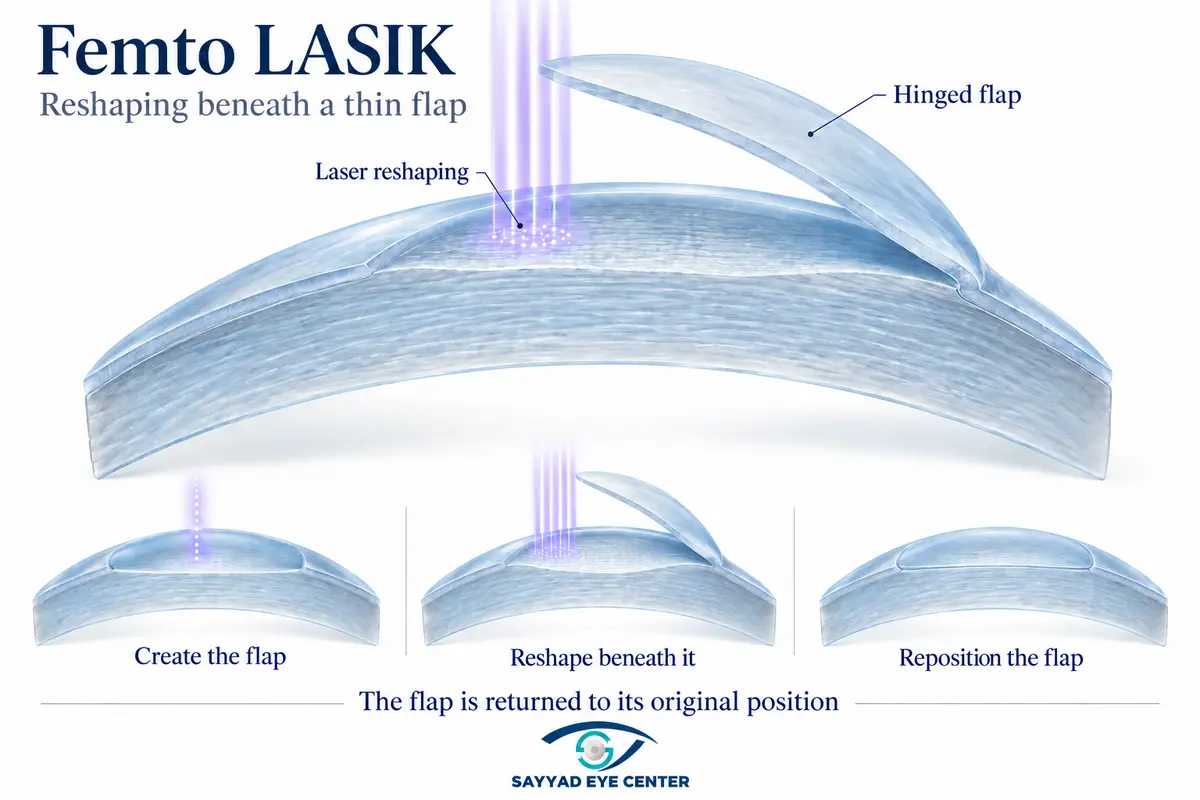
Femto-LASIK
A femtosecond laser creates a thin hinged flap. An excimer laser then reshapes the cornea beneath it, and the flap is repositioned. It can treat suitable cases of short sight, long sight and astigmatism.
Conventional LASIK uses a mechanical microkeratome to create the flap; Femto-LASIK uses a laser. Both reshape the tissue underneath. Dry eye and flap-related complications are among the considerations.
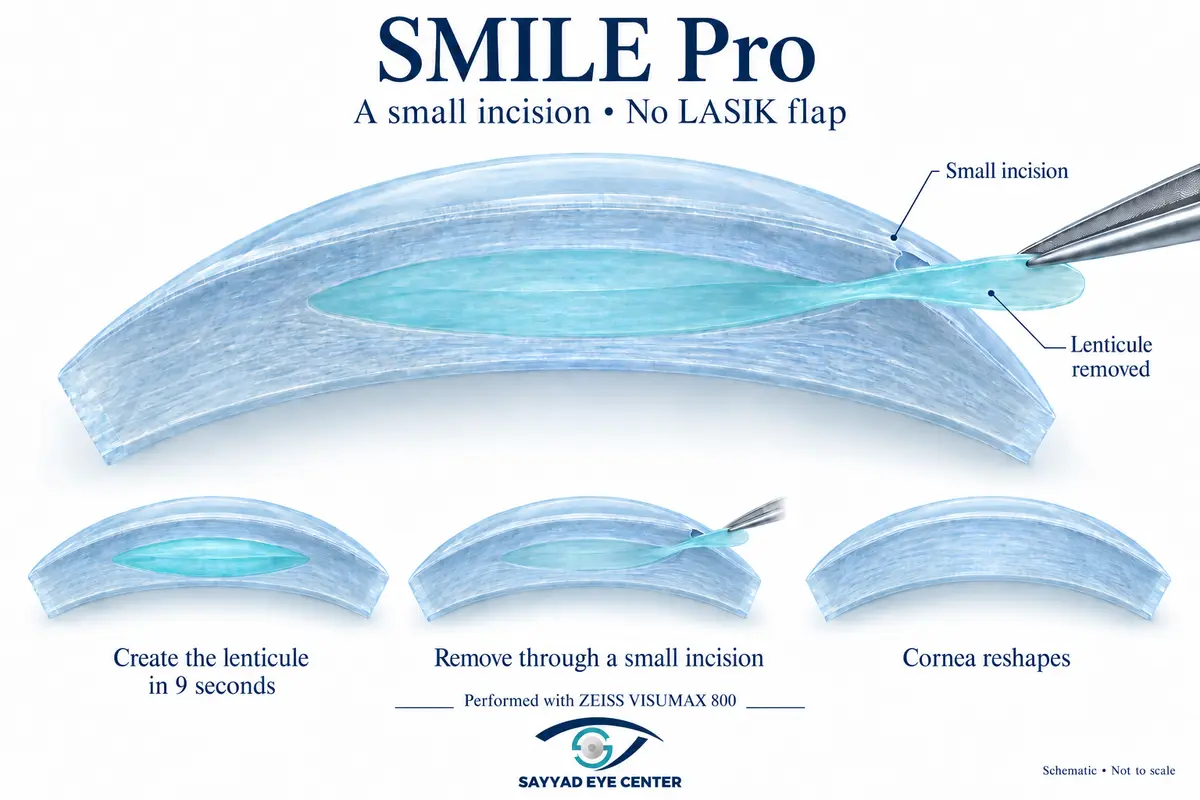
SMILE Pro
Using ZEISS VISUMAX 800, a femtosecond laser creates a lenticule inside the cornea. The surgeon removes it through a small opening to change the corneal shape, without a LASIK flap.
Commonly considered for short sight with or without astigmatism. The treatable range depends on the available platform and local indications. The brief laser step is only part of the operation; recovery varies.
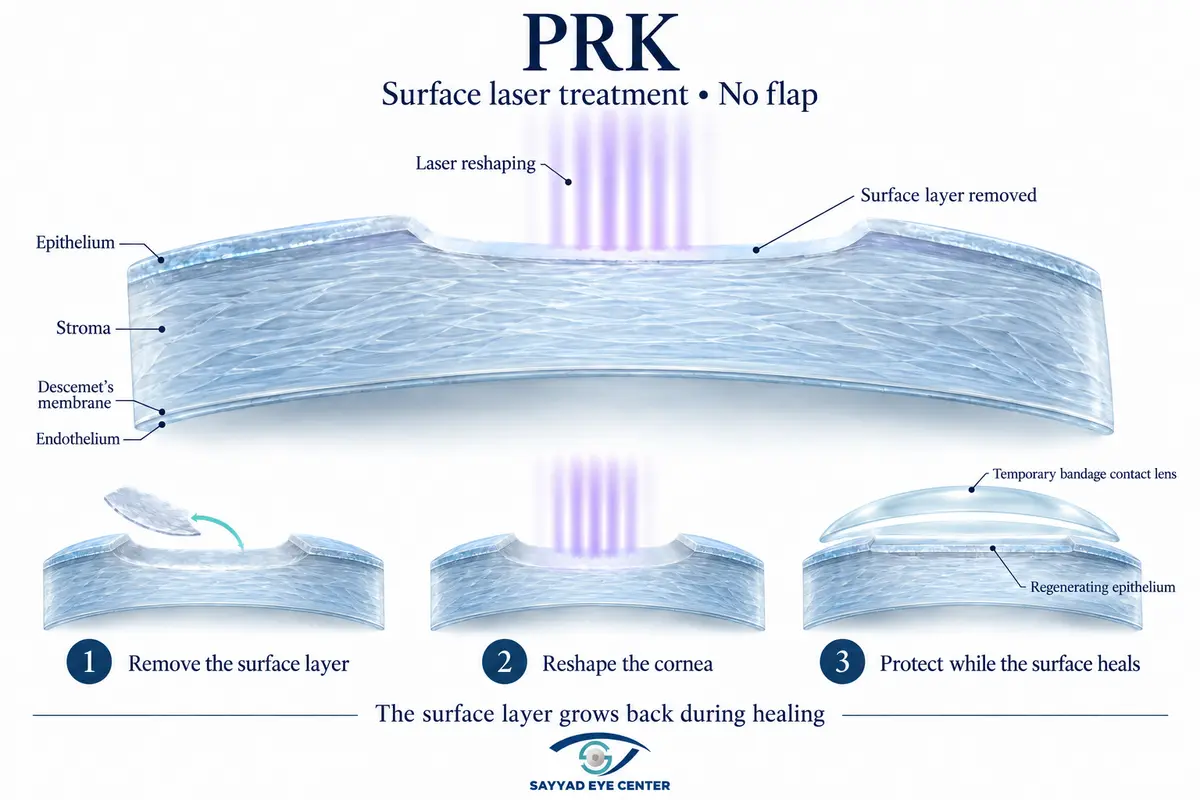
PRK · Surface laser
The surface cell layer is removed, then an excimer laser reshapes the underlying cornea. A temporary bandage contact lens protects the eye while the surface grows back.
May suit selected patients when avoiding a flap is helpful. A thin cornea alone does not make PRK safe: mapping and remaining tissue must still be suitable. Early discomfort, slower visual recovery and corneal haze are considerations.
ICL · Implantable lens
A lens is placed inside the eye, behind the iris and in front of your natural lens. It corrects vision without removing corneal tissue. Toric options can also address suitable astigmatism.
Assessment includes the space inside the eye and endothelial cell count. Risks include pressure changes, cataract, infection and the need for further surgery. Ongoing checks are important.
PRESBYOND · Vision for reading and distance
Presbyopia is the age-related loss of near focusing ability, often noticed from the forties. PRESBYOND is a personalised LASIK-based laser treatment intended to reduce reliance on reading glasses in suitable patients.
The treatment combines an increased depth of focus with a small planned difference between the eyes: one is mainly targeted for distance, the other for near. Their overlapping ranges help support intermediate tasks such as computer work when both eyes are used together.
Assessment includes corneal suitability, the health of the natural lens, eye dominance and tolerance of the planned difference between the eyes. Your reading, screen use and night-driving needs are part of the discussion.
PRESBYOND does not restore the natural lens’s youthful focusing ability. Adaptation may take time, and glasses may still be useful for fine print or demanding tasks. Glare, halos, dry eye and changes in depth perception should be discussed. Cataract or other eye disease may make another approach more appropriate.
The decision comes after your investigations
- Prescription stability and a full eye examination.
- Corneal shape and thickness maps to screen for irregularity and keratoconus risk.
- Tear film and eye surface assessment; dry eye may need treatment first.
- Pupil assessment and retinal examination when indicated.
- Additional internal measurements for ICL, or binocular vision and tolerance testing for PRESBYOND.
Before testing, stop wearing soft contact lenses for up to 1 week, soft toric lenses for up to 2 weeks, and rigid gas-permeable (RGP) lenses for up to 4 weeks. Contact lenses can temporarily alter corneal shape; measurements must be stable before treatment. Some eyes are better served by glasses or contact lenses, and treatment may need to be postponed.
Recovery and realistic expectations
Numbing drops are usually used. Arrange transport home and follow the prescribed drops and review schedule. Femto-LASIK and SMILE often allow earlier functional recovery than PRK, but clear, stable vision takes different amounts of time for different people. Do not drive until your surgeon confirms your vision is suitable.
All options have benefits and risks. These can include residual prescription, glare or halos, dry eye, infection and further treatment; uncommon serious complications can reduce vision. Laser procedures also carry a risk of corneal weakening. No procedure guarantees permanent freedom from glasses, and age-related changes continue.
If investigations show keratoconus
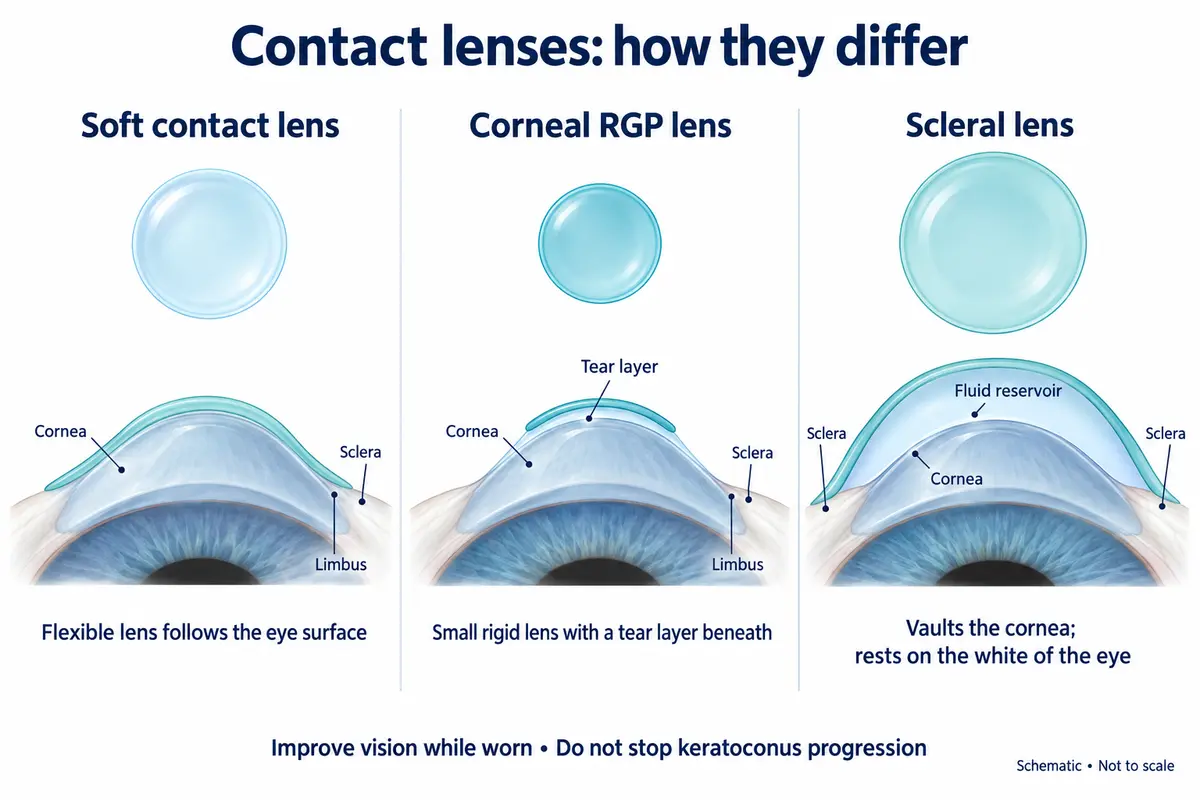
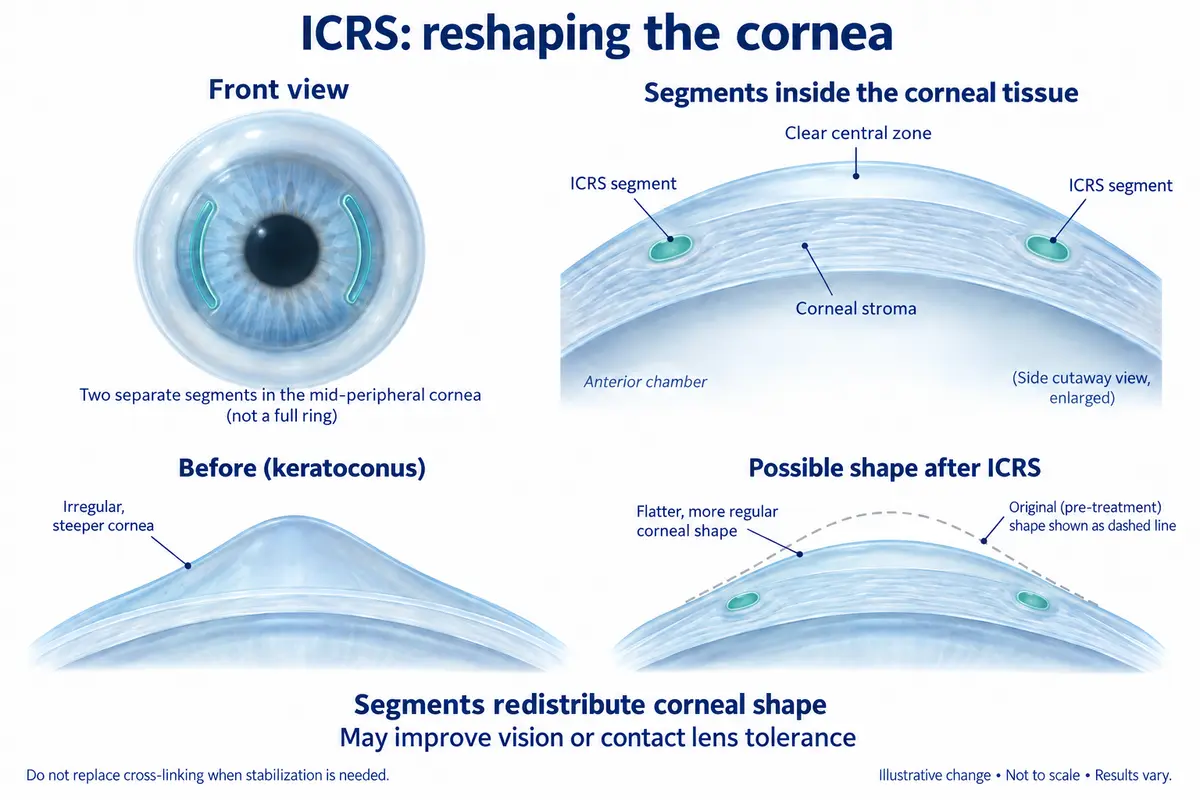
Keratoconus requires a different treatment pathway. RGP or scleral lenses can improve vision while worn; ICRS may improve corneal shape in selected eyes. Cross-linking addresses progression. These options are assessed separately from routine laser vision correction.
Common questions
Which option is best?
There is no single best procedure for everyone. Examination findings, investigations, your prescription and your priorities determine the recommendation.
Can laser treatment correct reading vision after forty?
Standard distance correction does not stop presbyopia. PRESBYOND may help selected patients reduce reading-glasses dependence after specific suitability and tolerance testing.
Is SMILE Pro a complete operation in a few seconds?
No. A short laser exposure is one step. Preparation, positioning and lenticule removal take additional time. The timing shown in the schematic is illustrative and varies with treatment settings.
Will I ever need glasses again?
You may. Healing, prescription changes, presbyopia and cataract can affect vision over time. Glasses or further treatment may be needed.
Will the procedure hurt?
Numbing drops reduce discomfort during treatment, although you may feel pressure or touch. Irritation can occur afterwards. The degree and duration of discomfort vary by procedure.
Should I stop wearing contact lenses before my assessment?
Yes. Before the assessment, stop wearing soft lenses for up to 1 week, soft toric lenses for up to 2 weeks, and rigid gas-permeable (RGP) lenses for up to 4 weeks. This allows the cornea to return towards its natural shape. Unstable measurements may require a longer break and repeat testing.
Can I have laser correction if I have dry eye?
Possibly, but the eye surface needs assessment first. Dry eye may need treatment before reliable measurements or surgery. Significant or uncontrolled dryness can make laser correction unsuitable, and surgery may worsen symptoms.
Is ICL the same as cataract surgery?
No. ICL adds a lens while leaving your natural lens in place. Cataract surgery removes the cloudy natural lens and replaces it. ICL requires its own suitability measurements and ongoing eye checks.
Does PRESBYOND take time to get used to?
It can. The eyes and brain may need time to adapt to the planned difference in focus. Progress varies, and glasses may still help with some tasks. Follow-up checks assess visual comfort and how well the eyes work together.
Find the option that fits your eyes
Bring your current glasses prescription and tell us about your work, hobbies and reading needs.
Book a vision correction assessment