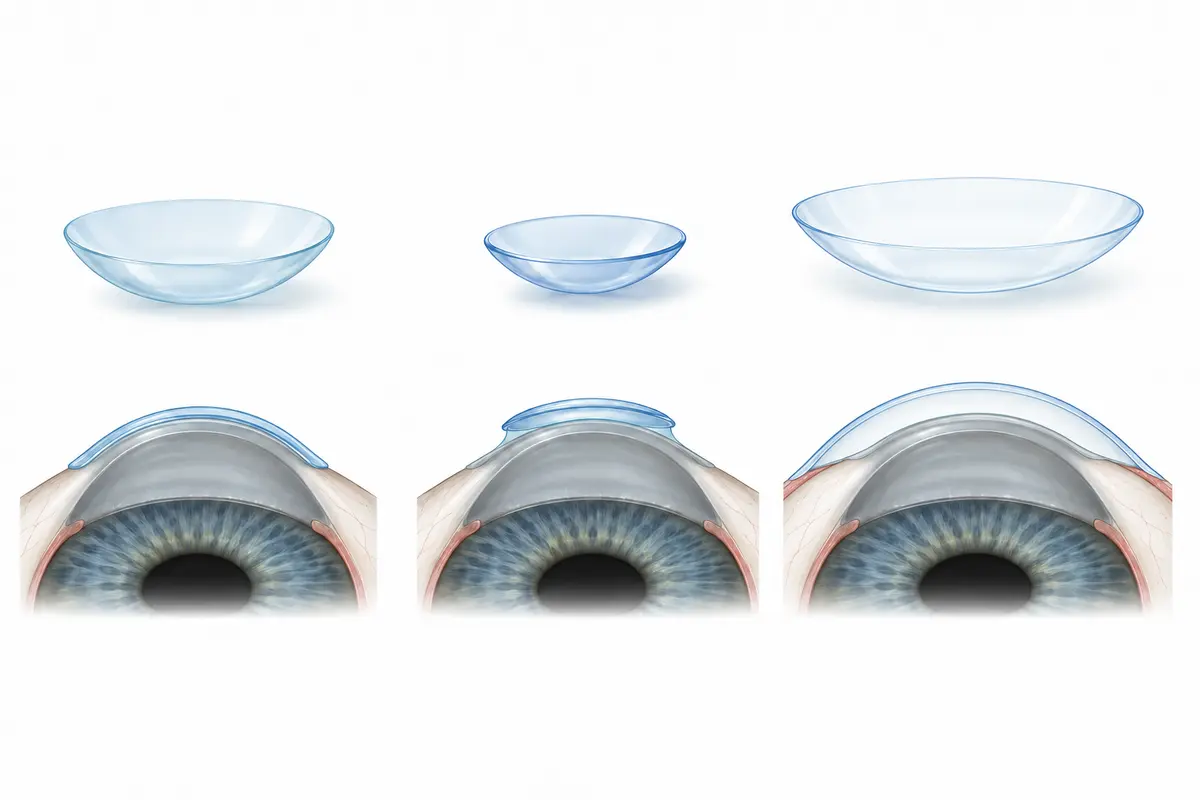
Soft lenses
Flexible designs for many everyday prescriptions, including toric and multifocal options.
A successful contact lens needs more than the right power. Its shape, material and fit must suit the eye, with clear instructions for safe wear and care.
Book an eye assessmentContact lenses can correct short sight, long sight and astigmatism, and selected designs can help with near vision. Specialist rigid gas-permeable (RGP) or scleral lenses may improve vision when an irregular cornea limits the benefit from glasses.
Selection considers corneal shape, tear-film health, vision requirements and handling ability. A spectacle prescription alone is not a complete contact-lens prescription; a trial fit and assessment on the eye are important.
Flexible designs for many everyday prescriptions, including toric and multifocal options.
Smaller rigid lenses that retain their shape and can provide a more regular optical surface.
Larger rigid lenses that vault the cornea and hold a fluid reservoir, with their landing zone on the white of the eye.
Assessment includes the prescription, corneal and eyelid health, tear film and relevant corneal measurements. Topography or tomography helps when the cornea is irregular. Trial lenses are checked for position, movement, vision and comfort.
For scleral lenses, assessment also checks corneal clearance, the landing zone and the fit after settling. Insertion, removal and cleaning are taught before independent wear. Follow-up confirms that the eye remains healthy during real-world use.
| Option | When it may help | What to know |
|---|---|---|
| Soft spherical lenses | Many cases of short sight or long sight. | Daily disposable or reusable schedules depend on the prescribed product. Daily disposable lenses are discarded after use. |
| Soft toric lenses | Regular astigmatism. | Stable orientation is important; rotation can make vision fluctuate. |
| Multifocal lenses | Near-vision difficulty from presbyopia, alongside distance correction. | A trial helps assess the balance between near, distance and contrast. Glasses may still help for some tasks. |
| Corneal RGP lenses | Selected regular prescriptions and irregular corneas, including keratoconus. | They may give sharper optics than soft lenses in an irregular cornea, but adaptation and careful fitting are needed. |
| Scleral lenses | Selected irregular corneas, post-surgical eyes or severe ocular-surface problems. | The reservoir is filled with suitable sterile preservative-free saline. Fitting and handling differ from standard soft lenses. |
A rigid lens and the fluid beneath it can reduce the optical effect of an irregular corneal surface. The choice between RGP and scleral lenses depends on the corneal shape, stability, comfort and achievable vision.
These lenses improve vision while worn. They do not stop keratoconus progression; monitoring and treatments such as cross-linking address that separate goal.
Wash and dry hands before handling lenses. Keep lenses away from tap water and saliva; remove them for showering or swimming. Do not sleep or nap in lenses unless a specific prescribed regimen explicitly permits it—overnight wear increases infection risk.
For reusable lenses, use the compatible cleaning and disinfecting system exactly as directed. Use fresh solution rather than topping up old solution, and maintain the case as instructed. Saline alone does not disinfect lenses. Peroxide systems require full neutralisation before the lens touches the eye.
Fill the lens with the specified sterile preservative-free saline before insertion, and check for trapped bubbles. Cleaning and disinfection are separate from filling the reservoir. Persistent fogging, discomfort or a tight fit needs reassessment.
Wearing time is built up according to the fitting plan and the eye’s response. More hours are not better if the eye becomes uncomfortable or vision changes.
Not by itself. Contact-lens power, dimensions, design and fit are assessed separately.
Both use rigid gas-permeable materials. A corneal RGP lens is smaller and fits over the cornea; a scleral lens is larger and vaults it.
They can improve vision while worn but do not stop progression or permanently reshape the cornea as a treatment for keratoconus.
No. Daily disposable means discard after use, not safe for overnight wear.
No. Tap, bottled and swimming-pool water can expose lenses to organisms that cause serious infection. Use the appropriate sterile lens products.
No. Saline can be used for specific rinsing or filling steps but does not disinfect. Reusable lenses need a compatible disinfection system.
Deposits, trapped bubbles, reservoir debris or fit can contribute. Persistent fogging needs a fit and surface review; do not keep wearing through pain or redness.
Cosmetic lenses also contact the cornea and need appropriate fitting, hygiene and follow-up. Never share lenses.
Often, yes—as a backup, during lens-free periods or for specific tasks such as fine near work. Keep an up-to-date pair available.
Bring previous eye reports, current prescriptions and a list of medicines to your appointment.
Content prepared: 9 October 2026