Strabismus in Children
Learn the signs of childhood squint, the difference from lazy eye, and options including glasses and surgery at Sayyad Eye Center in Cairo.
Medically reviewed by Dr Tarek Fathi
Consultant of Pediatric Ophthalmology and Strabismus
Childhood strabismus, often called a squint, means the eyes do not point in the same direction. Early assessment helps protect visual development and identifies whether your child needs glasses, treatment for lazy eye, monitoring or surgery. Visible eye misalignment is worth checking even when your child seems to see well.
Signs parents may notice
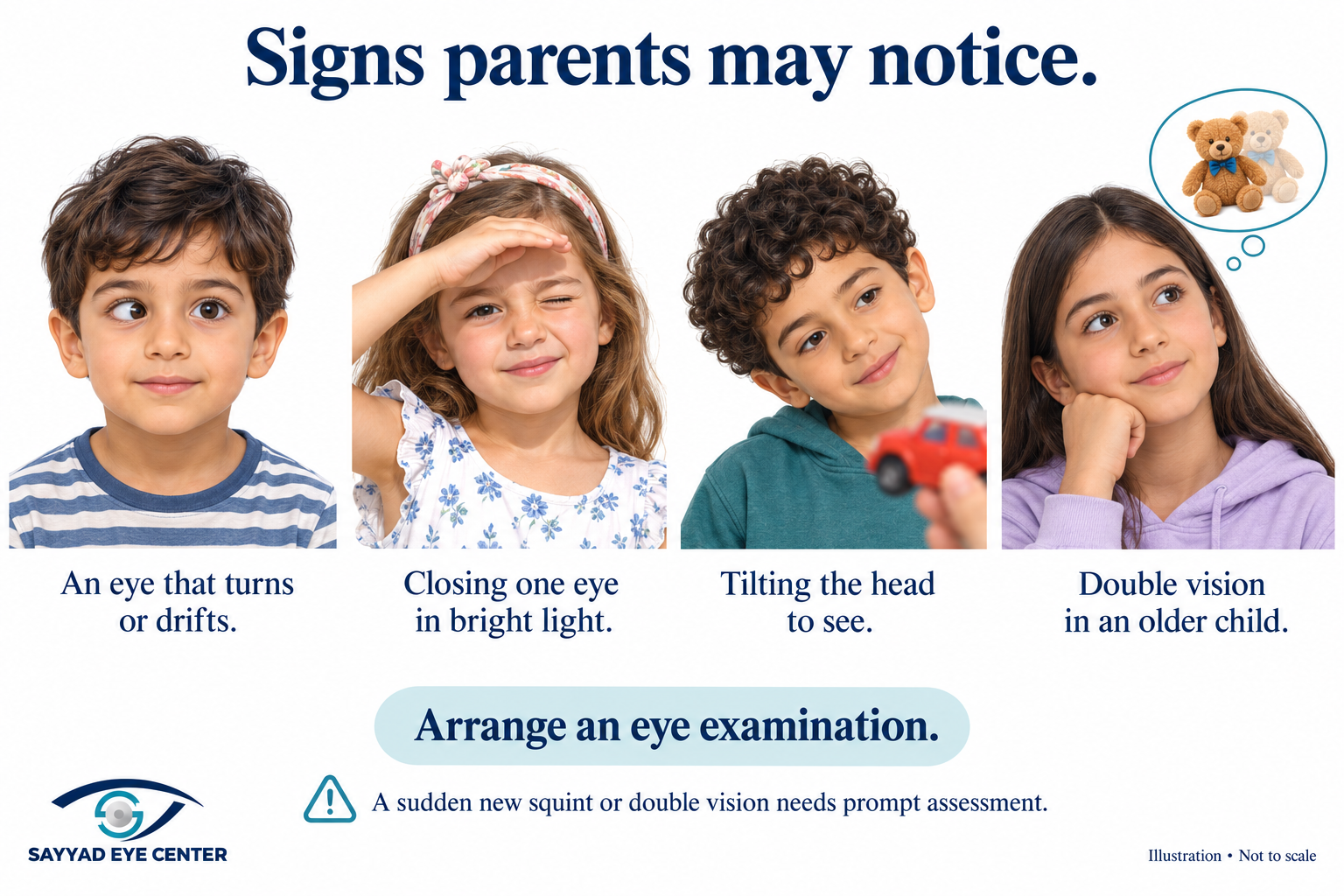
An eye may deviate inward, outward, upward or downward, either constantly or occasionally. Other clues include closing one eye in sunlight, tilting the head, favouring one eye or difficulty judging distances. Older children may describe double vision. These signs have several possible causes; an examination establishes what is happening.
A sudden new squint or double vision needs prompt assessment. If it occurs with severe headache, vomiting, weakness or other new neurological symptoms, seek emergency care rather than waiting for a routine appointment.
Eye misalignment in a baby
Brief, occasional wandering can occur while coordination develops in the first few months. A constant squint at any age, a worsening deviation, or repeated misalignment after about four months should be examined. Do not wait for a child to become old enough to read an eye chart.
True squint and pseudostrabismus
A broad nasal bridge or folds near the inner corners of the eyes can make a baby look cross-eyed even when alignment is normal. This is pseudostrabismus. It does not itself need treatment, but photographs alone cannot reliably rule out a true squint. Alignment tests distinguish the two.
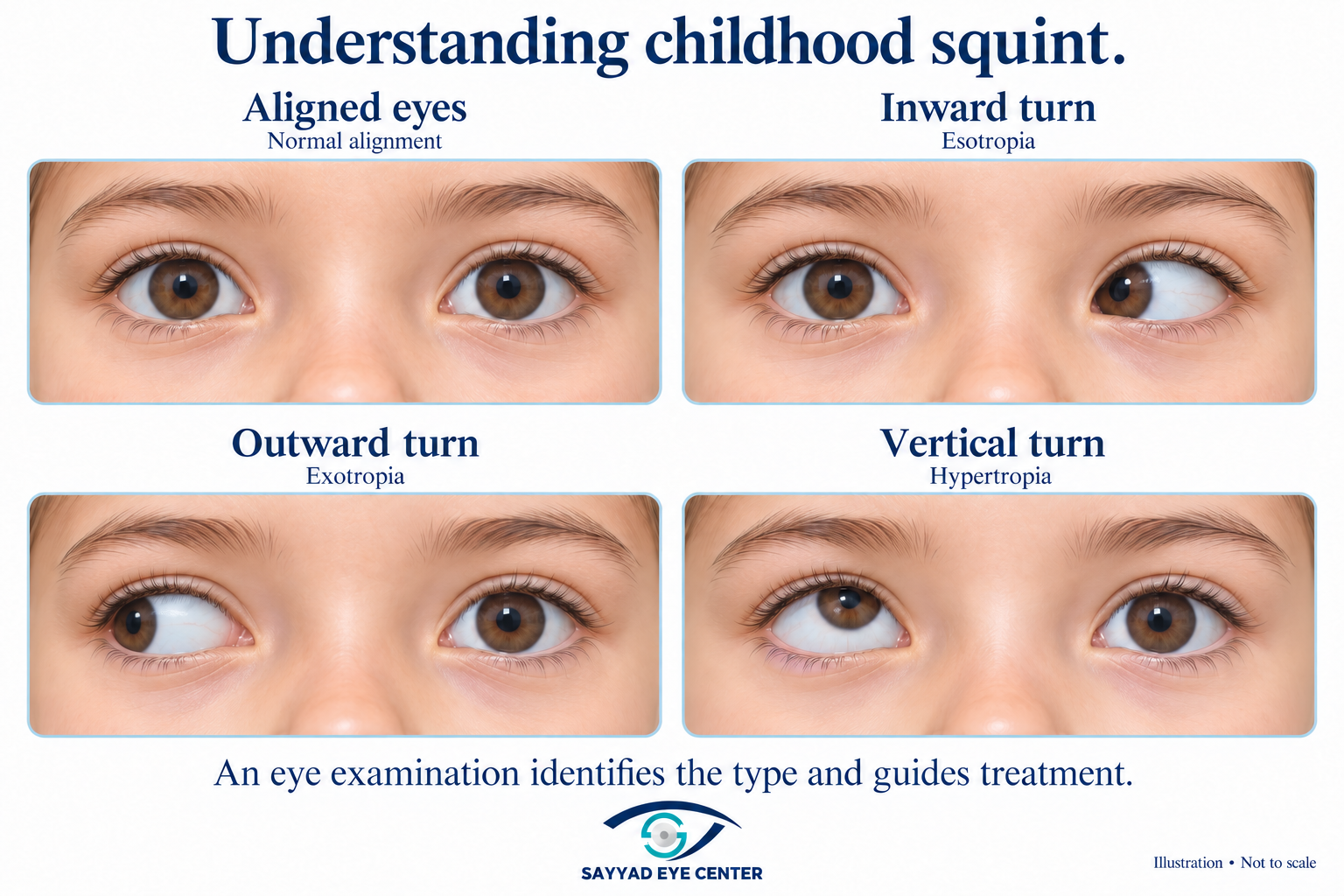
Common types of childhood strabismus
Inward squint — esotropia. The eye deviates toward the nose. In accommodative esotropia, focusing effort associated with long-sightedness contributes to the misalignment, and prescribed glasses can improve or fully correct alignment. Other inward squints begin in infancy or have different causes.
Outward squint — exotropia. The eye drifts away from the nose. An intermittent squint may be more noticeable with tiredness, illness, daydreaming or distance viewing. Increasing frequency is a reason for reassessment.
Vertical squint. One eye points higher or lower than the other. Examination of eye movements helps identify the pattern and cause.
Why it happens
Contributing factors include refractive errors, unequal vision, family history, premature birth and some developmental or neurological conditions. Occasionally an eye condition such as cataract reduces vision and affects alignment. Many children have no single identifiable cause. The examination checks both alignment and eye health.
Diagnosis and a treatment plan
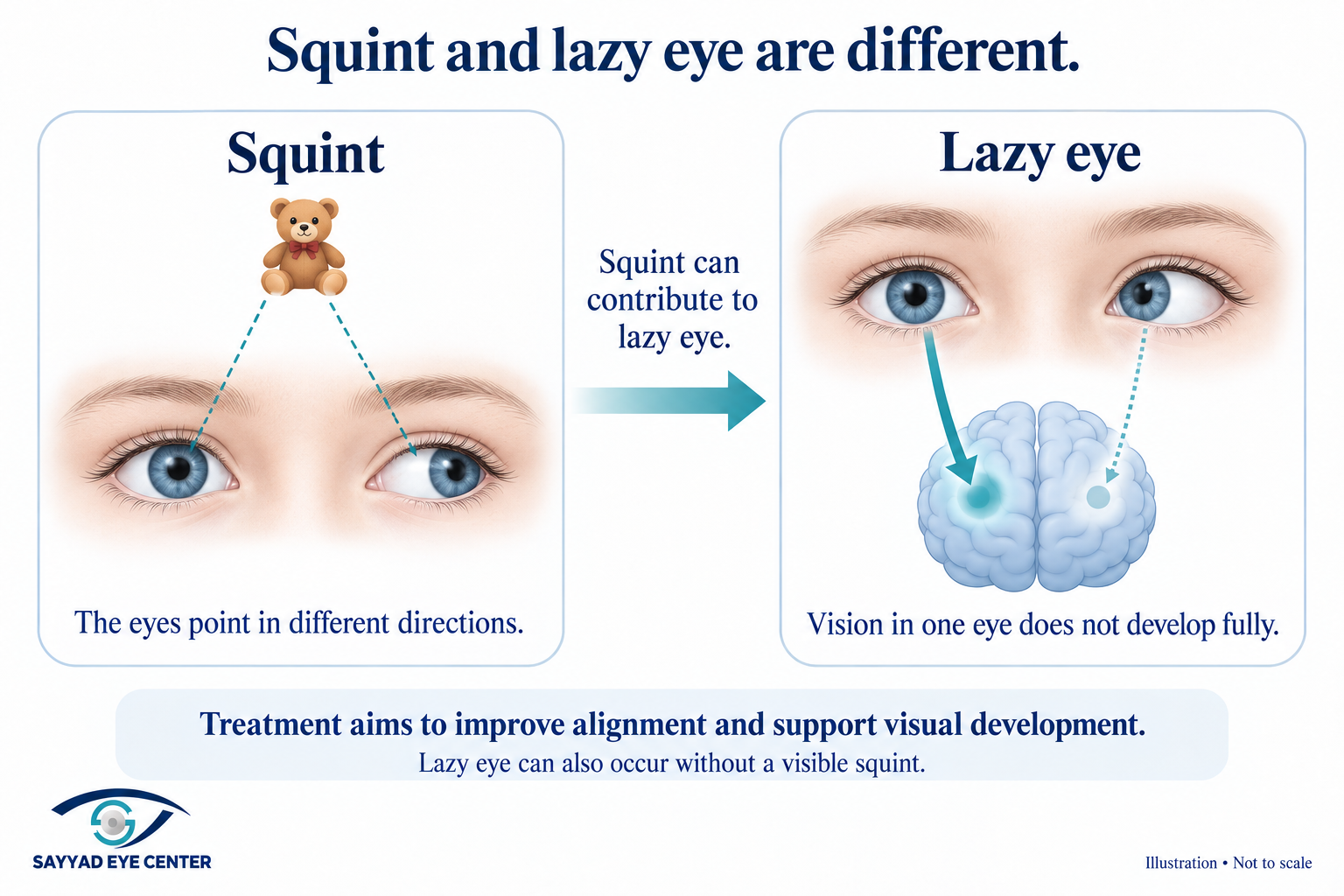
Squint and lazy eye are different
Squint describes alignment. Lazy eye, or amblyopia, means vision has not developed fully in an eye during childhood. When one eye is consistently misaligned, the brain may suppress its image, contributing to amblyopia. Unequal prescriptions can also cause lazy eye without a visible squint. Both eyes therefore need separate vision testing.
What happens during the appointment
The doctor asks when the squint was first noticed and whether it is constant. Testing can assess vision in each eye, alignment at near and distance, eye movements and how the eyes work together. Drops are often needed to relax focusing and measure the prescription accurately, as well as examine eye health. Bring previous glasses, reports and photographs or short videos showing an intermittent squint.
Glasses and planned monitoring
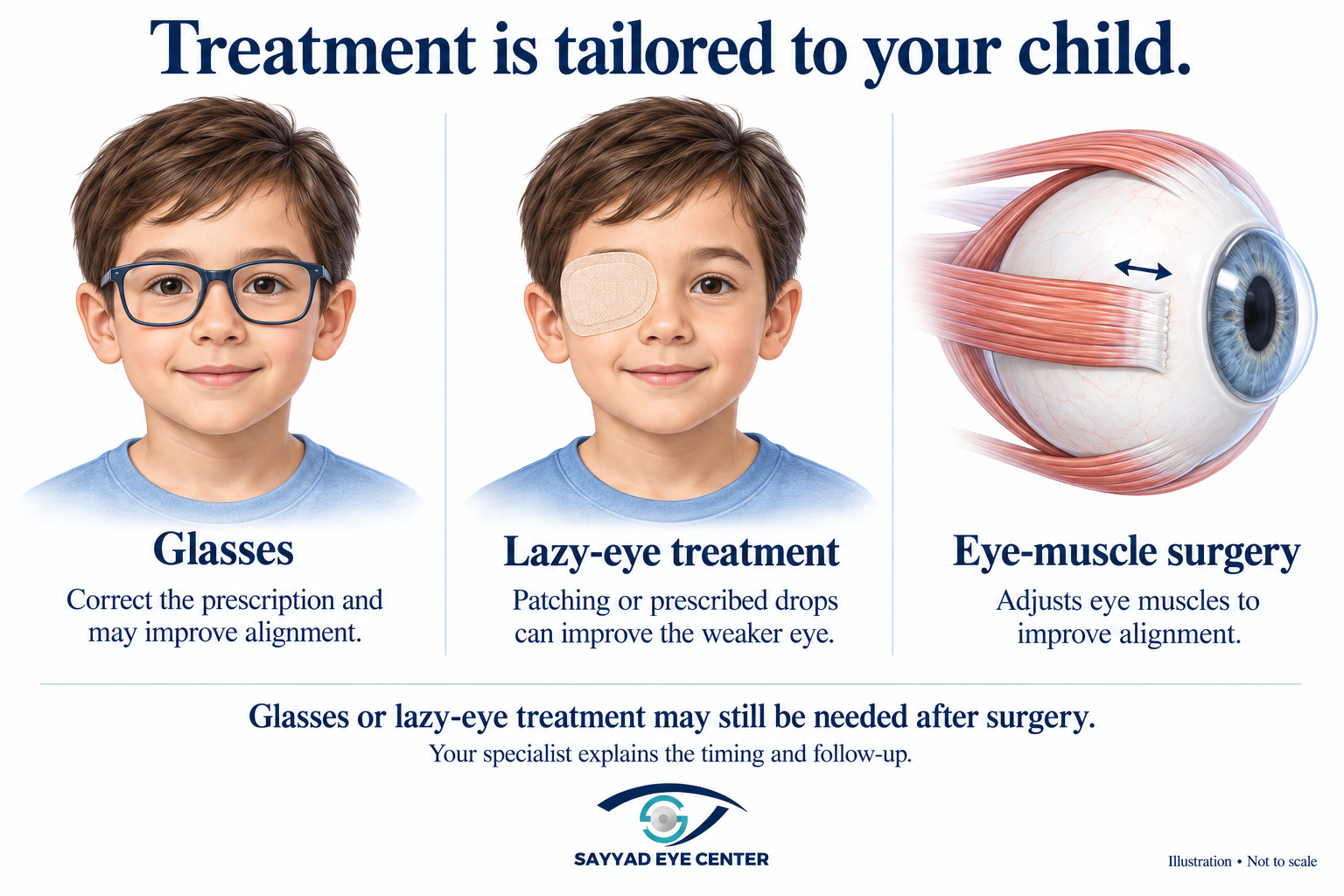
Glasses address a focusing error and may correct an accommodative inward squint. Follow the prescribed wearing schedule. A well-controlled intermittent outward squint may be monitored, with review of vision and binocular function. Monitoring is an active plan with follow-up, rather than simply ignoring the misalignment.
Treating lazy eye
Glasses may improve vision; some children also need a patch over the better-seeing eye or prescribed blurring drops. The purpose is to help develop vision in the weaker eye. Follow the exact schedule given by your specialist. Patching is not a substitute for alignment treatment when that is also needed. Younger children often respond best, but older children can still benefit from assessment and treatment.
When surgery may help
Surgery is considered when the remaining deviation warrants correction and glasses or other appropriate measures cannot provide adequate alignment. Timing depends on the type of squint, vision and binocular development; there is no single correct age for every child. Some squints beginning in infancy require early specialist planning.
The surgeon adjusts muscles on the outside of one or both eyes to improve their alignment. In children this is usually a day-case procedure under general anaesthesia. Benefits can include straighter eyes and, where possible, better use of the eyes together. Glasses and lazy-eye treatment may still be needed afterward.
Benefits and realistic expectations
The plan aims to improve alignment while supporting the best possible vision in each eye. Results vary with the underlying condition. Residual or recurrent misalignment can need further treatment or another operation. As with any operation there are risks; serious complications are rare. Your surgeon should explain the benefits and risks for your child and answer your questions.
Recovery and questions parents ask
Planning recovery
Ask for written instructions covering prescribed drops, follow-up appointments and return to nursery, school, swimming and sport. The surgeon should set these according to your child’s procedure and recovery. Contact the surgical team promptly for worsening pain, reduced vision or increasing swelling rather than assuming these are part of normal recovery.
Will my child grow out of a squint
Do not rely on this. Some apparent misalignment is pseudostrabismus, but persistent or recurrent true misalignment needs assessment. Treatment can be time-sensitive while vision develops.
Does every child need an operation
No. Treatment depends on the diagnosis. Glasses may be sufficient for an accommodative inward squint, while selected intermittent squints can be monitored. Surgery helps children whose alignment needs cannot be met by those measures.
Does a patch straighten the eyes
Its main role in lazy-eye treatment is to improve vision in the weaker eye. Improved vision and alignment are related goals, but one treatment does not automatically achieve both.
Will glasses still be needed after surgery
They may be. Surgery changes eye-muscle alignment; it does not remove the underlying glasses prescription. Continue glasses and any lazy-eye treatment unless the doctor changes the plan.
Can exercises treat every squint
No. Exercises are used for selected coordination problems. Ask whether they suit your child’s specific diagnosis; a general online exercise programme should not replace an examination.
Can a child have lazy eye without an obvious squint
Yes. Unequal focusing errors can affect visual development even when the eyes look straight. Age-appropriate vision assessment remains important.
What should families travelling to Cairo arrange
Share previous reports and the travel dates when arranging an appointment. If surgery is considered, agree on the assessment, recovery and follow-up plan before confirming a return journey. Do not delay urgent assessment abroad to wait for a trip to Egypt.
Arrange an assessment at Sayyad Eye Center
Contact the center to confirm Dr Tarek Fathi’s appointments in New Cairo or Mohandeseen. Families coming from Sheikh Zayed or 6th of October can confirm the most suitable branch and appointment. Bring your child’s glasses and previous examination results.
Medical reviewer: Dr Tarek Fathi, Consultant of Pediatric Ophthalmology and Strabismus.
References
المراجع الطبية
These American Academy of Ophthalmology resources support the patient information in this guide. Individual treatment depends on an eye examination.
American Academy of Ophthalmology — Strabismus in Children
https://store.aao.org/media/resources/051226/051226-strabismus.pdf
American Academy of Ophthalmology — Esotropia and Exotropia Preferred Practice Pattern
https://www.aaojournal.org/article/S0161-6420(22)00864-8/fulltext
American Academy of Ophthalmology — Amblyopia Preferred Practice Pattern
https://www.aaojournal.org/article/S0161-6420(22)00865-X/fulltext
American Academy of Ophthalmology — Accommodative Esotropia
https://aao.org/disease-review/strabismus-accommodative-esotropia
مراجع التثقيف الطبي من الأكاديمية الأمريكية لطب العيون. لا تغني المعلومات عن فحص الطفل وخطة العلاج الفردية.