Astigmatism
Understand CYL and AXIS on your prescription, how regular and irregular astigmatism differ, and how glasses, contact lenses or surgery may help.
Glasses, laser correction or a toric lens? Understanding your options.
“You have astigmatism.” It is a familiar phrase after an eye examination, but it often leaves patients wondering what it means. Is it a disease? Is it the same as short-sightedness? Can it be corrected?
Astigmatism is a common focusing error. Many people see well with the right glasses or contact lenses. Others may be suitable for laser correction or an implanted lens. The important first step is understanding the type of astigmatism and the health of the eye.
What is astigmatism?
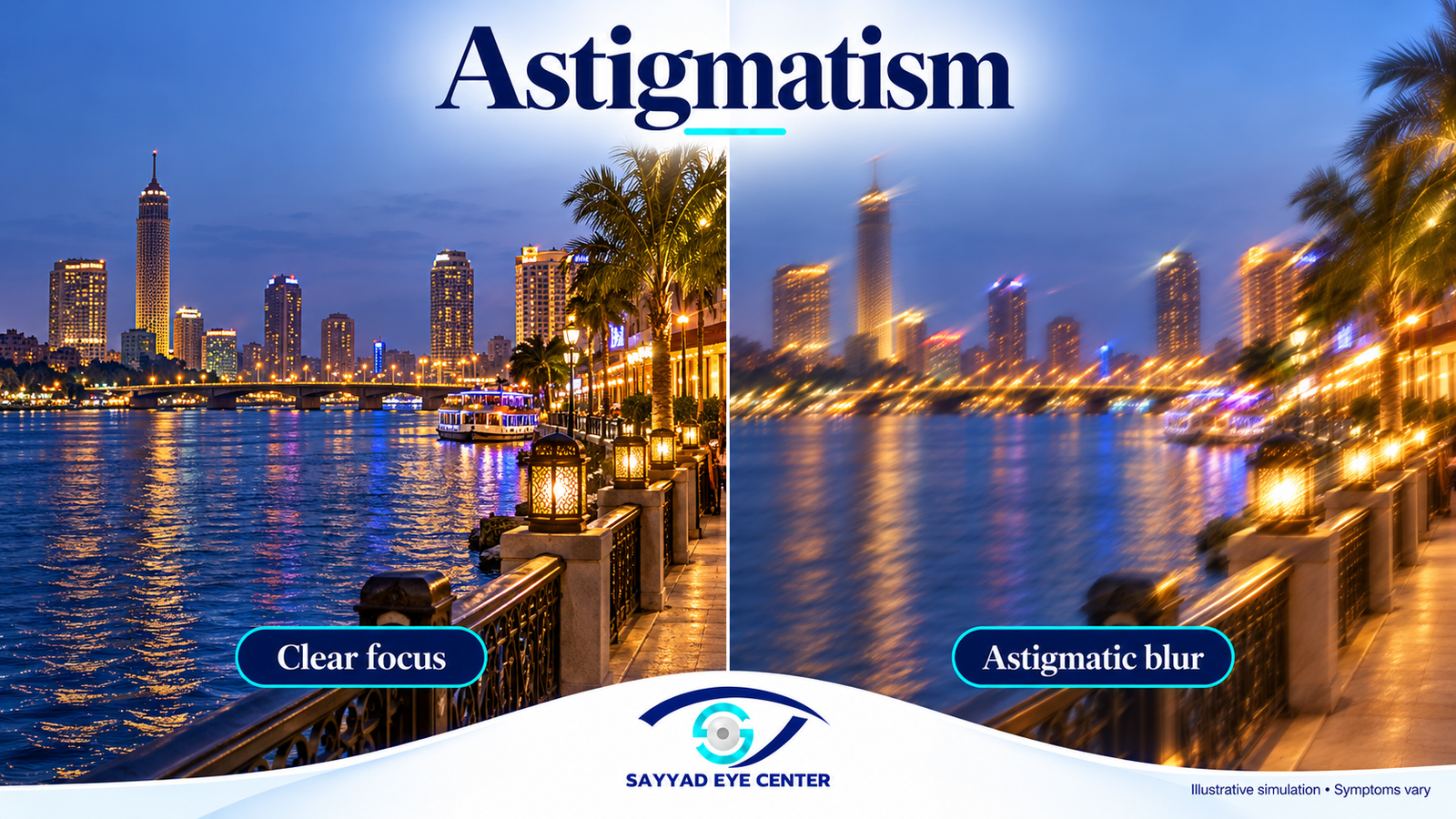
The cornea—the clear front surface of the eye—and the natural lens help focus light onto the retina. With astigmatism, the eye focuses light differently in different directions, so it does not form a single sharp focus on the retina.
A common explanation compares the corneal curve to a rugby ball rather than a football. That is a simplified description of curvature; it does not mean the entire eyeball is shaped like a rugby ball.
Astigmatism can come from the cornea, the natural lens, or both. It can occur with short-sightedness or long-sightedness.
What might you notice?
You may notice blur at distance or near, shadows around letters, difficulty with fine detail, or streaks around lights at night. Some people squint or develop eye strain during demanding visual tasks.
These symptoms are not specific to astigmatism. Dryness, cataracts and other conditions can cause similar complaints, so the examination matters more than an online symptom checklist.
Mild astigmatism may cause little difficulty and may not require correction.
What do CYL and AXIS mean on your prescription?
CYL, or cylinder, describes the amount of astigmatism correction in dioptres. AXIS describes its orientation, from 1 to 180 degrees. The axis is not a measure of severity: an axis of 180 is not worse than an axis of 90.
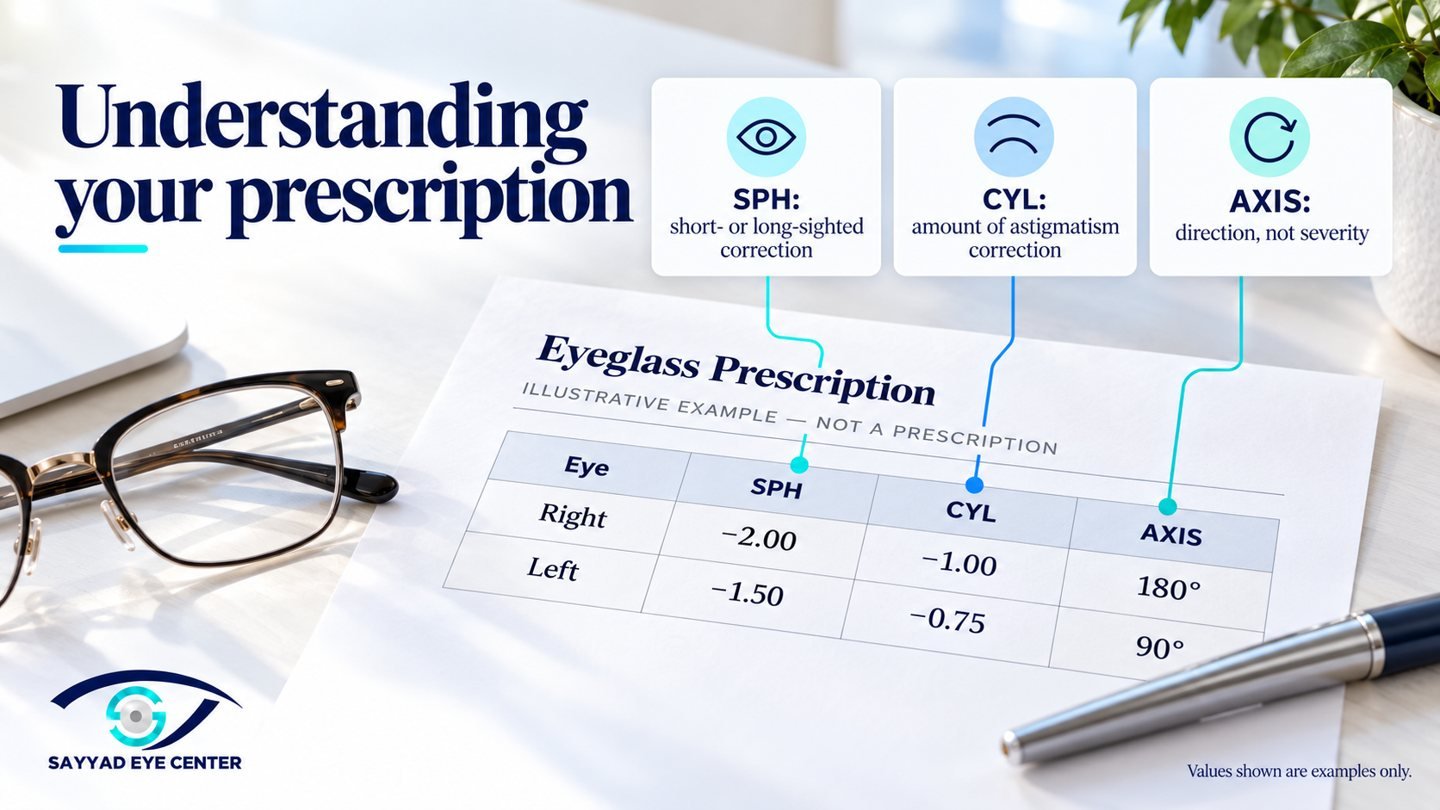
The SPH, or sphere, part describes the short-sighted or long-sighted component of the prescription. Your doctor considers these measurements together rather than judging the eye by one number.
Regular and irregular astigmatism: why the difference matters
Regular astigmatism has a relatively predictable pattern. Glasses and toric soft contact lenses can often correct it well, and suitable patients may have surgical options.
Irregular astigmatism means the corneal surface has a more uneven pattern that ordinary cylinder correction may not fully address. Causes include keratoconus, corneal scarring and changes after injury or surgery. An unstable tear film can also make the optical surface and measurements less consistent.
If letters remain shadowed despite an accurate glasses prescription, we may need to examine the cornea more closely. Specialty rigid or scleral contact lenses can improve vision in selected irregular corneas. Treatment must also address any underlying condition.
Having astigmatism does not automatically mean you have keratoconus. A changing prescription or reduced vision with glasses may, however, justify corneal scans.
Why glasses or toric implants may not fully help
Glasses, toric ICLs and toric cataract IOLs correct a regular focusing error. They generally cannot fully correct the irregular distortion created by an uneven corneal surface. A patient may therefore still notice shadows or reduced visual quality despite correction of the regular prescription.
This does not mean they never help: glasses may work in early keratoconus, and a toric implant may be considered for the regular component in carefully selected stable eyes. Significant irregular astigmatism often needs specialty RGP or scleral contact lenses. If continued rigid-lens wear is expected after cataract surgery, this must be included in the implant-planning discussion.
How do we assess it?
We start with vision testing, a careful glasses prescription and an eye examination. When appropriate, corneal topography and tomography assess the shape of the cornea, including information about its surfaces and thickness distribution.
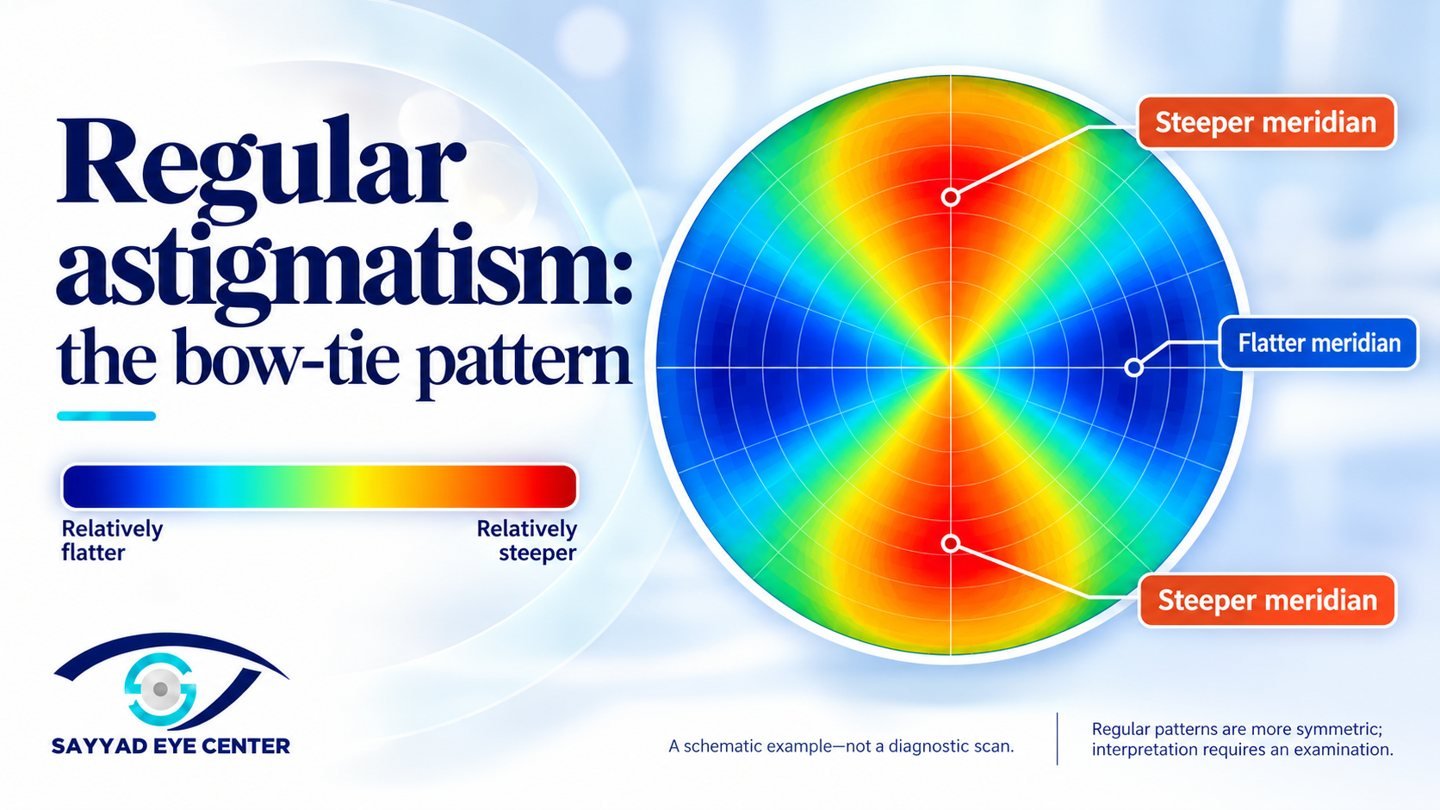
These scans are especially important before laser surgery and when irregular astigmatism or keratoconus is suspected. Cataract planning also requires measurements to calculate the implanted lens.
Dryness can affect measurement consistency. Contact lenses can temporarily change corneal shape. Treating the surface and allowing an appropriate break from lenses may be necessary before final measurements. Bring your previous prescriptions and scans if available.
Option 1: glasses
For many people, glasses are the simplest effective option. They can correct regular astigmatism together with short-sightedness or long-sightedness.
A new cylinder prescription can initially feel unfamiliar. If the vision remains uncomfortable, distorted or unexpectedly blurred, have the prescription and fitting checked rather than assuming you must tolerate it.
Wearing the correct glasses does not weaken your eyes.
How do glasses correct astigmatism?
A spectacle lens for astigmatism has different optical powers in different directions. This cylinder correction compensates for the difference in focusing power between the eye’s main meridians, helping light come to a common focus on the retina. The cylinder must be aligned at the correct axis. Any short-sighted or long-sighted component is corrected within the same lens.
The glasses change the path of light before it enters the eye; they do not reshape the cornea or permanently remove astigmatism. The benefit is present while you wear them. Correct lens power, axis and fitting all matter.
With irregular astigmatism, the focusing error varies across the corneal surface in a more complex way. A standard spectacle cylinder cannot compensate for every local irregularity, so ghosting may remain even with the best glasses prescription. A specialist RGP or scleral contact lens can create a smoother effective optical surface in front of that cornea.
Option 2: contact lenses
Toric soft contact lenses are designed to correct astigmatism and remain in a particular orientation. Fit and rotational stability matter: a lens that moves out of position may cause fluctuating vision.
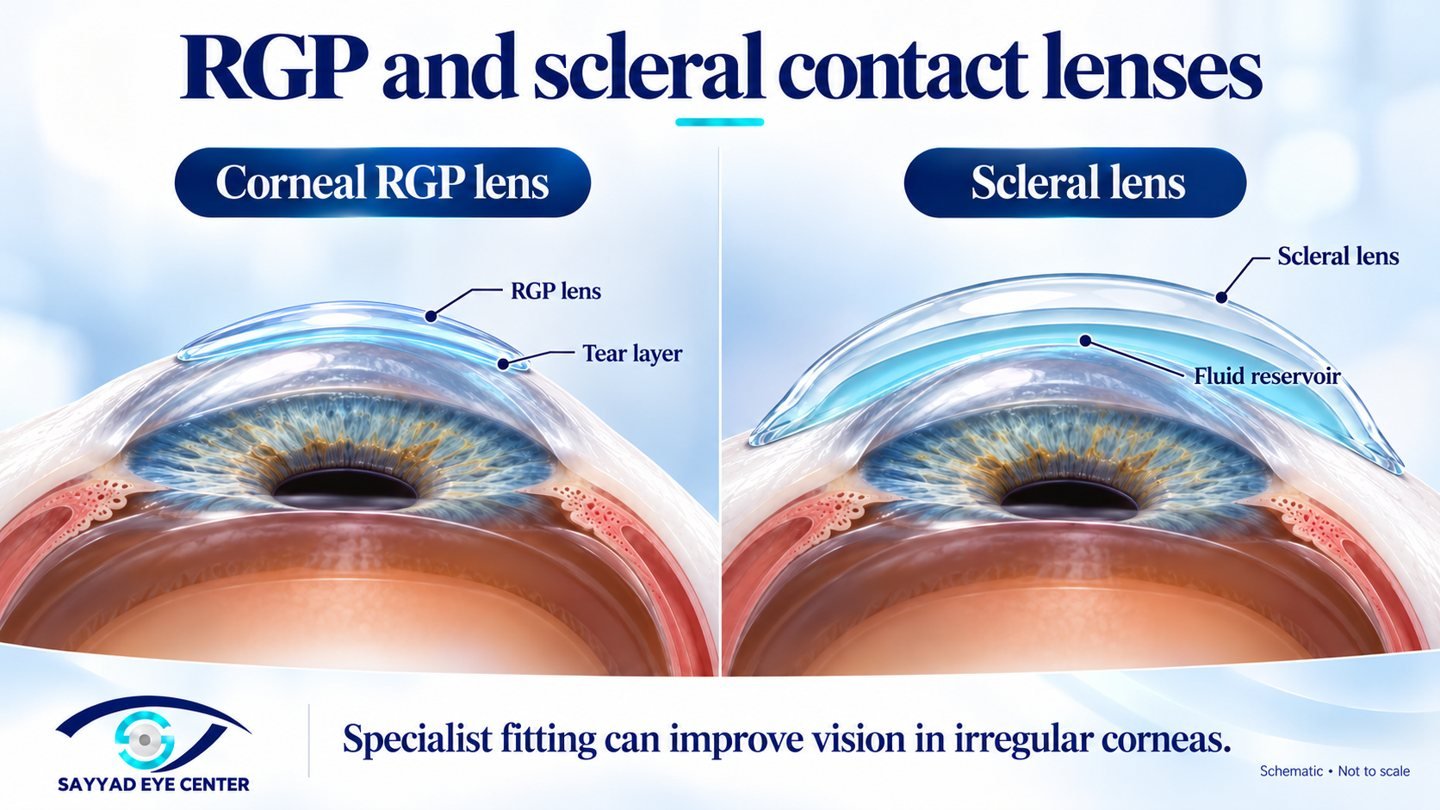
Rigid gas-permeable (RGP) contact lenses can correct regular astigmatism and are especially useful for irregular corneal astigmatism, including keratoconus. Their firm, smooth optical surface and the tear layer beneath can reduce the distortion caused by an uneven cornea.
Scleral contact lenses are larger rigid gas-permeable lenses that rest on the white part of the eye and vault over the cornea, with a fluid reservoir underneath. They can provide clearer, more stable vision in selected patients with keratoconus or other irregular corneas, including some who struggle with smaller corneal RGP lenses.
Both require specialist fitting, correct cleaning and follow-up. Improvement depends on the individual eye; neither guarantees perfect vision.
Contact lenses improve the way light focuses while worn. They do not treat progression of keratoconus or remove a corneal scar.
Option 3: laser vision correction
Selected adults with regular astigmatism may be suitable for FemtoLASIK, PRK or SMILE Pro, depending on the associated prescription, corneal findings and the treatment range of the system used.
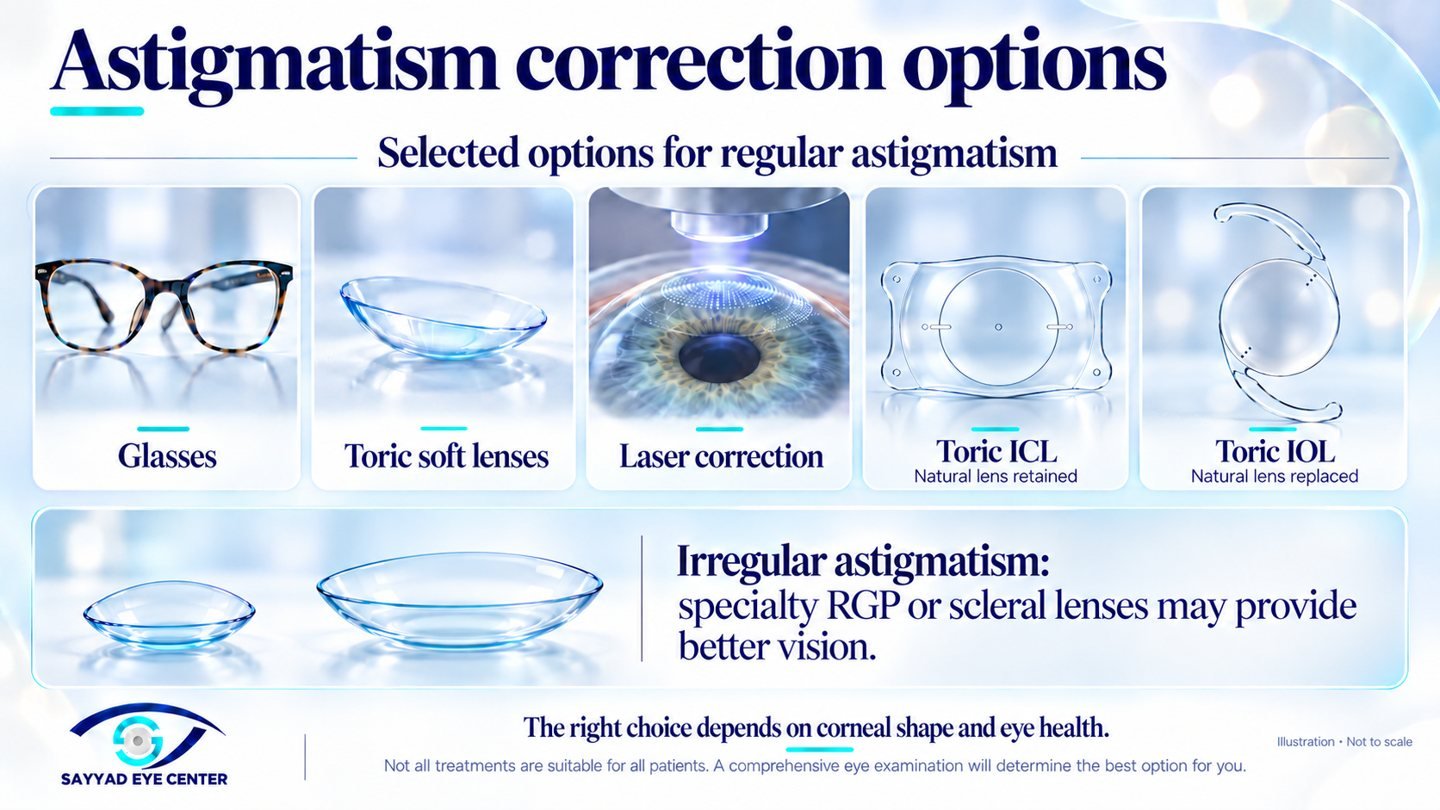
The cylinder number alone does not determine suitability. We also assess prescription stability, corneal shape and thickness, ocular-surface health and visual expectations.
If the scans suggest keratoconus or an unstable cornea, routine laser correction may be inappropriate. In that situation, protecting corneal stability takes priority over reducing dependence on glasses.
Our separate laser guides explain how the procedures and recovery differ. No method guarantees zero residual prescription or identical results for every patient.
Option 4: a toric ICL
A toric implantable collamer lens may be considered for selected patients with short-sightedness and astigmatism, particularly when corneal laser treatment is unsuitable or less appropriate.
The ICL sits inside the eye, behind the iris and in front of the natural lens. The natural lens remains in place. This is different from cataract surgery, which removes the cloudy natural lens.
Suitability depends on measurements inside the eye, prescription, age and other health findings. It is an intraocular operation with specific risks and follow-up requirements, not a routine substitute for glasses for everyone with astigmatism.
Option 5: correcting astigmatism during cataract surgery
If you have a cataract and significant regular corneal astigmatism, a toric intraocular lens may reduce the remaining astigmatism after surgery.
Removing the cataract alone does not necessarily correct the corneal component. Planning may include measurements of both corneal surfaces and careful selection of lens power and alignment. Selected corneal incisions are another option in some cases.
A Cochrane review found that toric lenses were more likely than limbal relaxing incisions to leave less than 0.5 dioptres of residual astigmatism, although the average difference in unaided distance vision was small. The choice still depends on the individual eye.
“Toric” means the lens includes astigmatism correction. It does not mean multifocal. Toric designs can be available with monofocal, extended-depth-of-focus or multifocal optics. Near-vision expectations require a separate discussion.
Can astigmatism remain after treatment?
Yes. Glasses, contact lenses and surgery aim to improve focus, but the amount of correction and final visual quality vary.
After surgery, residual blur can have several explanations, including remaining prescription, tear-film instability or healing changes. With a toric implant, its orientation may also need checking. An enhancement is not automatically the answer; first we establish the cause and whether the measurements are stable.
Normal chart vision (6/6) and freedom from all visual symptoms are not the same thing. Night vision and fine-detail quality depend on more than the cylinder number.
Astigmatism in children
Children may not realize their vision is blurred. Significant uncorrected astigmatism can interfere with visual development and contribute to amblyopia, often called a lazy eye.
If glasses are prescribed, following the wearing advice and attending reviews matters. Do not wait for a child to complain before arranging a recommended examination.
Frequently asked questions
Is astigmatism the same as a squint?
No. Astigmatism is a focusing error. A squint, or strabismus, means the eyes are not aligned in the same direction. They can occur together but are different conditions.
Does everyone with astigmatism need surgery?
No. Many people are comfortable with glasses or contact lenses. Treatment should fit your visual needs, eye health and preferences.
Can eye exercises or drops remove it?
They do not correct the underlying regular corneal or lens curvature responsible for astigmatism. Treating dryness may improve fluctuating vision and measurement accuracy, but that is different from removing structural astigmatism.
Can the amount change?
Yes, it can change with age or changes in the cornea or natural lens. A noticeable or repeated increase, especially with reduced glasses-corrected vision, should be assessed.
Will a toric lens mean I never need glasses?
Not necessarily. It reduces the astigmatic component, while reading needs depend on the lens design, the planned focus and other factors. Some residual prescription may remain.
Which treatment is best?
There is no single best treatment for everyone. A regular, stable cornea and an irregular cornea may need very different approaches, even when their prescription numbers look similar.
Astigmatism assessment at Sayyad Eye Center
At our Mohandeseen and New Cairo centers, we assess the prescription and the health of the eye before discussing correction. The goal is clear, comfortable vision with realistic expectations about what each option can achieve.
Medical review
Medically reviewed by Dr Fouad El Sayyad
American Board certified ophthalmologist
Fellowship in Cornea, External Eye Disease and Refractive Surgery
Washington University in St Louis, USA