Keratoconus and Corneal Cross Linking
Understand keratoconus symptoms, corneal cross-linking, treatment options and recovery. Arrange an assessment with Dr Fouad El Sayyad in Cairo.

Keratoconus changes the shape of the clear front surface of the eye and can make vision increasingly distorted. Early assessment gives you more options. Treatment aims to keep the cornea stable and help you see as clearly as possible. Corneal cross-linking can slow or stop progression in suitable eyes; glasses, specialist contact lenses and selected procedures address the quality of vision.
What is keratoconus
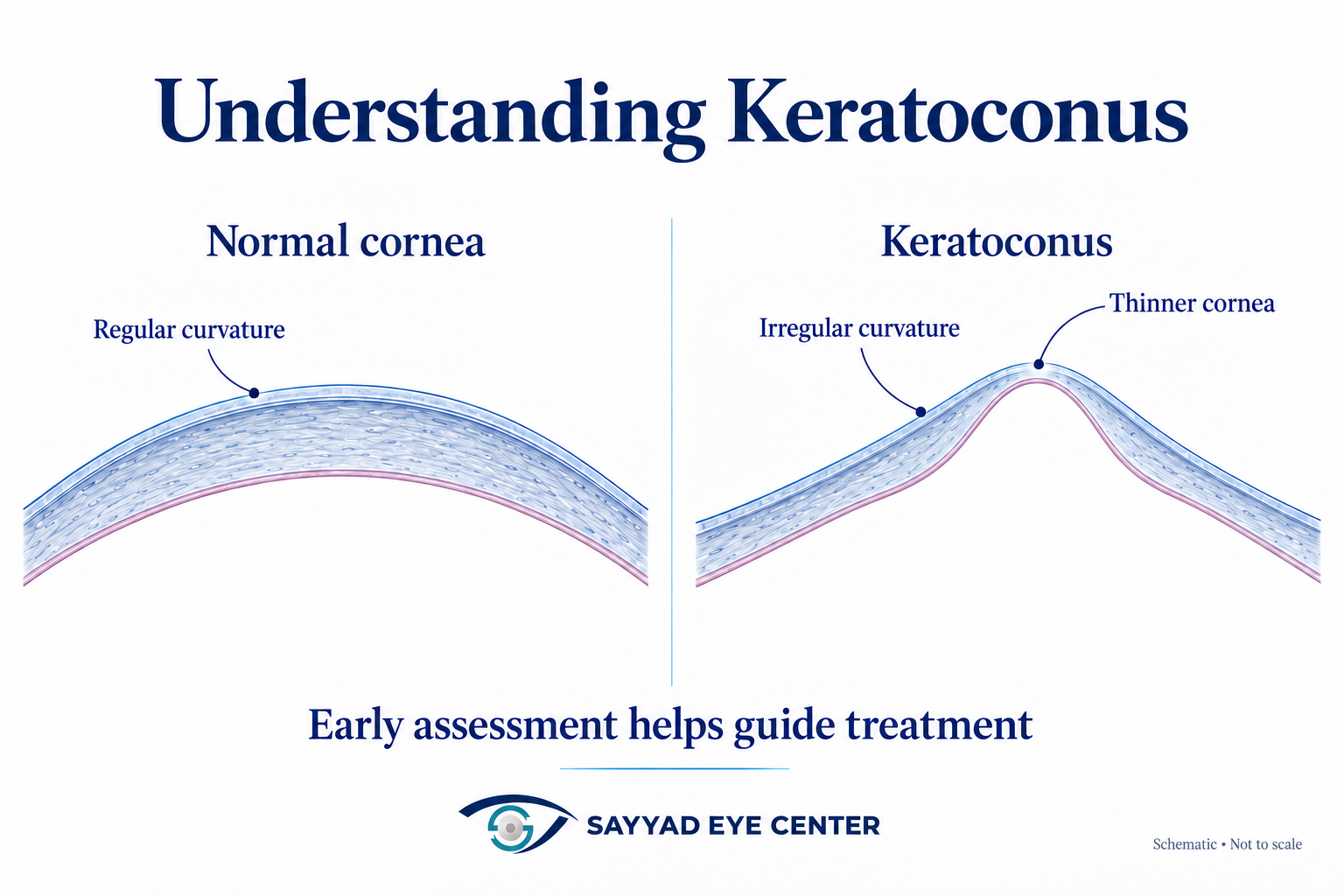
The cornea normally has a smooth, rounded shape. In keratoconus, it becomes thinner and bulges unevenly, creating irregular astigmatism. It often begins in the teenage years or young adulthood and usually affects both eyes to different degrees. Having keratoconus does not automatically mean you will need a corneal transplant.
Symptoms that deserve an assessment
• Frequent changes in your glasses prescription, particularly increasing astigmatism.
• Blurred or distorted vision that glasses no longer correct well.
• Ghost images, glare or halos, especially around lights at night.
• One eye seeing noticeably less clearly than the other.
These symptoms can have other causes. A corneal examination and scans are needed to establish the diagnosis.
How keratoconus is diagnosed and monitored
Your assessment includes vision testing, a glasses prescription and examination of the cornea. Corneal topography maps its curvature; tomography examines its shape more fully, including the back surface and thickness. Comparing reliable scans over time helps determine whether the condition is progressing. A single glasses prescription or thickness number cannot make that decision alone.
Bring previous scans and prescriptions. Contact lenses can temporarily change corneal measurements, so ask the clinic how long to leave your particular lenses out before testing. Both eyes should be assessed, even when only one seems affected.
Two treatment goals
Keep the cornea stable
What may help: Cross-linking when indicated; managing allergy and avoiding eye rubbing.
What to understand: Cross-linking aims to limit further weakening.
Improve everyday vision
What may help: Glasses, specialist contact lenses and, in selected cases, a procedure.
What to understand: Better vision does not by itself prove that the disease has stopped.
Eye rubbing allergy and family history
Avoid rubbing or pressing on your eyes. If itching makes this difficult, ask for an allergy and ocular-surface treatment plan. Tell your doctor if a close relative has keratoconus; relatives, particularly children and teenagers, may benefit from assessment. These practical steps support eye health but do not replace follow-up or cross-linking when it is needed.
Cross linking and the treatment plan
What corneal cross linking does
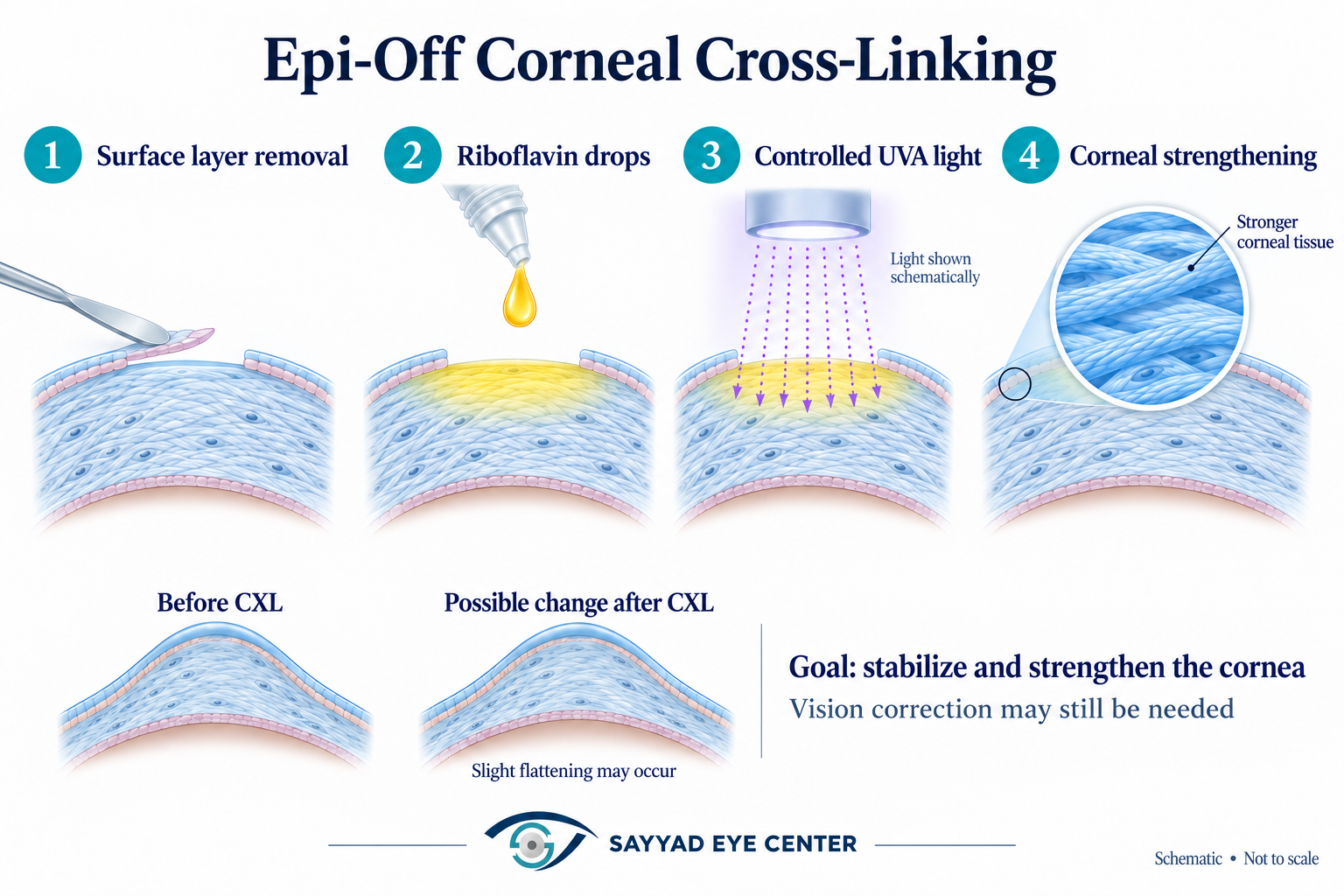
Corneal collagen cross-linking, usually called CXL, combines riboflavin drops, a form of vitamin B2, with a controlled dose of ultraviolet A light. The treatment strengthens the corneal tissue to reduce further change in its shape. Its main benefit is preserving the vision you have by treating progression early. Some eyes become flatter or see more clearly, but cross-linking is not a guaranteed way to remove a glasses prescription.
Who may benefit
Cross-linking is usually considered when keratoconus is progressing. The decision also takes account of age, the likelihood of further progression, corneal thickness, scarring and surface health. Children and teenagers can progress faster and need prompt specialist assessment. Stable eyes may be monitored instead. Very thin or advanced corneas require an individual plan; standard treatment is not suitable for every eye.
Understanding epi off epi on and accelerated treatment
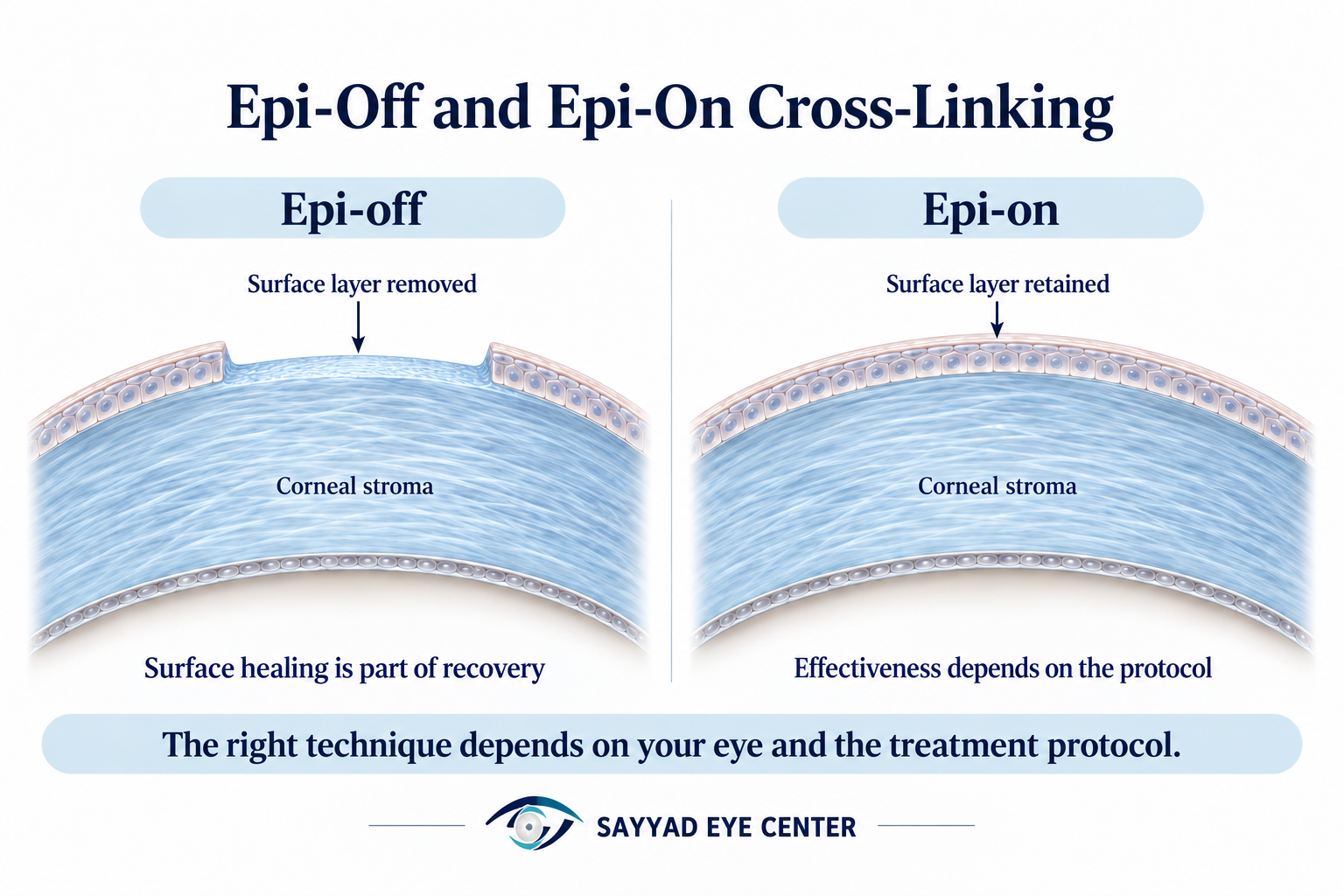
With epi-off cross-linking, the thin surface layer is removed to help riboflavin enter the cornea. This approach has substantial clinical evidence. Epi-on techniques leave that layer in place and may offer a more comfortable early recovery, but their effectiveness depends on the exact protocol. Accelerated treatment changes the light-delivery schedule. These terms do not describe one identical treatment, and a shorter procedure is not automatically the best choice. Ask why the recommended protocol suits your eye.
What happens on the day
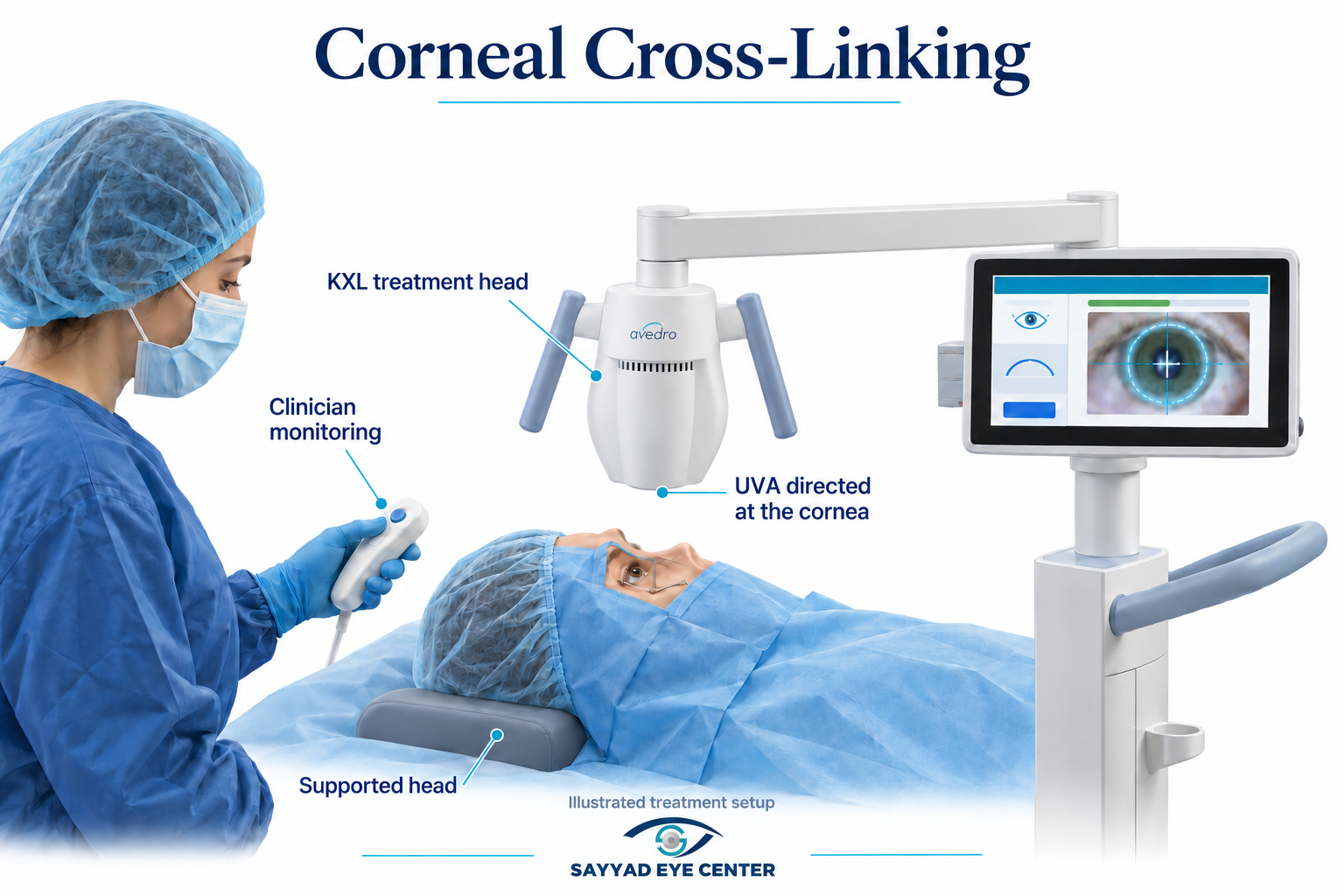
Numbing drops are used. Depending on the technique, the surface layer is prepared, riboflavin drops are applied and the cornea is exposed to controlled UVA light. A protective bandage contact lens is commonly used after epi-off treatment. The team explains the drops, comfort measures and early review. Arrange transport home; you should not drive yourself after treatment.
Other ways to improve vision
Glasses may be enough in early disease. If the cornea becomes more irregular, rigid gas-permeable, hybrid or scleral contact lenses can provide clearer vision. They need specialist fitting and care. Lenses improve focusing but do not replace treatment of documented progression.
In selected eyes, corneal ring segments can help improve the shape and visual function. Some patients may be considered for carefully planned surface laser treatment with cross-linking; this requires enough suitable tissue and specialist assessment. These are individual options, not a routine package for everyone.
A transplant may help when significant scarring or poor usable vision remains despite appropriate alternatives. DALK preserves a healthy inner cell layer; PKP replaces all layers of a central corneal section when needed. Many patients can be managed without transplantation.
Planning treatment with Dr Fouad
At Sayyad Eye Center, your assessment with Dr Fouad El Sayyad should explain whether the condition is progressing, which treatment addresses that problem and how vision will be corrected afterward. Honest advice includes discussing monitoring when appropriate, the expected benefit and time to answer your questions.
Recovery and frequently asked questions
After epi-off treatment, soreness, watering, light sensitivity and blur are common during the first few days. The surface usually heals over several days; the clinician checks healing before removing the bandage lens. Vision may fluctuate for weeks and continue settling over months. Return to work, driving, swimming and contact lenses depends on healing and your surgeon’s advice.
Use the prescribed drops and attend every planned review, including later scans. Do not rub the eye or remove the bandage lens yourself. Like any procedure, CXL has risks. Serious complications are uncommon; possible problems include infection, delayed healing or persistent haze or scarring. Some eyes continue to progress and need further treatment.
Contact your eye team promptly the same day for increasing pain or redness, discharge, or a sudden reduction in vision, particularly after initial improvement. If the team is unavailable, seek urgent eye care.
Does cross linking cure keratoconus
It aims to stabilize the cornea. The diagnosis remains, and regular checks are still important. You may continue to need glasses or specialist contact lenses.
Can I wait until my vision becomes worse
Do not judge progression by vision alone. Scans may show a change before you notice it. Agree a monitoring interval and treatment threshold with your specialist, especially for a child or teenager.
Is cross linking painful
Numbing drops help during treatment. Discomfort is expected afterward, especially with epi-off treatment. Your team will give you a pain-control plan and explain which symptoms need review.
Will it improve my eyesight immediately
Usually not. Vision may initially be blurrier. Some eyes improve over time, but the main goal is stability; discuss a separate plan for your best usable vision.
Is epi on always better because recovery is easier
No. Comfort is only one consideration. Ask about evidence for the exact technique, your suitability and how stability will be checked afterward.
Can keratoconus be treated in children
Yes, selected children may benefit from cross-linking. The timing and technique require specialist assessment, because progression can be quicker and cooperation and corneal thickness matter.
Can I have LASIK or SMILE instead
Routine LASIK and SMILE are generally unsuitable for keratoconus. Cross-linking does not automatically make you eligible. Selected vision-improving procedures require a separate corneal specialist assessment.
Will I need cross linking more than once
Many eyes remain stable after one treatment, but retreatment may be considered if reliable follow-up confirms further progression. It is not a guaranteed lifetime result.
Will I need a corneal transplant
Most treatment plans start with options that preserve your cornea. A transplant is considered for advanced disease when scarring or poor vision cannot be managed adequately with other options.
Can I arrange assessment while visiting Egypt
Yes. Share previous scans and reports before travelling and ask about contact-lens preparation. Allow time for early reviews and any bandage-lens removal. Agree travel clearance and follow-up after returning home; avoid booking around a guaranteed recovery date.
Arrange a keratoconus assessment in Cairo
Contact Sayyad Eye Center to arrange an assessment with Dr Fouad El Sayyad. The team can confirm consultation access in New Cairo or Mohandeseen. Bring your scans, current prescription and contact-lens details so that the discussion starts with your eye and your needs.
Medical review: Dr Fouad El Sayyad, Consultant Cornea, Cataract and Refractive Surgeon; American Board Certified in Ophthalmology; Fellowship in Cornea, External Eye Disease and Refractive Surgery, Washington University in St. Louis, USA.
References
American Academy of Ophthalmology publications and its journal Ophthalmology. References belong at the end of each website language version, without numbers after sentences.
AAO Corneal Ectasia Preferred Practice Pattern. Ophthalmology, 2024. https://www.aaojournal.org/article/S0161-6420%2824%2900010-1/fulltext
AAO Safety and Efficacy of Epithelium-Off Corneal Collagen Cross-Linking for the Treatment of Corneal Ectasia. Ophthalmology, 2024. https://doi.org/10.1016/j.ophtha.2024.05.006
Nath and colleagues. Transepithelial versus Epithelium-off Corneal Collagen Cross-linking for Corneal Ectasia. Ophthalmology, 2021. https://doi.org/10.1016/j.ophtha.2020.12.023
AAO Refractive Surgery Subspecialty Day educational syllabus, 2022. https://cdn.aao.org/pdf/AAOSub_2022_REF_Syllabus.pdf
AAO Refractive Surgery Preferred Practice Pattern. Ophthalmology, 2023. https://www.aaojournal.org/article/S0161-6420%2822%2900868-5/fulltext
The studies compare particular techniques. Findings from older epi-on protocols should not be applied automatically to every newer system. Your surgeon should discuss evidence for the proposed treatment.
Questions to ask at your appointment
• Do my scans show progression, and how reliable is that comparison?
• What is the goal of the proposed treatment for each eye?
• Which cross-linking protocol is recommended and why?
• How will I achieve my best vision afterward?
• When are my early reviews and later scans, and whom do I contact urgently?