Laser Vision Correction
Compare Femto LASIK, SMILE Pro and PRK in Egypt. Learn about suitability, dry eye, recovery and reading vision with Dr Fouad El Sayyad.
Imagine starting your day with less dependence on glasses or contact lenses. Laser vision correction can make work, exercise and everyday activities more convenient for suitable patients. The right treatment starts with understanding your eyes, your prescription and what you want from your vision.
At Sayyad Eye Center, Dr Fouad El Sayyad assesses which approach fits your eyes and explains the benefits, trade-offs and alternatives. Our New Cairo facility uses the ZEISS VISUMAX 800 for SMILE Pro. Modern technology supports treatment, but careful assessment and honest advice remain essential.
What laser vision correction does
Laser treatment changes the shape of the cornea, the clear front window of the eye, so light focuses more accurately on the retina. It can reduce suitable short-sightedness, long-sightedness or astigmatism, depending on the procedure and treatment range. It does not treat every cause of blurred vision or stop the eye from changing with age.
Who may be suitable
Treatment is generally considered for adults with a stable glasses prescription, healthy corneal scans and enough suitable corneal tissue for the planned correction. The assessment also considers dry eye, the retina, your medical history and realistic expectations. A prescription number alone cannot tell you which operation is appropriate.
Surgery may need to be delayed or avoided if the prescription is changing, dry eye is uncontrolled, scans suggest keratoconus or the eye has another active condition. Pregnancy and breastfeeding can affect the timing of assessment and treatment. Tell your doctor about medicines, previous surgery and general health conditions.
What your assessment should include
• Your prescription and its stability, vision testing and a full eye examination.
• Corneal topography or tomography and thickness measurements to assess shape and tissue suitability.
• Tear-film and eyelid assessment, with dry-eye treatment before surgery when needed.
• Retinal examination when indicated, particularly with high short-sightedness.
• A discussion of night driving, screen work, sports, reading needs and the glasses you may still need.
Ask how long to stop wearing contact lenses before measurements. The interval depends on the lens type and whether scans have stabilised. Bring previous prescriptions and eye reports if available.
If laser is not the best option
Glasses and contact lenses remain effective choices. An implantable lens such as ICL or IPCL may suit some patients, including selected people with high short-sightedness, after a separate assessment. If cataracts are affecting vision, cataract surgery may be more appropriate than corneal laser treatment. Read our separate implantable-lens and cataract guides for more detail.
Choosing between Femto LASIK SMILE Pro and PRK
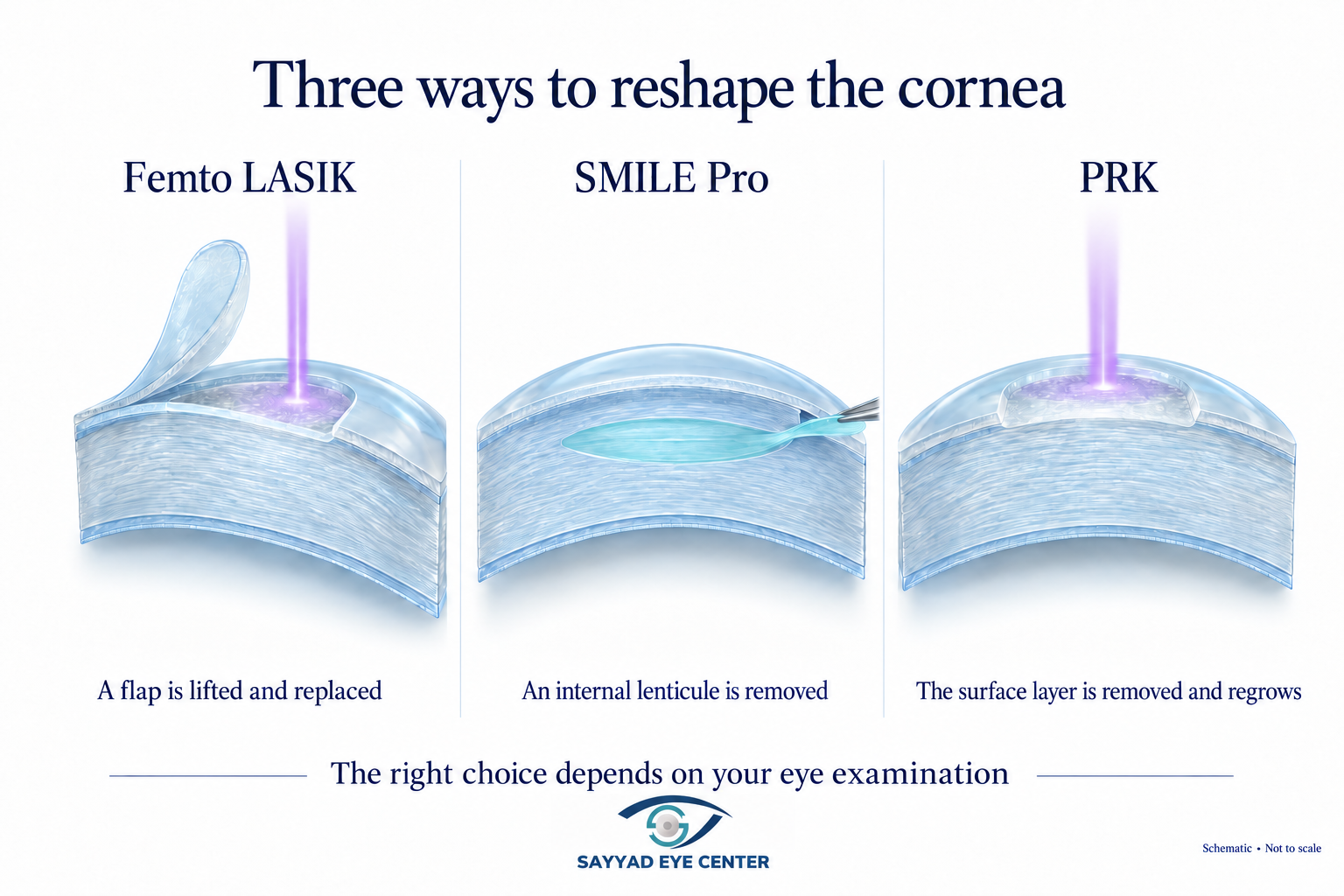
Femto LASIK
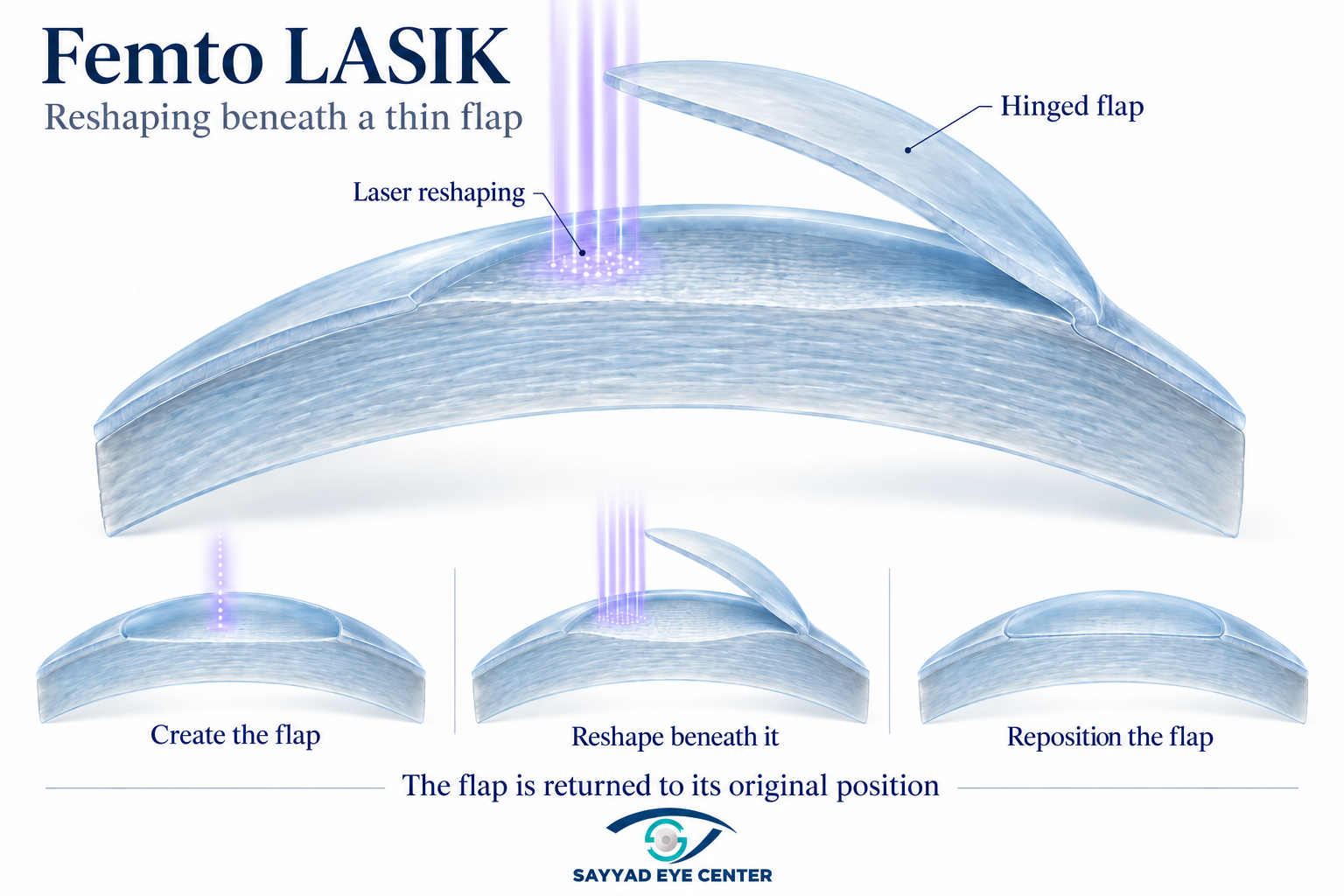
A femtosecond laser creates a thin corneal flap. The surgeon lifts it, uses an excimer laser to reshape the tissue beneath it, then repositions the flap. Femto LASIK offers rapid functional recovery for many patients and can treat a range of suitable prescriptions. The flap, dry-eye tendency and your work or contact-sport activities are part of choosing whether it fits your needs. Traditional LASIK uses a mechanical microkeratome to create the flap instead.
SMILE Pro with ZEISS VISUMAX 800
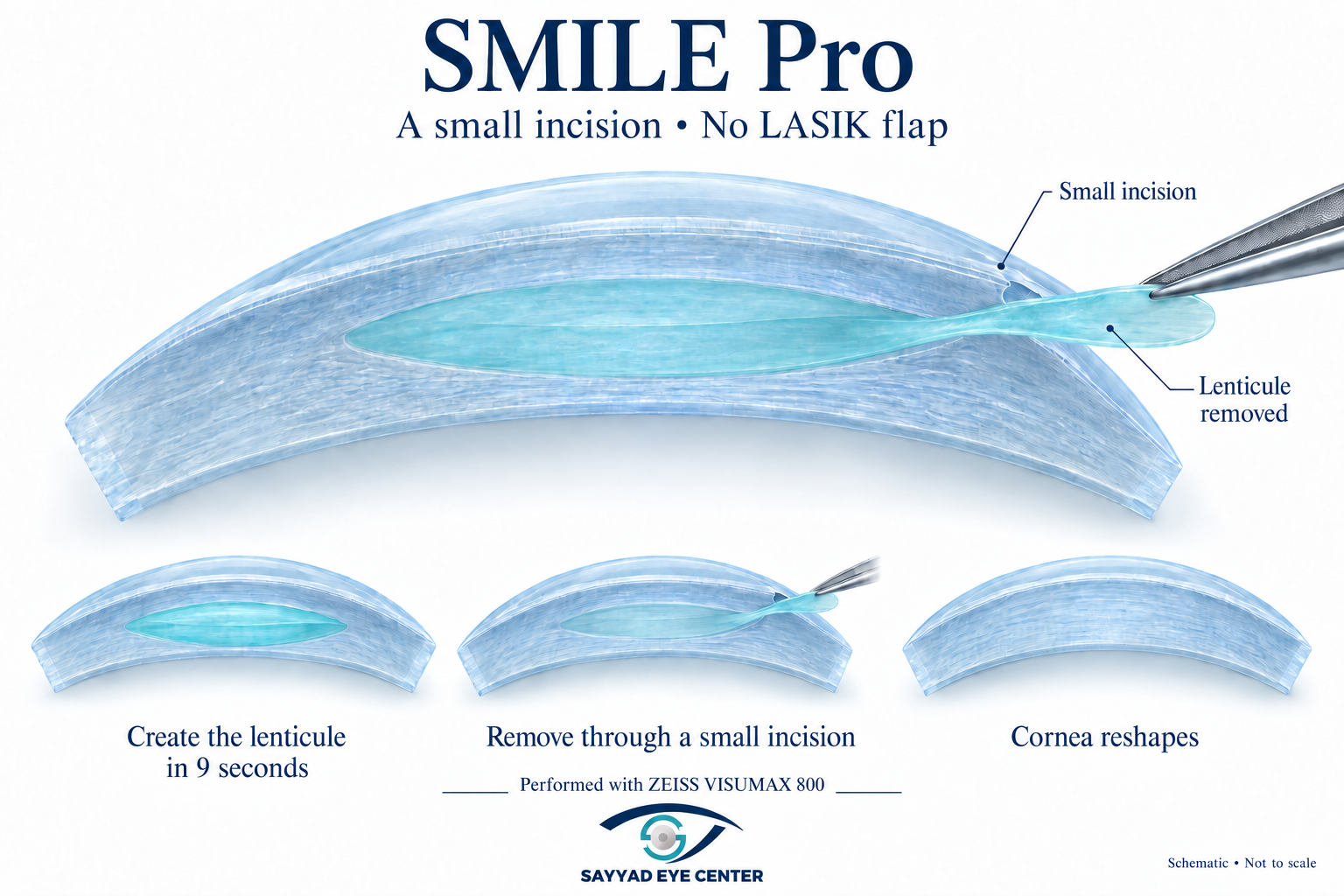
The femtosecond laser creates a small disc of tissue, called a lenticule, inside the cornea. The surgeon removes it through a small incision, changing the corneal shape without creating a LASIK flap. SMILE Pro is an option for suitable short-sightedness and astigmatism; eligibility depends on the prescription, scans and locally available approved treatment range.
Its flap-free approach can be attractive for active patients. Many people recover useful vision quickly, although fine clarity may settle at a different pace from LASIK. Our dedicated SMILE Pro article explains the VISUMAX 800 procedure in more detail.
PRK and surface laser treatment
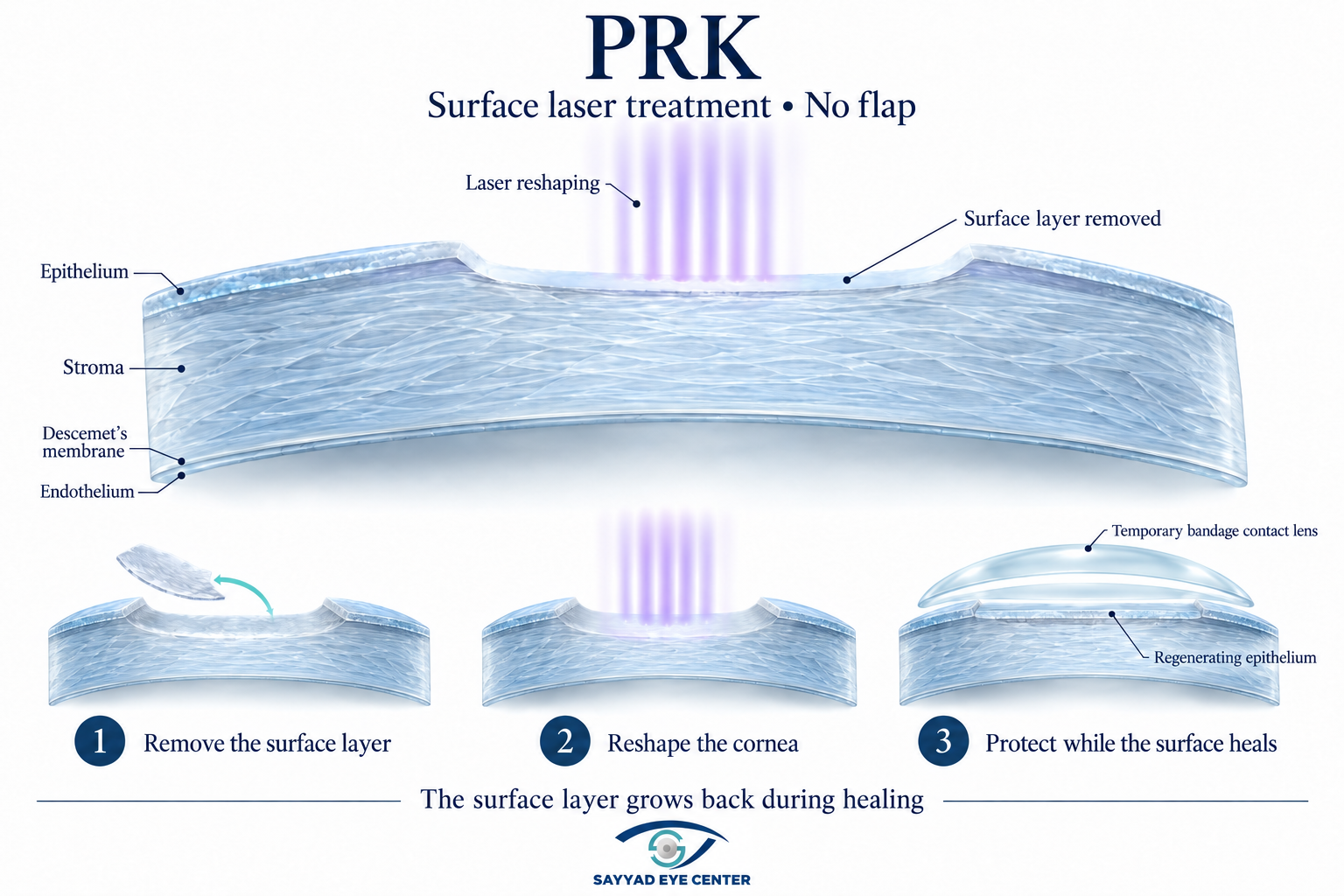
PRK removes the thin surface layer of the cornea, called the epithelium, before an excimer laser reshapes the underlying tissue. A temporary bandage contact lens protects the eye as the surface heals. In TransPRK, a laser also removes the epithelium. Neither technique creates a LASIK flap.
Surface treatment may suit some patients whose lifestyle or corneal measurements favour avoiding a flap. It is not a solution for every thin or irregular cornea. Early discomfort and light sensitivity are usually greater, and visual recovery is slower, than after LASIK or SMILE. The doctor will explain the drop schedule and follow-up needed.
Femto LASIK
Main attraction: Rapid visual recovery for many suitable patients.
Planning point: A flap is created; dry eye and trauma exposure matter.
SMILE Pro
Main attraction: Small incision with no LASIK flap.
Planning point: Prescription and scans must suit lenticule extraction.
PRK or TransPRK
Main attraction: Surface treatment without a flap.
Planning point: Allow more time for comfort and vision to recover.
What does the evidence say about dryness
Dryness can occur after any laser vision correction. Comparative evidence on SMILE generally suggests less dry-eye disturbance than Femto LASIK, especially early in recovery; this does not mean every patient will have less dryness or that it cannot persist. These findings should not be treated as proof that the VISUMAX 800 alone guarantees a better dry-eye outcome. Discuss existing symptoms beforehand so the ocular surface can be treated and the procedure chosen carefully.
Recovery reading vision and your questions
What to expect after treatment
Numbing drops are used during treatment; you may notice pressure or lights. Arrange a ride home. LASIK and SMILE often allow a quicker return to routine activities than PRK, but the examination determines when work and driving are appropriate. PRK needs extra time for surface healing, and vision may continue improving over weeks. With every method, temporary fluctuation, glare, halos or dryness can occur.
Use prescribed drops, avoid rubbing the eyes and attend your reviews. Follow your own instructions for swimming, makeup, exercise and contact sports. Seek urgent advice for worsening vision, increasing pain or marked redness. If travelling from abroad, agree the assessment, treatment, early reviews and later follow-up before booking your return journey.
Reading vision after forty
Presbyopia is the age-related reduction in the natural lens’s ability to focus up close. Standard distance correction does not prevent it. Selected patients may consider monovision or a blended-vision approach, with different focusing targets between the eyes. A contact-lens trial can help assess tolerance. These approaches have trade-offs for depth perception or visual quality and do not restore a young natural lens. Branded options such as PRESBYOND require specific suitability assessment and confirmation of availability.
Risks in perspective
Most appropriately selected patients do well. Like any surgery, laser vision correction carries risks. Dryness and night-vision symptoms are more common than serious complications and often improve, but can persist. Residual prescription, regression or additional treatment may occur. Infection, scarring, corneal weakening called ectasia and lasting loss of visual quality are uncommon but important to discuss. Your surgeon should explain your individual risks without pressure to proceed.
Frequently asked questions
Which procedure is best
There is no single best operation for everyone. Corneal shape, prescription, dry eye, age and daily activities guide the choice.
Will I never need glasses again
The aim is less dependence on glasses. Some tasks may still need them, and reading glasses are often needed as the natural lens ages.
Is SMILE Pro better for dry eyes
It may cause less early dry-eye disturbance than Femto LASIK, but screening and treating existing dryness are still necessary.
Can laser fix high short-sightedness
Sometimes. The safe treatment plan depends on the scans and tissue requirements. An implantable lens may be more suitable for some eyes. Correcting the prescription does not remove the retinal risks associated with high myopia.
How much does treatment cost
Ask for a written quotation after assessment, specifying the procedure, testing, medicines and follow-up included. Choose according to suitability and the complete care plan, not price alone.
Book an assessment through Sayyad Eye Center in New Cairo or Mohandeseen. Patients travelling from Sheikh Zayed, 6th of October or overseas should confirm the consultation branch and treatment location before their visit.
References
Patient and technology references are collected here rather than repeated after individual sentences. AAO provides medical patient guidance; ZEISS describes its own technology. Manufacturer information does not establish that one procedure is best for every patient. Sources checked 6 October 2026.
American Academy of Ophthalmology — LASIK https://www.aao.org/eye-health/treatments/lasik
American Academy of Ophthalmology — Presbyopia https://www.aao.org/eye-health/diseases/what-is-presbyopia
ZEISS — SMILE Pro overview https://www.zeiss.com/vision-care/en/eye-surgery/vision-correction-surgery/smile-pro-laser-eye-surgery.html
ZEISS — Suitability https://www.zeiss.com/vision-care/en/eye-surgery/vision-correction-surgery/smile-pro-laser-eye-surgery/suitability.html
ZEISS — Possible side effects https://www.zeiss.com/vision-care/en/eye-surgery/vision-correction-surgery/smile-pro-laser-eye-surgery/side-effects.html
This guide supports a consultation and cannot determine an individual treatment plan. The final clinical text and reviewer attribution require Dr Fouad El Sayyad’s approval before publication.