Red Patch on the Eye: Subconjunctival Hemorrhage Explained
A red patch on the white of your eye can look alarming. Learn why it happens, including after eye surgery, how it heals and when to seek advice.

A red patch on the white of your eye: subconjunctival hemorrhage
You look in the mirror and notice a bright red patch on the white of your eye. It can look dramatic, even when the eye feels normal and you can see as usual.
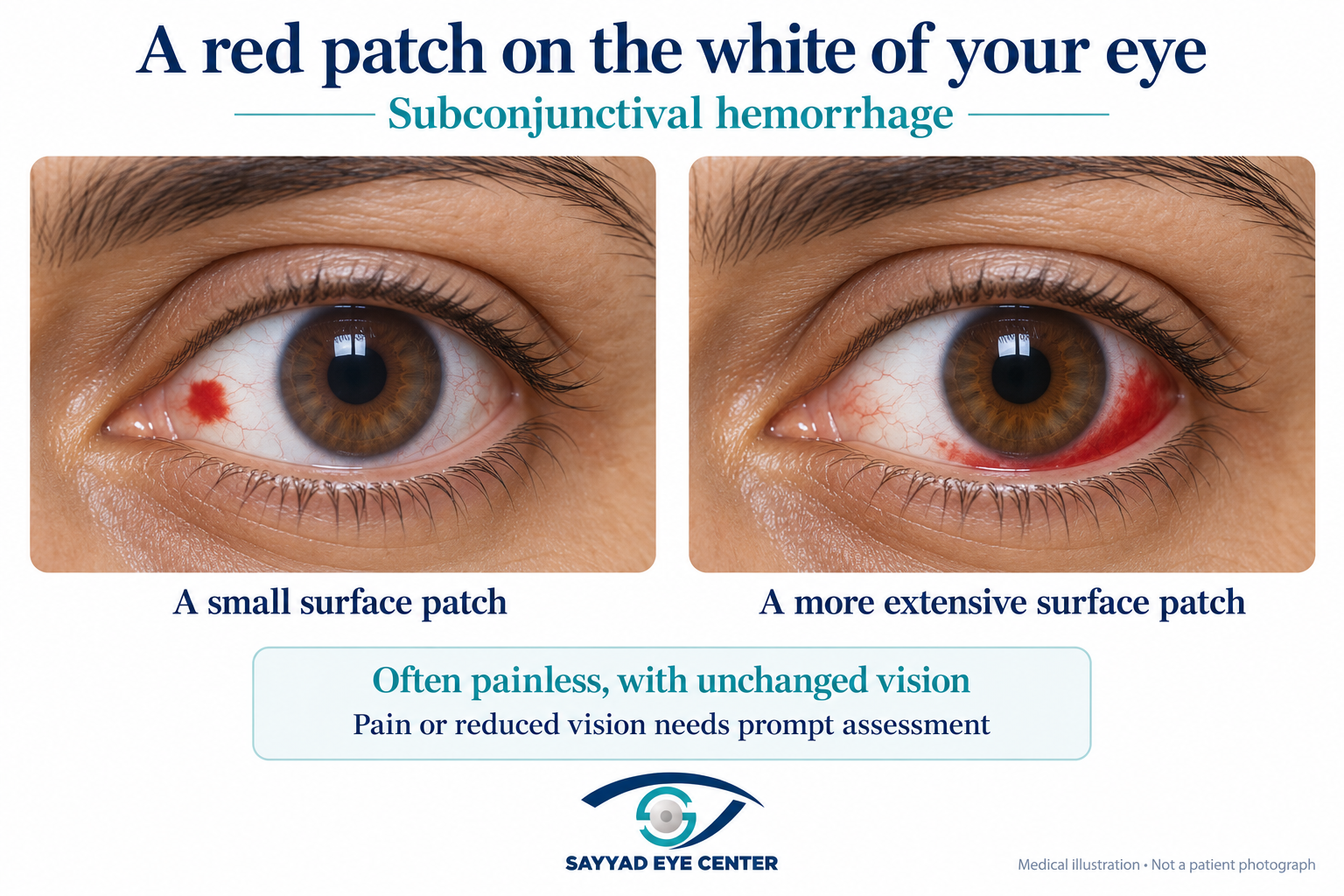
A common explanation is a subconjunctival hemorrhage: a small surface blood vessel has broken, leaving blood beneath the clear membrane covering the white of the eye. When it is an uncomplicated surface bleed, it is usually harmless and clears on its own. It can happen without surgery, and it can also appear after cataract surgery.
What exactly is the red patch?
The conjunctiva is the thin, transparent covering over the white part of the eye. It contains tiny blood vessels. If one leaks, the blood becomes visible beneath that covering, rather like a bruise under the skin.
The patch may be small or cover a larger area. The redness is on the surface, away from the clear centre through which you see. A simple subconjunctival hemorrhage should not reduce vision or cause significant pain. A little surface irritation can occur.
Why did it happen?
Often there is no obvious trigger: you may simply notice the patch in the mirror. Common causes include rubbing the eye, a small scratch while inserting or removing a contact lens, coughing, sneezing, vomiting or straining. These can briefly increase pressure in the small vessels or irritate the surface. A minor injury, an eye procedure or a local anaesthetic injection can also cause a vessel to leak.
High blood pressure and medicines that affect bleeding, including aspirin and anticoagulants, can make it more likely. A single patch does not prove that your blood pressure is high or that you have a bleeding disorder. It is sensible to have your blood pressure checked, especially if you have not checked it recently. Repeated episodes deserve a review of medication and other symptoms as well.
Can it happen before cataract surgery?
Yes. It can appear in everyday life, including while you are waiting for an operation. A small, uncomplicated surface bleed does not usually mean that the cataract has become worse or automatically require cancellation.
Let the surgical team know before the procedure so the eye can be checked. The decision depends on confirming that it is a simple surface bleed, rather than infection, an injury or another cause of redness. Do not change your medicines or cancel the operation yourself because of the appearance alone.
What if it appears after cataract surgery?
A red patch can appear after an otherwise successful operation. Small vessels on the surface may leak during the procedure or when local anaesthesia is given. Once the examination confirms a simple surface bleed, its appearance does not mean the implanted lens has moved or that the operation has failed. It usually does not affect the visual result.
Which types of local anaesthesia can cause bruising?
Numbing drops anaesthetise the surface without an injection around the eye. Some operations also use a local anaesthetic block to keep the eye comfortable and still. A sub-Tenon’s block delivers anaesthetic through a small blunt tube beneath a tissue layer covering the eye. Peribulbar and retrobulbar blocks use an injection around or behind the eyeball. These are different techniques; the choice depends on the operation and the patient.
An injection or the small opening used for a block can disturb a blood vessel. This may leave blood on the white of the eye, bruising under the eyelid skin, or both. It can happen even when the anaesthetic and surgery have otherwise gone well.
Why are both my upper and lower eyelids bruised?
The eyelid skin is thin, and blood can spread through the loose tissues around the eye. A bruise may therefore involve both the upper and lower eyelid on the operated side and extend beyond the injection site. It may look like a black eye, with some puffiness. A larger collection of blood is sometimes called a haematoma.
The red patch on the white of the eye and the bruise under the eyelid skin are in different tissues, although they can occur together. A broad, dark bruise can look alarming without meaning that the vision or the surgery has been harmed. After the team has checked it and confirmed uncomplicated bruising, time is usually what allows it to settle.
What if I take blood thinners?
Bruising may be more extensive or take longer to fade in people taking medicines such as aspirin, clopidogrel, warfarin, apixaban or rivaroxaban. Tell the surgical team which medicines you take. Do not stop or reduce them yourself because of a red patch or eyelid bruise; any change must be agreed with the doctors responsible for your treatment.
What should I expect over the next few weeks?
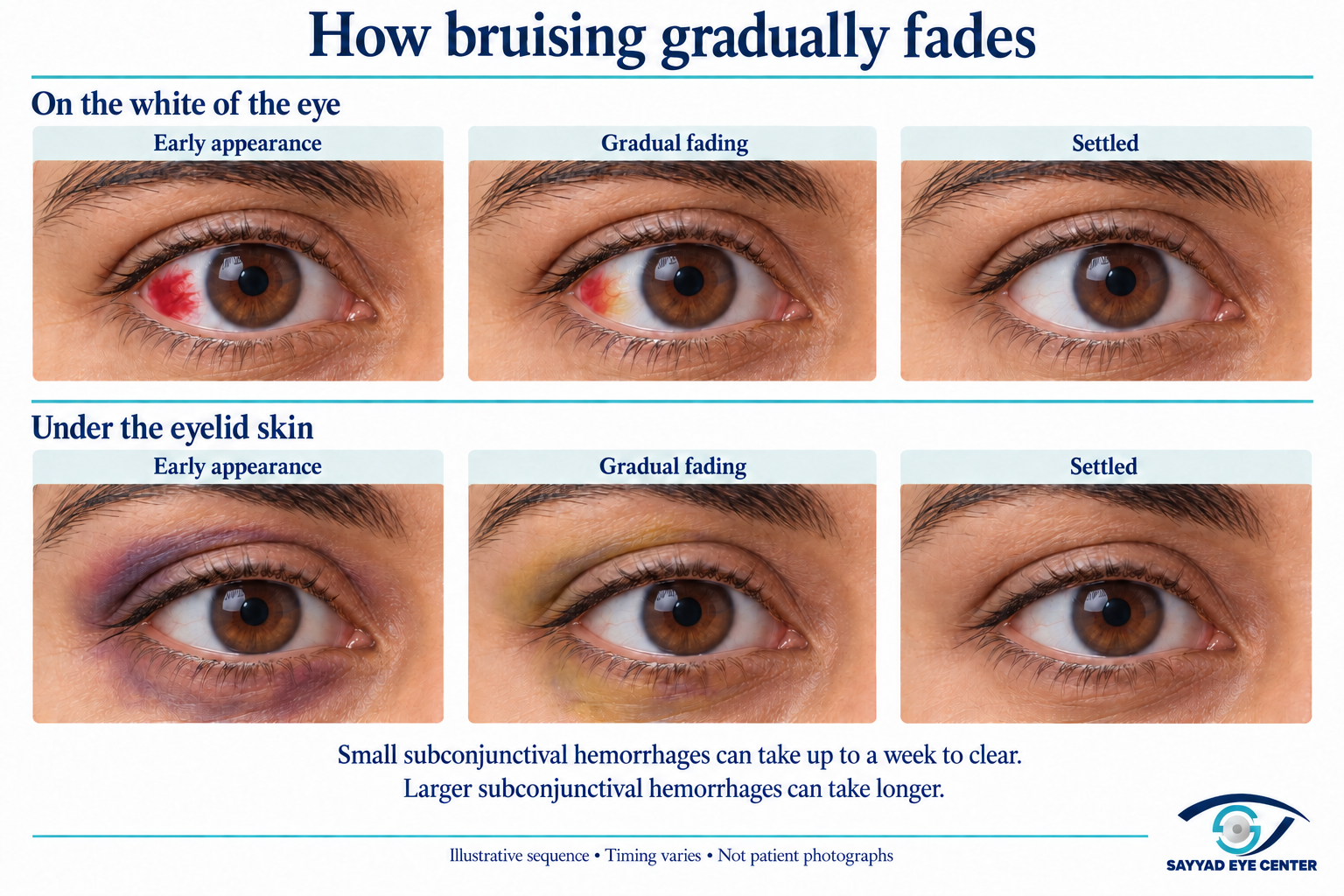
Small surface patches often clear within a week. Larger patches and uncomplicated eyelid bruises usually fade over one to three weeks. Larger bruises, particularly in patients taking blood thinners, may take longer. The body gradually absorbs the blood, as it does with a bruise elsewhere. Eyelid bruising may change from purple or blue to greenish or yellow before clearing, and the surface patch may develop a yellow tinge as it fades.
The discolouration can become more noticeable or spread a little before it fades. That alone does not necessarily mean fresh bleeding. The overall trend should be towards less swelling and fading colour, with vision following the expected postoperative course.
Continue your prescribed eye drops and planned follow-up. The drops help recovery from the operation; they do not wash the bruise away. Avoid rubbing, massaging or pressing on the eye, and do not apply creams or home remedies to it.
When is it more than an ordinary bruise?
Contact the surgical team promptly if the bruising is newly extensive or you are unsure that it has been assessed. Seek urgent eye care immediately for severe or increasing pain, reduced vision, rapidly increasing tight swelling, an eye that appears pushed forward, or new double vision. These are not features to watch at home for one to three weeks. Increasing redness with discharge or marked light sensitivity also needs prompt assessment.
Most checked, uncomplicated bruises do not have these symptoms and gradually clear without a procedure to remove the blood.
How long does it take to disappear?
Small surface patches often clear within a week. Larger patches usually take one to three weeks, and some may take longer. The colour can change as the blood is absorbed, and the patch may spread out slightly before fading. That change alone does not necessarily mean new bleeding.
A photograph taken in similar lighting every few days can help you notice gradual improvement. If it is not fading, remains after several weeks or keeps recurring, arrange an examination. Avoid checking and rubbing it repeatedly throughout the day.
Does it need treatment?
Usually, the body absorbs the blood without treatment. Lubricating drops may help mild grittiness, but they do not make the blood disappear immediately. Antibiotic drops are not needed for an uncomplicated surface bleed, and steroid or redness-relief drops should not be started just to improve its appearance.
Do not rub or press on the eye. Do not stop aspirin or another prescribed blood thinner yourself. If bleeding is recurrent or there are other concerns, the prescribing doctor can review the medicine safely. After surgery, continue to follow the activity restrictions in your recovery plan.
When should it be checked urgently?
Seek urgent eye care if the redness follows a significant injury or comes with pain, reduced vision, marked light sensitivity or substantial swelling. After recent surgery, worsening symptoms should be assessed promptly rather than watched at home.
Arrange a medical review if patches keep appearing or you also have easy bruising, nosebleeds, gum bleeding or other unusual bleeding. Blood tests are not necessary for every single uncomplicated episode; the history and examination guide that decision.
Frequently asked questions
Is it contagious?
No. An uncomplicated subconjunctival hemorrhage is blood beneath the surface membrane, not an infection. It does not spread by sharing a room or looking at the eye.
Is this bleeding in the retina?
No. This particular condition affects the visible surface of the eye. Bleeding deeper inside the eye is a different diagnosis. New loss of vision, floaters or other visual symptoms should not be explained away by the surface patch.
Can I read, use screens or go to work?
A simple surface bleed generally does not prevent normal everyday activities if your vision is normal and you feel comfortable. After an operation, the surgical recovery instructions still apply.
Can I wear contact lenses?
If the redness followed lens insertion or removal, or the eye feels irritated, use glasses and arrange a check if it does not settle. Pain or reduced vision in a contact-lens wearer needs prompt assessment. Do not force a lens onto an uncomfortable eye.
Does a large red patch mean something serious?
Its appearance can be alarming, but size alone does not establish the cause or severity. Pain, vision, injury history, recent surgery and whether the problem recurs are more useful than the colour alone.
Related articles
Contact the centre
For a planned consultation or follow up, contact Sayyad Eye Center on +20 100 008 8168. Confirm whether your visit is in Mohandeseen or New Cairo. Bring any drops you use and tell us about recent eye surgery. For urgent symptoms, seek an eye emergency service if you cannot reach the centre.
Medical review
Medically reviewed by Dr Fouad El Sayyad
American Board certified ophthalmologist
Fellowship in Cornea, External Eye Disease and Refractive Surgery
Washington University in St Louis, USA
References
American Academy of Ophthalmology — What Is a Subconjunctival Hemorrhage?
Moorfields Eye Hospital NHS Foundation Trust, UK — Subconjunctival haemorrhage
American Academy of Ophthalmology — 10 Cataract Surgery Side Effects, and How to Cope
Royal College of Anaesthetists, UK — Local anaesthesia for your eye operation
Moorfields Eye Hospital NHS Foundation Trust, UK — Local anaesthesia
Royal Berkshire NHS Foundation Trust — Subconjunctival haemorrhage, patient advice (2023)