Recovery after cataract surgery
Your cataract recovery guide: eye drops, sleep, screens, driving, exercise, follow-up and warning signs. Patient advice from Sayyad Eye Center in Cairo.

Most people return home on the day of cataract surgery and notice clearer vision over the following days. This guide explains how to care for your eye, return to everyday activities and recognize symptoms that need attention. The activity timetable below is our centre’s routine guidance after uncomplicated cataract surgery. If your written discharge instructions specify a different plan, follow those instructions.
What to expect during the first days
A little grittiness, watering, light sensitivity and mild redness can occur. Vision may be misty or fluctuate, particularly while the pupil is still dilated or the cornea is settling. The useful question is whether you are gradually improving. Severe pain, a sudden decline or deterioration after initial improvement should not be dismissed as ordinary healing.
Colors may look brighter, and your old glasses may feel different. Each eye can recover at a different pace; comparing yourself with a friend is not a reliable guide.
Halos glare and a dark crescent after surgery
Some patients notice unwanted optical effects called dysphotopsias. Positive dysphotopsia means bright effects such as halos, glare, streaks or arcs of light. Negative dysphotopsia is a dark crescent or curved shadow at the outer edge of vision. These can relate to how light interacts with the implanted lens and often become less noticeable over time.
Mention them at follow up, particularly if persistent or bothersome; an examination can confirm the cause and guide treatment if needed. Do not assume a new or spreading shadow is a lens effect. A curtain across vision, new flashes or many new floaters, or a sudden drop in sight needs urgent assessment.
A realistic recovery timeline
On the day of surgery, rest at home and have someone take you back. Read your drop schedule and confirm your first review.
During the first week, many patients feel more comfortable and manage light daily tasks. Keep all checks even if vision seems excellent.
Over the following weeks, the prescription and quality of vision usually become more stable. Final glasses are often considered around four to six weeks after uncomplicated surgery, but the timing can be later and may depend on the second eye. These are broad milestones, not promises or automatic clearance for activities.
Use your drops correctly
Use the exact medicines, frequency and duration on your discharge sheet. Do not copy another patient’s schedule or stop steroid drops suddenly unless instructed. Continue existing glaucoma drops unless your surgeon changes them.
Wash your hands, tilt your head back and gently pull down the lower eyelid. Put one drop into the pocket without touching the bottle tip to the eye or lashes. Close the eye gently; do not squeeze or rub. Leave at least five minutes between different drops unless given another instruction. Ask the team if you miss a dose, run out, cannot manage the bottle or develop a reaction. Do not use leftover antibiotic or steroid drops from an earlier illness.
Sleeping and protecting your eye
Use a protective shield at night for the period specified by your surgeon. Avoid pressure on the operated eye, including from your hand or pillow. You do not generally need to sleep sitting upright after routine cataract surgery; follow any special positioning instructions if another procedure was performed. Keep the eye free from rubbing, dust and accidental knocks.
Washing and personal care
You can usually wash carefully while keeping soap, shampoo and direct shower spray out of the operated eye. Do not scrub the eyelids or put a towel against the eye. Ask when eye makeup, swimming and hot tubs can resume; these need more caution than ordinary washing. Sunglasses can make outdoor light more comfortable. They do not replace prescribed eye protection.
Reading screens and returning to exercise
Reading, watching television and using your phone are usually acceptable as comfort allows. These activities do not dislodge the implanted lens. Take breaks, blink regularly and use the lubricating drops recommended in your discharge plan.
Gentle walking is suitable early in recovery. Light gym activity can resume within the first week if you feel comfortable and your vision is improving. Keep it gentle, such as easy walking on a treadmill or gentle stationary cycling, without straining or holding your breath.
Avoid heavy lifting and vigorous workouts for two weeks. After two weeks, build up gradually if recovery has been uncomplicated. This timetable does not cover contact sports or activities that risk a direct blow to the eye. Avoid rubbing your eye or letting sweat run into it. If bending makes you strain or puts your eye at risk, adapt the task or ask for help.
Driving work and travel
Do not drive on the day of surgery. Resume driving when your vision is clear and comfortable, you can judge distances safely and you meet the legal vision requirements. Avoid driving if blur, double vision or glare interferes with seeing the road; night driving may need more time. Any specific restriction in your discharge instructions still applies.
Desk work may be possible before dusty, physical or safety critical work. For patients visiting Cairo from abroad, arrange follow up appointments and obtain written instructions before booking the return journey. Routine cataract surgery does not involve a gas bubble inside the eye. Plan travel around your postoperative appointments and recovery.
When to contact us urgently
Seek urgent eye assessment for sudden or worsening loss of sight, severe or increasing pain, increasing redness with reduced vision, or discharge. New flashes, many new floaters, or a curtain or shadow in your vision also need urgent assessment. Eye pain with marked headache, nausea or vomiting should be checked promptly. Do not wait for your scheduled appointment or a routine message reply. If the centre cannot be reached, go to the nearest emergency eye service.
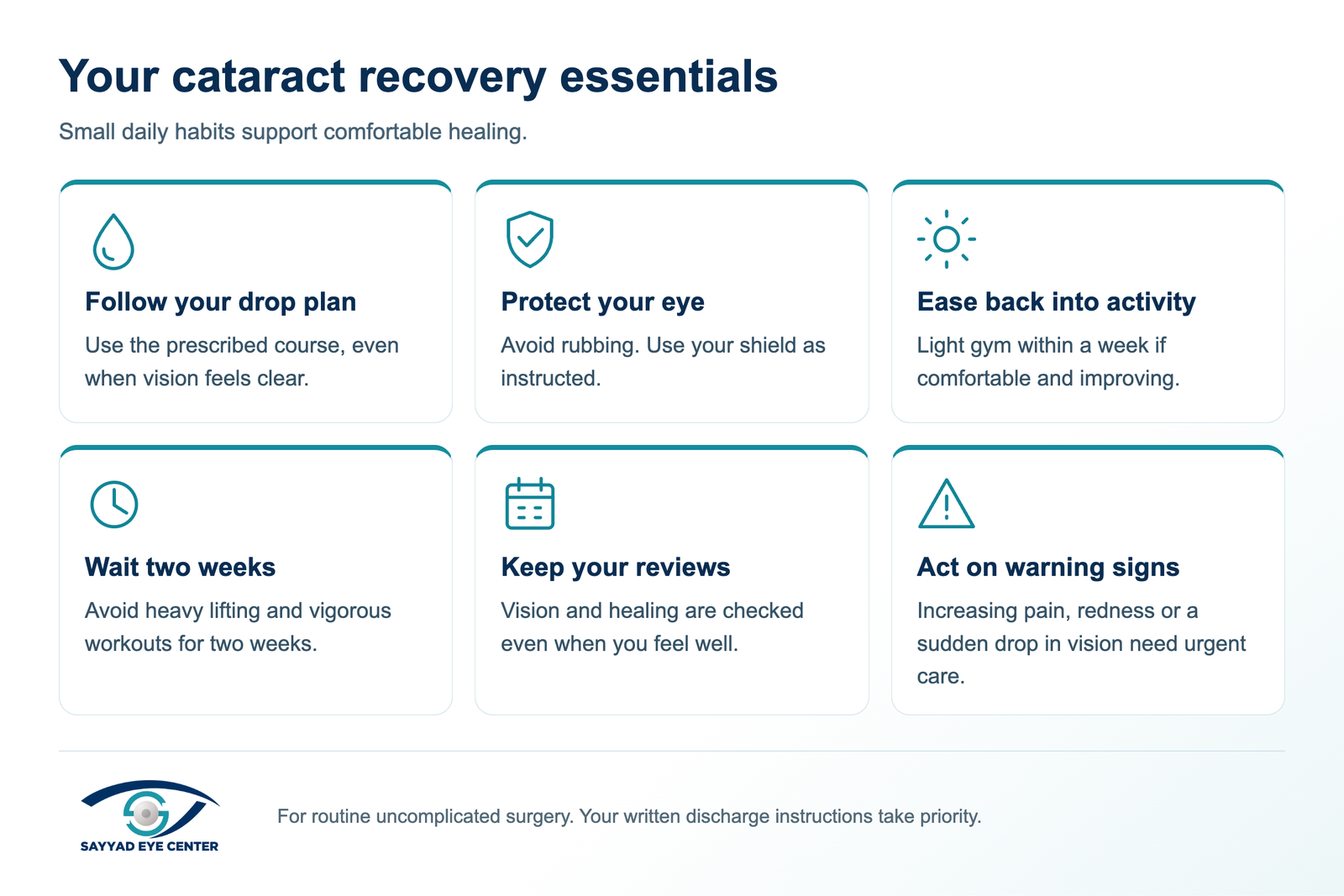
Your recovery checklist
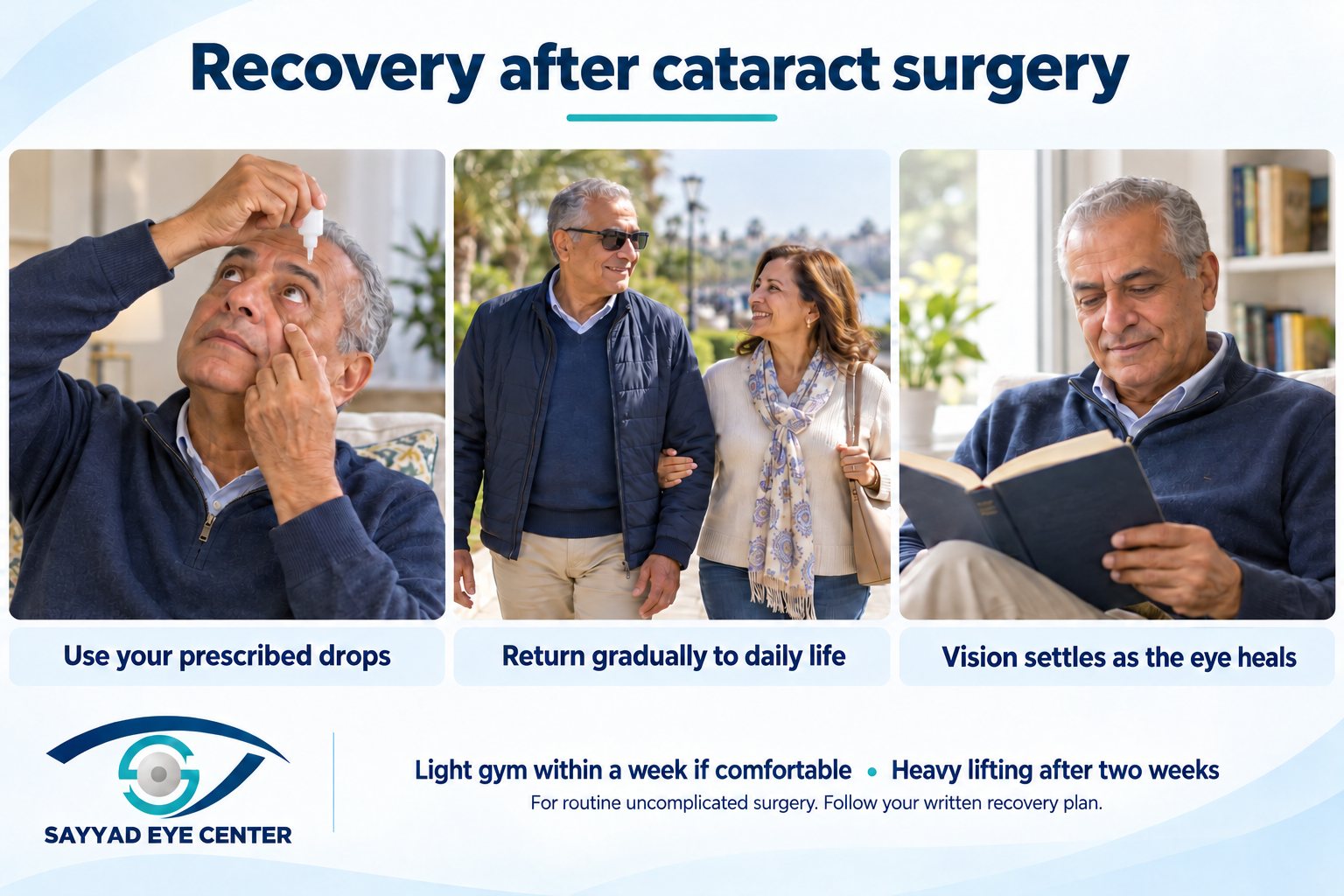
Keep your discharge instructions and postoperative contact details together. Use your drops as prescribed, protect your eye and attend every review. Note any changes in vision or difficulties with drops. Remember the activity timetable: light gym within the first week as comfort allows, and no heavy lifting or vigorous workouts for two weeks. Keep the written instructions for swimming and eye makeup, and arrange final glasses once your prescription has settled.
Frequently asked questions
Do I need an artificial lens implanted during cataract surgery
For almost all adults, yes. A cataract is your natural lens becoming cloudy. During surgery, we remove that cloudy lens and usually replace it with a clear artificial lens called an intraocular lens, or IOL.
The IOL replaces the focusing power of your natural lens, helping focus light onto the retina so you can see clearly. It is a standard part of modern cataract surgery, rather than an optional cosmetic addition.
Different IOLs offer different focusing options. Even a standard monofocal lens performs this essential role. In uncommon situations, implantation may be delayed or another approach needed because of the condition of the eye.
Is some blur normal after cataract surgery
Yes, early blur can accompany healing, but worsening or sudden blur needs prompt advice. Do not use the calendar alone to decide that a symptom is safe.
Can I use my phone
Usually, for short comfortable periods. Rest when the eye feels tired or dry; the main restrictions concern rubbing, contamination and physical injury.
When can I go back to the gym
Light gym activity can resume within the first week if you are comfortable and recovering well. Avoid heavy lifting and vigorous workouts for two weeks, then return gradually. Follow any different instructions given for your own operation.
Will I still need glasses
Possibly. The lens design, target focus, astigmatism and health of the retina all matter. Even premium lenses do not guarantee freedom from glasses.
Do cataracts come back
No. The cloudy natural lens has been removed and cannot grow back. Months or years later, the thin capsule behind the artificial lens can become cloudy. This is called posterior capsule opacification, or PCO, and is sometimes described as a secondary cataract. It is different from the original cataract returning.
What is YAG laser treatment
If capsule clouding affects your vision, an examination can confirm whether a short outpatient YAG laser treatment would help. The laser makes an opening in the cloudy capsule; the artificial lens stays in place. Not everyone needs YAG, and it does not treat every cause of blurred vision. A separate article explains PCO and YAG in more detail.
Why does my old glasses prescription feel wrong
Your new lens changes the eye’s focus. Your old glasses may no longer suit the operated eye, and the two eyes may feel unbalanced before the second eye is treated. A final prescription is usually arranged once vision has settled, often around four to six weeks after uncomplicated surgery.
Do I need sunglasses all day
No. Sunglasses are useful outdoors if bright light is uncomfortable, but you do not need to wear them continuously indoors. Use the nighttime shield according to your discharge instructions.
Should I keep my follow up if I feel fine
Yes. Follow up checks healing, eye pressure and the response to treatment, including changes that may not cause obvious symptoms. Clear vision does not replace these checks.
Contact the centre
For a planned consultation or follow up, contact Sayyad Eye Center on +20 100 008 8168. Confirm whether your visit is in Mohandeseen or New Cairo. Patients living abroad should arrange follow up before travel. This routine contact route is not a substitute for emergency eye care.
Medical review
Medically reviewed by Dr Fouad El Sayyad
American Board certified ophthalmologist
Fellowship in Cornea, External Eye Disease and Refractive Surgery
Washington University in St Louis, USA
References
AAO Cataract surgery recovery
https://aao.org/eye-health/tips-prevention/safe-exercise-driving-cataract-surgery-recovery
AAO Cataract surgery patient information
https://store.aao.org/media/resources/PEHANDOUTS/Cataract_Surgery_2020_FINAL.pdf
AAO Cataract surgery side effects
https://aao.org/eye-health/tips-prevention/side-effects-cataract-surgery-complications-cope
AAO Posterior capsulotomy patient information
https://store.aao.org/media/resources/051204/051204-posterior-capsulotomy-rf1.pdf
AAO Cataract in the Adult Eye Preferred Practice Pattern
https://www.aaojournal.org/article/S0161-6420%2821%2900750-8/fulltext
AAO Choosing an intraocular lens for cataract surgery
https://aao.org/eye-health/tips-prevention/best-artificial-lens-implant-iol-cataract-surgery