Before Your Cataract Consultation
Prepare for your cataract consultation: contact lenses, medicines, previous eye records, examinations and lens measurements at Sayyad Eye Center.

How to prepare and what to expect at Sayyad Eye Center
Your cataract consultation helps us understand why your vision has changed, assess the health of your eyes and discuss whether surgery would help. If surgery is appropriate, we will explain the measurements and lens choices needed to plan it. Bring your glasses, medicine list and previous eye records, and follow the contact-lens instructions below.
Pause contact lenses before your appointment
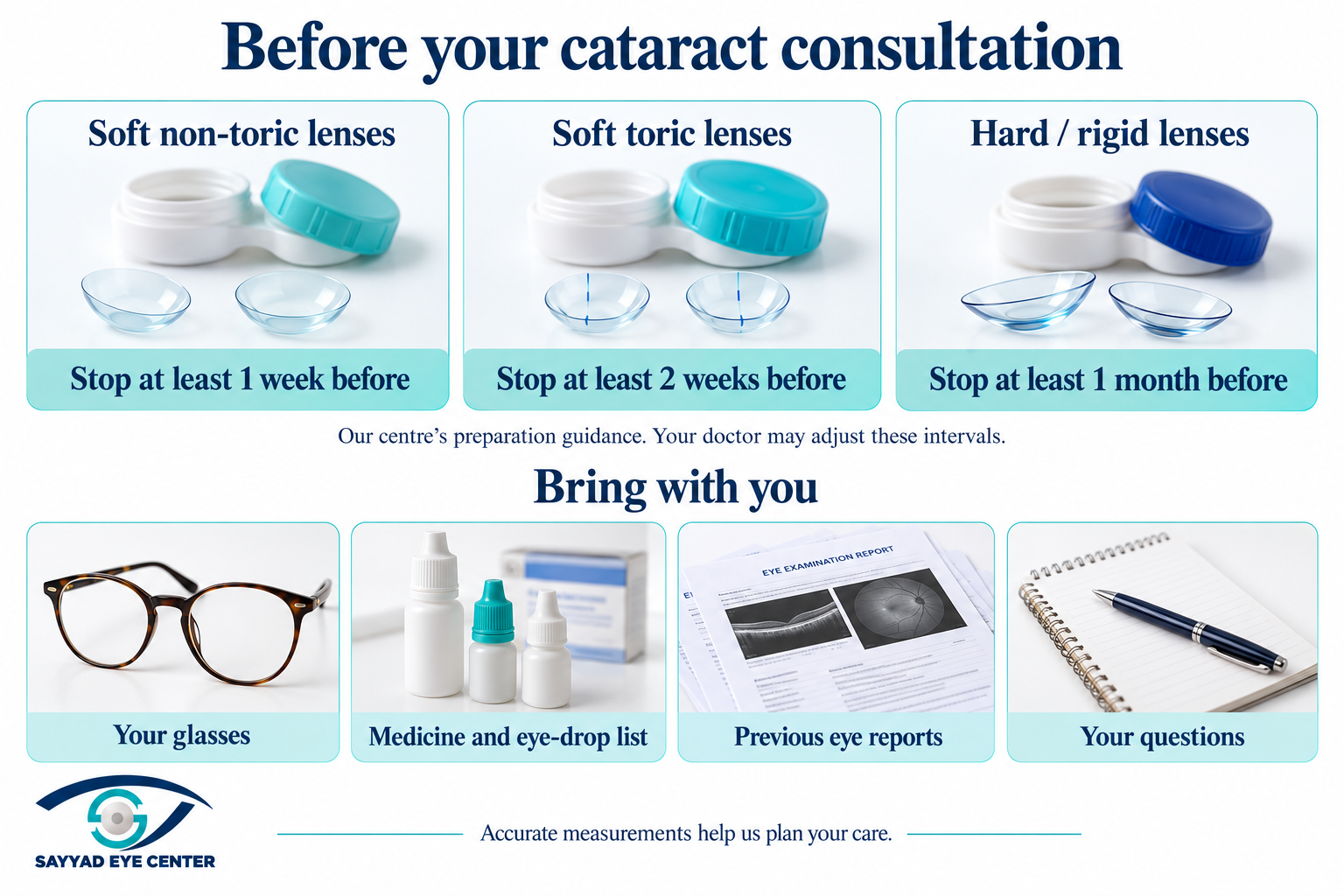
Contact lenses can temporarily change the shape of the cornea, the clear front surface of the eye. Leaving them out helps us obtain reliable measurements. At Sayyad Eye Center, please stop wearing:
• Soft non-toric contact lenses: at least 1 week before assessment.
• Soft toric contact lenses for astigmatism: at least 2 weeks before assessment.
• Hard or rigid contact lenses: at least 1 month before assessment.
Wear glasses during this break. Tell us your lens type and when you last wore it. If you use specialty lenses, are unsure of the type, or cannot manage without them, contact us before your visit. Some eyes need longer or repeat measurements until the corneal shape is stable. These intervals refer to contact lenses worn on the eye, not implanted cataract lenses.
Bring the information that helps us plan
Bring your distance and reading glasses; a list or photographs of all medicines and eye drops; and any previous scans, prescriptions or operation reports. Records of LASIK, PRK, SMILE, corneal surgery or lens implantation are particularly useful because they may affect treatment planning.
Tell us about your eyes and general health
Explain when the blur began and whether glare, night driving, reading or screen work is difficult. Tell us about diabetes, glaucoma, retinal disease, dry eye, allergies and previous eye injuries or surgery. Mention blood thinners and current or past prostate medicines such as tamsulosin, even if you no longer take them.
Continue your prescribed medicines and eye drops unless your treating team tells you otherwise. Do not stop treatment simply because you have an eye appointment. Let us know about mobility, hearing or communication needs so we can help you during the visit.
Preparing for your visit and what to expect
Your examination and additional measurements
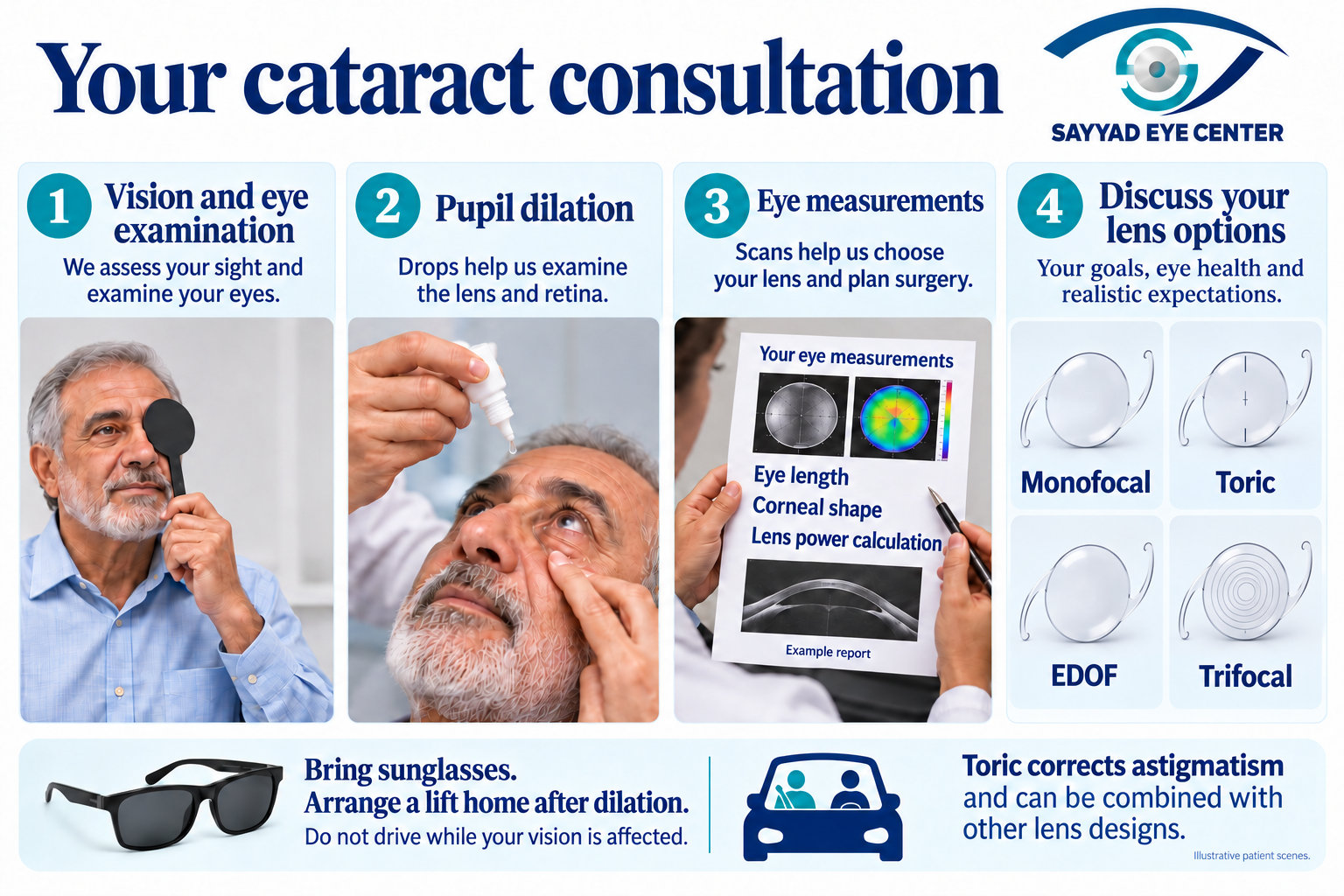
What the consultation examination includes
The consultation includes vision testing, an eye examination and pupil dilation. We assess the cataract and the other structures that affect sight, including the cornea and retina, as far as the view allows. The findings help us judge how much of your visual difficulty is due to cataract.
Additional tests depend on your eyes and treatment plan
The doctor may recommend additional measurements or imaging. These may be performed during the assessment or arranged separately. You will not necessarily need every test listed below. Biometry is needed to calculate the implant when proceeding with cataract surgery, even if it is not performed at the first consultation.
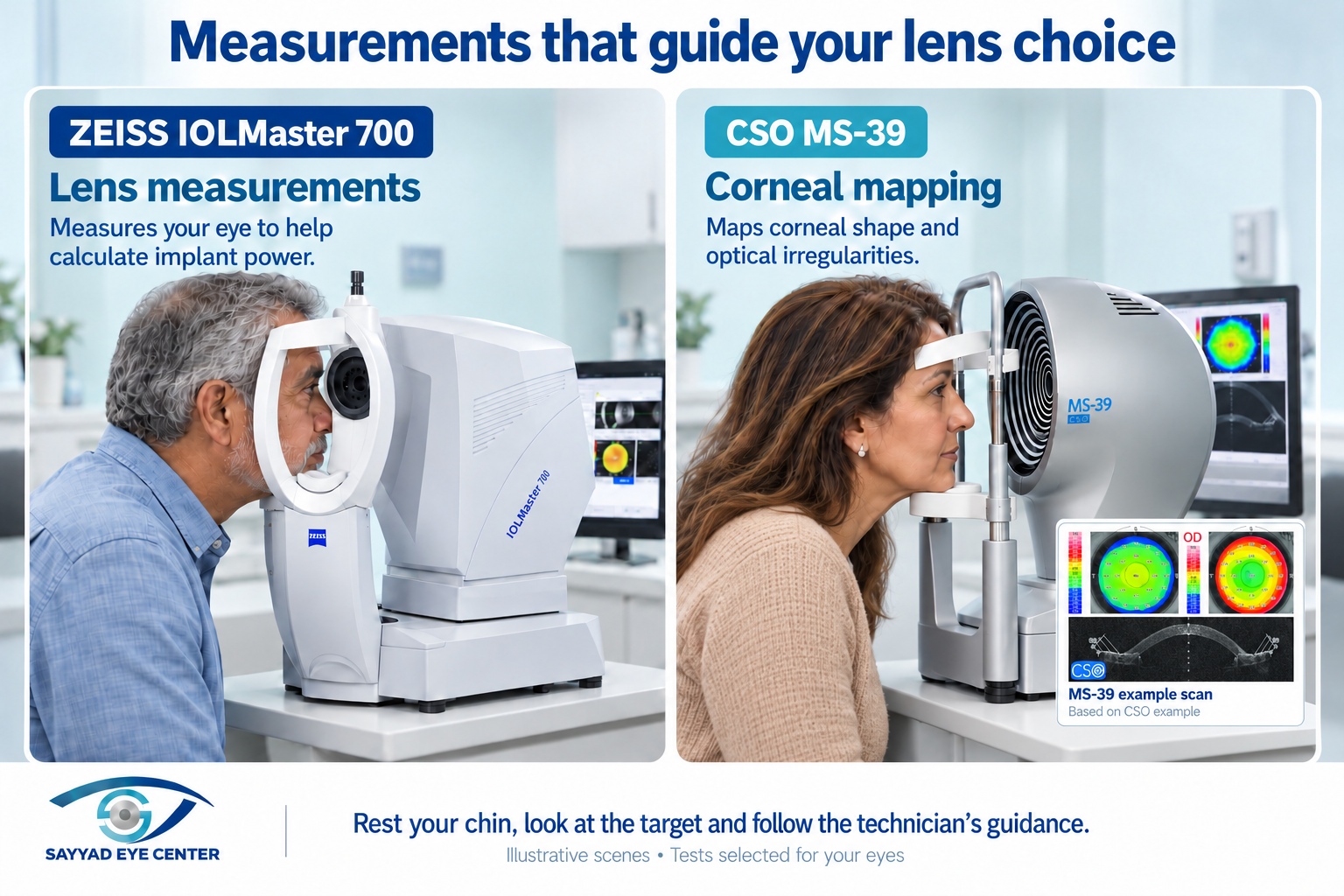
Biometry with the ZEISS IOLMaster 700
Biometry measures the eye, including its length and corneal curvature, to help calculate the power of the intraocular lens, or IOL. We use the ZEISS IOLMaster 700 for optical measurements. Accurate measurements are an important part of planning the intended focus after surgery.
Corneal topography and tomography with the MS 39
These scans map the shape, curvature and thickness of the cornea. The MS-39 also supports analysis of corneal wavefront aberrations: optical irregularities that can affect the quality of vision beyond a standard glasses prescription. This information helps assess astigmatism, previous corneal laser treatment and suitability for different lens designs.
Macular OCT
This scan shows detailed layers of the macula, the central part of the retina responsible for fine vision. At our centre, it is usually requested for patients with diabetes and those considering a premium IOL, particularly lenses designed to extend the range of focus. It helps identify swelling or other macular changes that may influence lens choice and expectations.
B scan ultrasound for a dense cataract
If a very dense cataract prevents a clear view of the back of the eye, an ultrasound scan may be needed to assess structures behind it. It can reveal problems such as retinal detachment, but cannot exclude every subtle retinal condition or guarantee the final visual result.
Corneal specular microscopy
Sometimes we examine the endothelial cells lining the inner surface of the cornea. These cells help keep the cornea clear. Measuring their density and appearance can help plan surgery when the examination suggests reduced cell reserve or an endothelial disorder.
Meet the measurement devices
Illustrated patient scenes based on manufacturer equipment references.
Lens choice questions and your journey home
Choosing a lens with realistic expectations
Your doctor will discuss your eye health, measurements and daily activities before recommending a lens. Explain how much you value reading without glasses, computer work, distance vision and night driving. Monofocal lenses provide one main focus; selected patients may consider extended-depth-of-focus or multifocal lenses to reduce dependence on glasses across more distances.
Toric lenses correct astigmatism and can be combined with different focusing designs. No lens guarantees freedom from glasses for every task. Your doctor will explain relevant compromises, including glare or halos with some designs, and how corneal, retinal or other eye conditions may affect the result. There is time to ask questions and consider the recommendation.
Getting home after dilation
Dilation can temporarily blur vision, particularly for reading, and increase sensitivity to light. Bring sunglasses and arrange for someone to accompany you or take you home. Do not drive while your vision remains affected; the duration varies between people.
Questions patients often ask
Will I need every scan? No. Your examination and proposed treatment determine which additional tests are useful.
Can I choose my lens before the visit? You can tell us your preferences, but a recommendation follows examination and measurements.
Why might measurements be repeated? Contact-lens effects, an unstable tear film or inconsistent readings may require treatment or time before repeating them.
Does a consultation commit me to surgery? No. We will explain whether surgery is appropriate and discuss your options.
Your appointment checklist
• Follow the contact-lens break for your lens type.
• Bring glasses, medicine and drop details, and previous eye records.
• Write down your visual priorities and questions.
• Bring sunglasses and arrange transport after dilation.
• Ask which tests are recommended and what each will help decide.
For a cataract consultation at Sayyad Eye Center in Mohandeseen or New Cairo, contact the team on +20 100 008 8168. If you live abroad, share available records before travelling and allow flexibility if further measurements are needed.
Medical reviewer: Dr Fouad El Sayyad, Consultant Cornea, Cataract and Refractive Surgeon; American Board Certified in Ophthalmology; fellowship in Cornea, External Eye Disease and Refractive Surgery, Washington University in St. Louis, USA.