Before Your Cataract Surgery
Prepare for cataract surgery with guidance on tests, medicines, fasting, anaesthesia, surgery day and follow-up from Sayyad Eye Center.

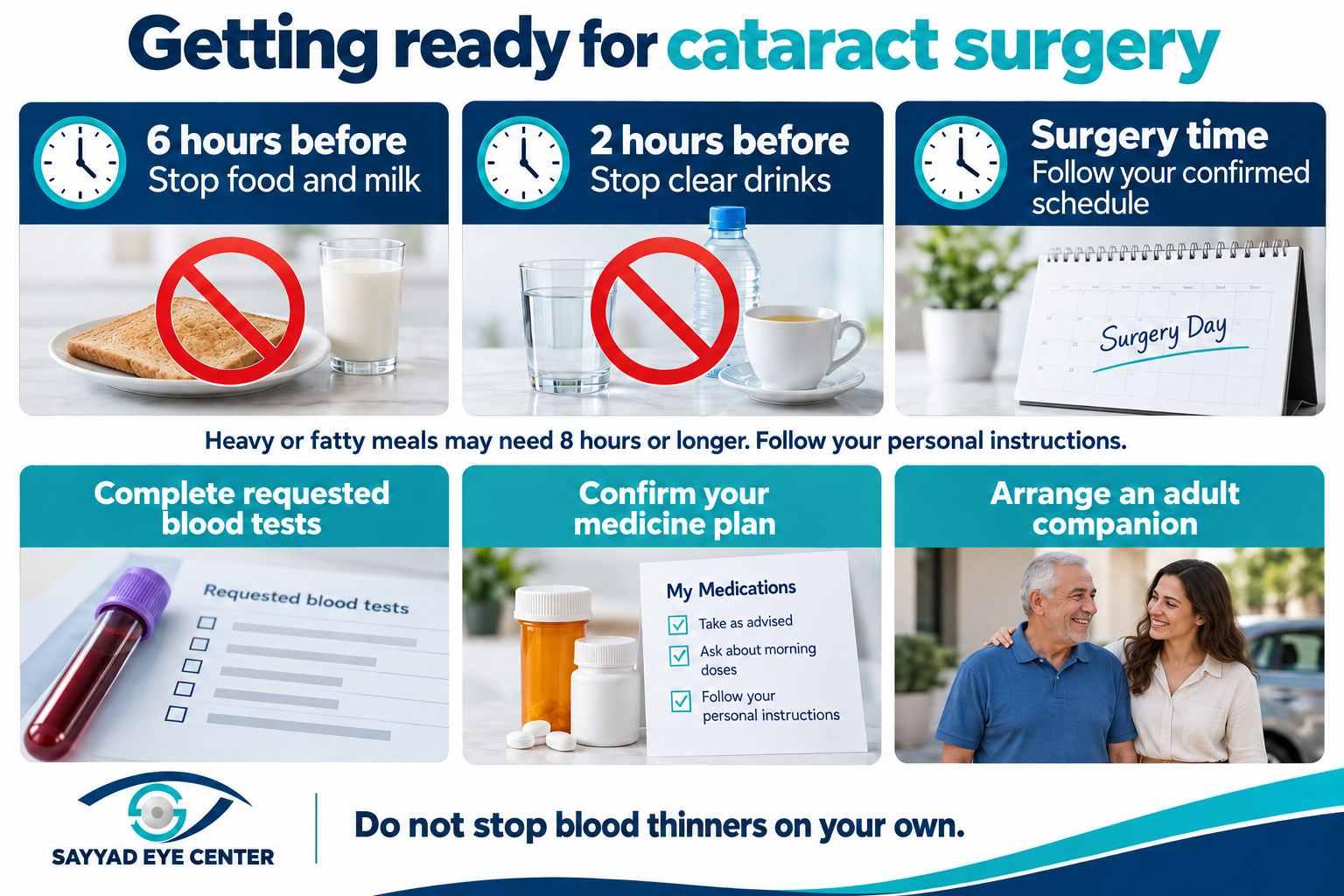
Preparing for surgery at Sayyad Eye Center
Once your cataract surgery has been arranged, a clear plan helps you arrive prepared and feel more at ease. This guide explains your tests, medicines, fasting, anaesthesia and the day itself. Keep your personal instructions with this guide; the team may adjust them for your health or planned procedure.
What the operation involves
The cloudy natural lens is removed through a small opening and replaced with an intraocular lens, or IOL. The incision usually seals without stitches. Most patients go home the same day with a companion. A straightforward operation often takes about 15–20 minutes; allow around 2–3 hours at the centre for preparation and recovery, sometimes longer.
Confirm your plan before surgery
Make sure you know which eye is being treated, the agreed lens and intended focus, your arrival time and the surgical location. Your doctor will explain expected benefits, the possibility of needing glasses and the risks relevant to your eye. Cataract surgery generally offers good results, but like any operation it carries risks, including uncommon serious complications. Ask any remaining questions before signing consent.
Blood tests and medical review
At Sayyad Eye Center, routine blood tests are ordered in most cases as part of our preoperative preparation. The team will tell you which tests to arrange, when to have them and how to send the results. Additional investigations or a physician’s assessment depend on your health, medicines and anaesthesia plan. Bring any requested results; do not arrange extra tests on your own.
Tell us before the day
Report a new cold, persistent cough, fever, eye redness or discharge, or any change in your health. Tell us about allergies, diabetes, heart or lung disease, sleep apnoea and difficulty lying flat or keeping still. Mention all medicines, supplements and current or previous tamsulosin or other prostate treatment. Do not stop prostate treatment yourself. If you live abroad, send requested results before travelling and confirm your follow-up arrangements.
Medicines and fasting
Do not change treatment on your own
Send a complete medicine and eye-drop list in advance. Most regular medicines can continue, but some need a specific plan. Confirm which morning tablets to take with a small sip of water. Continue glaucoma drops unless your surgeon advises otherwise. If preoperative drops are prescribed, use only that schedule; do not start leftover antibiotic or steroid drops.
Blood thinners
Do not stop aspirin, clopidogrel, ticagrelor, warfarin, apixaban, rivaroxaban or other blood thinners yourself. Many patients having routine cataract surgery continue them. The decision depends on your medicine, why you take it, the type of anaesthesia and whether another procedure is planned. If a change is needed, we coordinate it with the prescribing doctor. Tell us especially about a recent stent, stroke, blood clot or mechanical heart valve.
If you take warfarin
Our usual preparation includes an INR blood test 1–2 days before surgery. Bring the result; it should be within the therapeutic range set by your treating doctor. Contact the team if it is outside that range. Do not adjust the dose yourself.
Diabetes and weight-loss medicines
Arrange a written plan for insulin and diabetes tablets before fasting. Some medicines need changes several days ahead, not just on surgery morning. Tell us if you use an SGLT2 medicine such as empagliflozin or dapagliflozin, or a GLP-1 medicine such as semaglutide or tirzepatide. The team will confirm any pause, dose adjustment or extra dietary instructions. Bring your glucose monitor and treatment for low glucose. If you develop low-glucose symptoms while fasting, treat the low glucose according to your usual plan and contact us immediately; do not ignore it to preserve the fast.
Fasting before surgery
Our standard fasting instructions
Stop food and milk at least 6 hours before your scheduled surgery. Clear drinks may be taken until 2 hours before surgery, then stop drinking unless the team gives a specific instruction. Clear drinks include water, pulp-free clear juice, and plain tea or coffee without milk. Milk, milky drinks and smoothies are not clear liquids. A fatty or heavy meal may require at least 8 hours, and some conditions require a different plan. Confirm the actual clock times with us; arrival time is not necessarily surgery time.
If you accidentally eat or drink
Tell the team what you had and when. We may need to change the timing. Do not conceal it, and do not extend fasting unnecessarily if the schedule changes; ask us what to do.
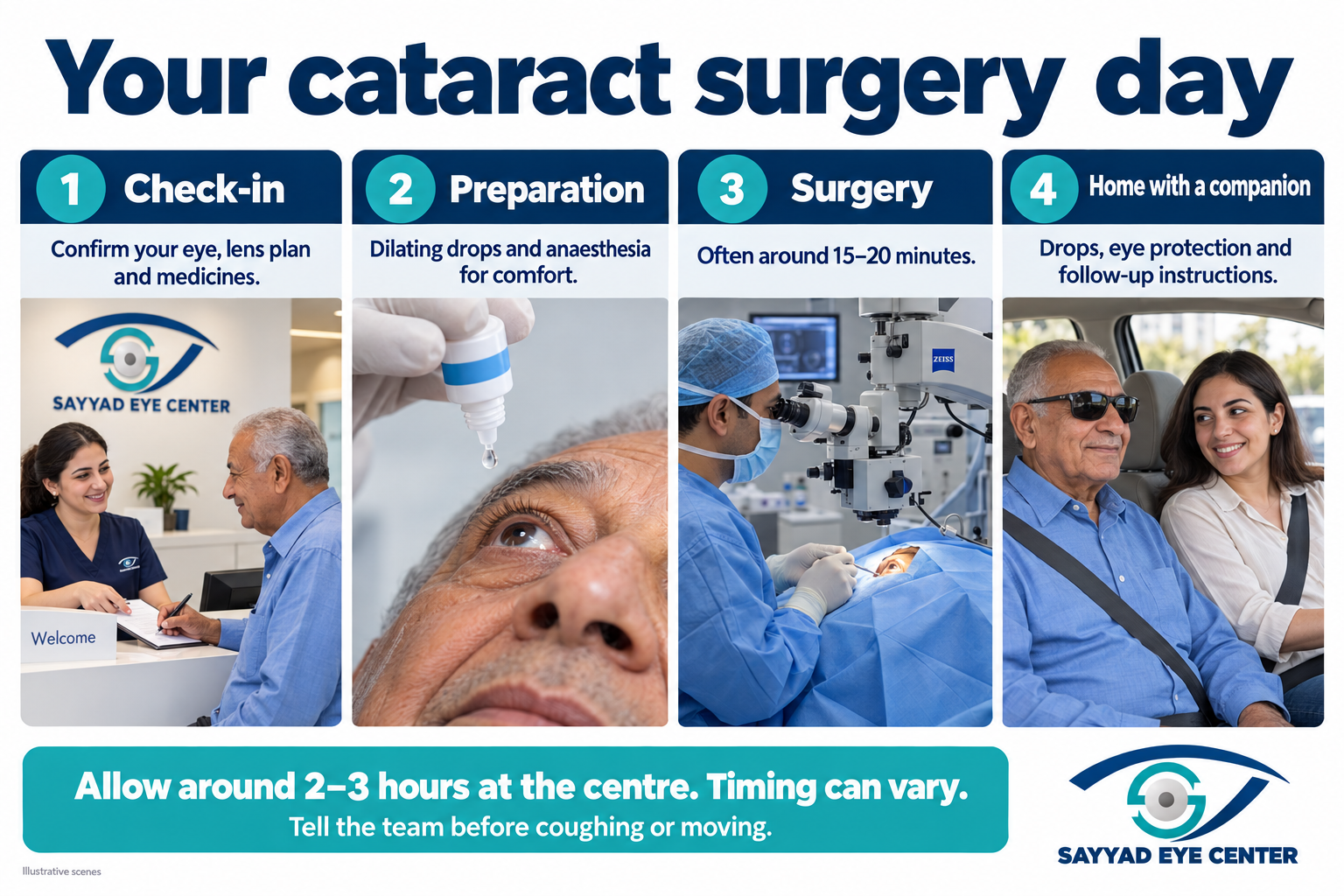
Anaesthesia and your surgery day
Numbing drops or local anaesthesia around the eye
Both approaches are designed to keep you comfortable. With topical anaesthesia, numbing drops are used; additional anaesthetic may be given inside the eye. You may notice light, gentle pressure or cool fluid, and you need to follow instructions and keep your head still. A local anaesthetic around the eye can provide deeper numbness and reduce eye movement. A temporary red patch or bruise can occur. A pad or shield may be used afterward, depending on the technique and your surgeon’s plan.
Will I be awake
Most patients are awake. Sedation may be offered when appropriate to help with anxiety; it is not the same as general anaesthesia. General anaesthesia is reserved for selected circumstances. We choose the approach with you according to your eye, health and ability to cooperate. If you feel pain or distress, tell us immediately so we can respond.
The night before and the morning of surgery
Wash your face and hair, remove makeup and get a normal night’s rest. On surgery morning, avoid eye makeup, face cream around the eyes and jewellery. Wear comfortable loose clothing, preferably a front-opening top. Follow your fasting and medicine plan and arrive at the time given. Arrange an adult companion to take you home.
What to bring
Bring your ID or passport, medicine and drop list, requested blood-test results, INR if applicable, glasses and sunglasses. Bring any prescribed drops and your diabetes supplies if needed. A snack for after surgery can be useful once the team says you may eat. Keep the centre’s contact number and your companion’s details available.
What happens at the centre
1. Check-in: we confirm your identity, operated eye, consent, lens plan and medicines.
2. Preparation: the pupil is dilated and the eye is cleaned. Dilation commonly takes about 30–45 minutes, but timing varies.
3. Anaesthesia and surgery: the eye is numbed and covered with a sterile drape. You may notice lights, colours and movement and hear the team talking.
4. Recovery: after a short rest, we check that you are ready to leave and explain your drops, eye protection and follow-up. Tell the surgeon before coughing or moving so the team can pause safely.
Going home and knowing when to call
Before you leave
Make sure you and your companion understand when to start each drop, when to remove any pad, how to use the shield and when your first review will take place. Get the postoperative contact route before leaving. Do not drive home. If you had sedation, follow the discharge restrictions, including arrangements for supervision and avoiding driving, alcohol and important decisions for the period advised.
The first days
Vision may be blurred at first, with mild grittiness, watering or light sensitivity. Many patients notice improvement within days, but recovery varies and vision can take several weeks to settle. Use your prescribed drops, wash your hands before applying them and avoid touching the bottle tip to the eye. Do not rub or press the eye. Use the shield as directed and keep soap and dirty water out of the eye. Ask when you may resume exercise, swimming, lifting, makeup and driving.
Contact us urgently
Seek urgent eye assessment for severe or increasing pain, a sudden or worsening loss of vision, increasing redness with pain or reduced sight, or sticky discharge. New flashes, a sudden shower of floaters or a curtain or shadow in your vision also need urgent assessment. Severe headache or nausea with eye pain should be checked promptly. Do not wait for the next routine appointment. If you cannot reach the team, attend the nearest emergency eye service.
Your questions and final checklist
Questions patients often ask
Will I need glasses? This depends on your lens, target focus and eye health. Toric lenses correct astigmatism; EDOF and trifocal designs can extend the range of focus in suitable eyes. No lens guarantees complete freedom from glasses.
When is the second eye treated? It is usually on a separate date, often 1–2 weeks later in our usual pathway, depending on recovery and the plan agreed with you.
Can the cataract return? The removed lens cannot become cloudy again. The capsule behind the implant may later become cloudy; if it affects vision, the doctor may recommend a YAG laser treatment after assessment.
Can I travel home immediately? If you live abroad, agree your review schedule and travel plans before booking the return journey.
Your final checklist
Confirm the eye, lens plan, surgical location and arrival time. Complete requested blood tests. Keep your fasting and medicine instructions ready. Bring an adult companion. Leave with a written drop schedule, follow-up appointment and contact instructions.
Contact and medical review
For preparation questions, call or WhatsApp Sayyad Eye Center on +20 100 008 8168. Clinics: Mohandeseen and New Cairo. Confirm the location for your operation with the team.
Medical reviewer: Dr Fouad El Sayyad, Consultant Cornea, Cataract and Refractive Surgeon; American Board Certified in Ophthalmology; fellowship in Cornea, External Eye Disease and Refractive Surgery, Washington University in St. Louis, USA.