Choosing a Lens for Cataract Surgery
Compare monofocal, toric, EDOF and trifocal cataract lenses. Understand reading, screen use and night-driving trade-offs with Dr Fouad El Sayyad in Cairo.
Cataract surgery replaces the cloudy natural lens with a clear artificial lens, called an intraocular lens or IOL. It can improve clarity and make everyday activities easier. Choosing the implant also gives you an opportunity to plan how you want to see after surgery: at a distance, on a computer and up close. The best lens matches your eye health and daily priorities; it is not automatically the most expensive one.
Start with what you want to do comfortably
Tell your doctor which matters most: driving, reading a book, using your phone, working on a screen or reducing the need to carry glasses. Mention frequent night driving and whether wearing reading glasses would bother you. These preferences help define a realistic target for each eye.
The main lens options at a glance
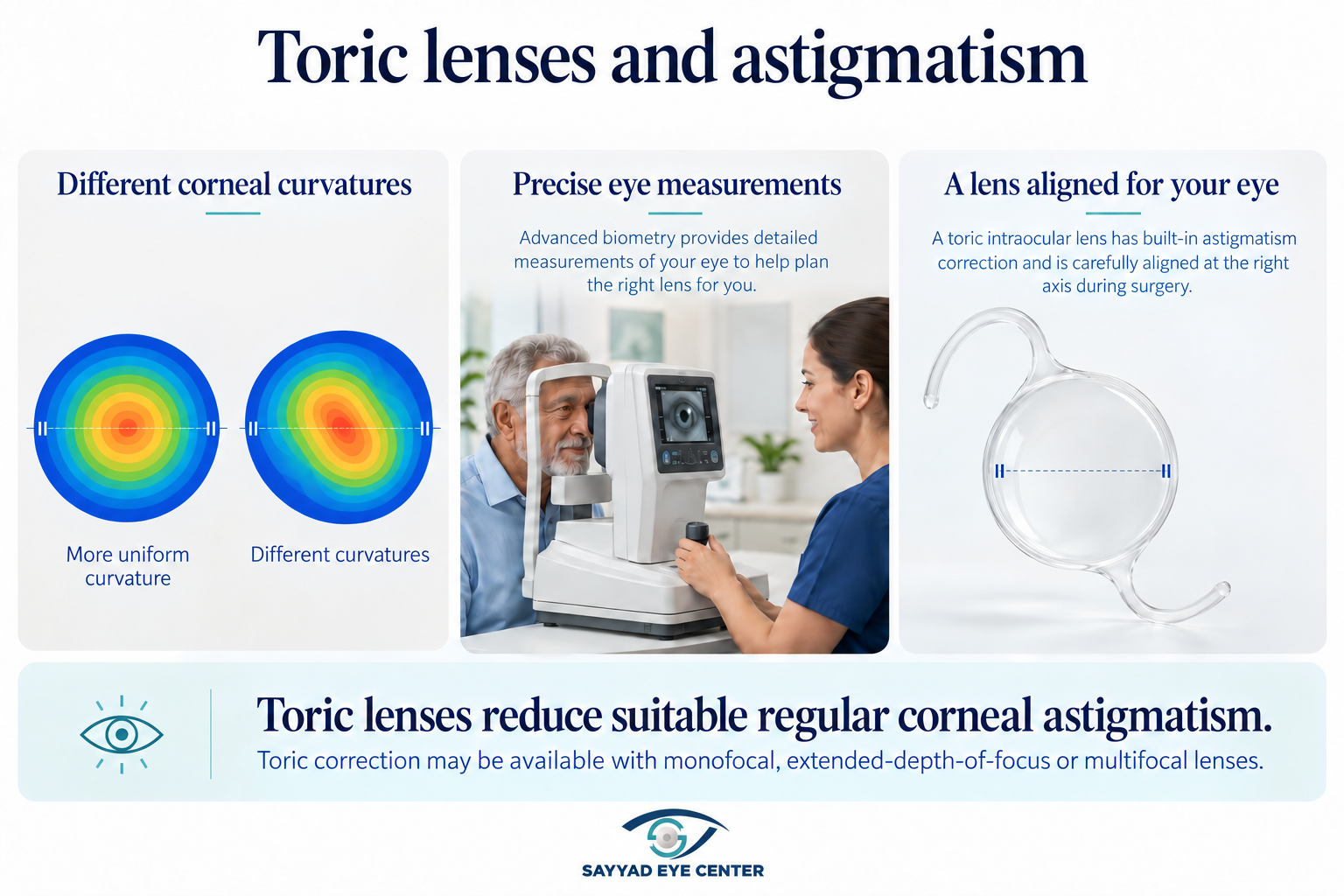
Monofocal
Main benefit: Clear vision at one main chosen distance.
What to expect: Usually reading glasses if targeted for distance.
Enhanced monofocal
Main benefit: May add some useful intermediate vision to a monofocal design.
What to expect: Reading glasses usually remain necessary; results vary by model.
EDOF
Main benefit: A broader useful range, especially distance and intermediate.
What to expect: Fine print often needs glasses; near vision varies by design.
Multifocal or trifocal
Main benefit: More than one focus; trifocals cover distance, intermediate and near.
What to expect: Greater opportunity to reduce glasses use, with possible halos and glare.
Toric feature
Main benefit: Corrects suitable regular corneal astigmatism.
What to expect: Can be combined with monofocal, EDOF or multifocal designs.
These are broad categories, not promises for an individual eye. The exact model, measurements, treatment target and health of the retina and cornea all affect the result.
Monofocal lenses
A monofocal lens can provide excellent visual quality at its chosen focus. Distance is a common target, with glasses for reading and sometimes computer work. A near target is also possible for selected patients who prefer to read without glasses and accept distance glasses. Monofocal does not mean low quality; it may be the strongest match for someone who values optical simplicity or has other eye conditions.
Enhanced monofocal lenses
Some designs extend useful vision toward arm’s length while keeping a monofocal approach. This may help with a dashboard or screen, but does not make the lens equivalent to a trifocal. Ask what the proposed model is expected to achieve at your usual working distance.
Matching the lens to your eyes and lifestyle
EDOF lenses for distance and intermediate tasks
Extended depth of focus lenses aim to broaden the range of useful focus. They may suit patients who value distance and computer vision and are comfortable using glasses for small print. EDOF designs differ: neither near vision nor the likelihood of halos can be predicted from the category name alone. Discuss the particular model, especially if night driving is important.
Multifocal and trifocal lenses for a wider range
These lenses provide more than one focus. Trifocal lenses aim to support distance, intermediate and near vision, helping suitable patients rely less on glasses for everyday tasks. They require careful selection. Halos around lights, glare or reduced contrast can be noticeable, especially in dim light; adaptation varies. Good lighting or glasses may still help with prolonged reading or fine print.
Toric lenses for astigmatism
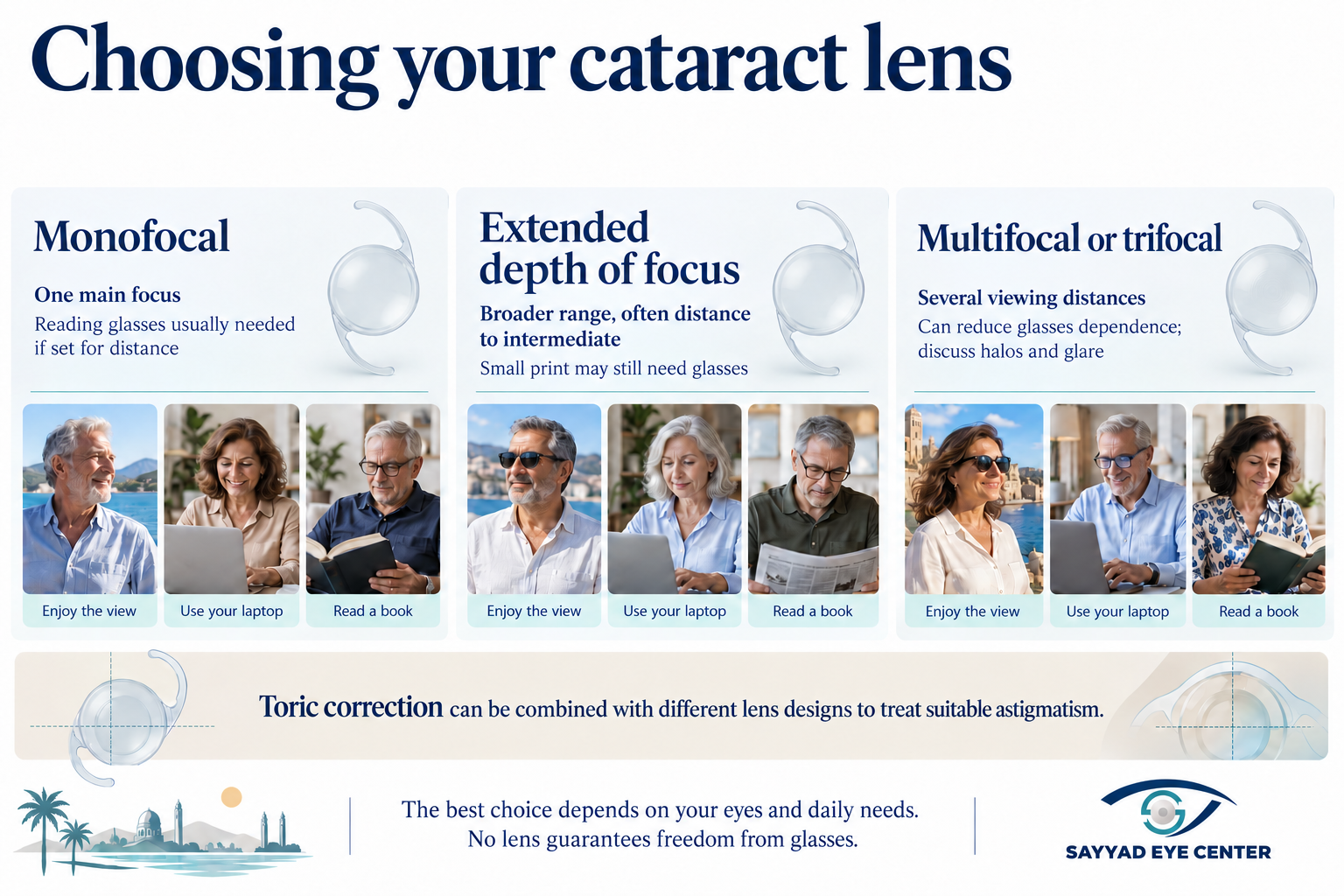
Regular corneal astigmatism means the cornea focuses light differently in different directions. A toric IOL can reduce this blur at the time of cataract surgery. “Toric” describes astigmatism correction, not the number of focal distances: monofocal toric, EDOF toric and trifocal toric options exist. Accurate corneal measurements and alignment of the implant are important; irregular astigmatism needs a more individual plan.
Mini monovision as another strategy
In selected patients, one eye is targeted mainly for distance and the other slightly nearer. This is a focusing strategy, not a separate lens material, and may reduce glasses use. It does not suit everyone: the balance between the eyes, depth perception and fine-detail needs must be discussed. A contact-lens simulation may be useful when practical, although cataract can limit the trial.
What Dr Fouad assesses before recommending a lens
At Sayyad Eye Center, Dr Fouad El Sayyad considers your visual priorities alongside measurements and a full eye examination. Planning includes lens-power calculation, corneal shape and astigmatism, the tear film, and the retina and optic nerve. Corneal mapping or a macular OCT scan may be needed to clarify suitability.
Dry eye may need treatment before final measurements. Previous LASIK, PRK or other eye surgery can change lens calculations, so bring earlier records if available. Macular disease, glaucoma, corneal irregularity or other conditions may limit the benefit of some advanced lenses. Diabetes alone does not decide the choice; the condition of the retina and the rest of the eye matters.
A clear recommendation without pressure
You should leave knowing the proposed lens model, target for each eye, expected glasses use and the reasons for the recommendation. Premium cataract care includes accurate assessment, thoughtful planning, careful surgery and follow-up—not just a particular implant. Honest advice may favour a monofocal lens even when more expensive options are available.
Frequently asked questions about cataract lenses
Which cataract lens is best
There is no single best lens for every patient. The strongest choice balances the vision you want with the eye’s measurements and health. Ask why the recommended option suits you and what the alternatives would change.
Will I be completely free of glasses
A suitable advanced lens can substantially reduce glasses use, but no lens guarantees freedom from glasses for every task. Small print, low light or a remaining prescription may still call for glasses.
Is EDOF better than trifocal
They serve different priorities. EDOF often emphasises distance and intermediate vision; trifocal designs aim to add stronger near function. Compare the actual models and their optical trade-offs, not just their labels.
Which lens should I consider if I drive at night
Tell your surgeon how often and under what conditions you drive. Monofocal designs are often considered when avoiding additional halos and preserving contrast are priorities. Some EDOF designs may be suitable, but no lens is guaranteed to eliminate glare.
Does astigmatism mean I need a multifocal lens
No. Astigmatism correction and the range of focus are separate decisions. A toric monofocal lens may meet your needs, while some patients benefit from a toric EDOF or trifocal design.
Can I choose an advanced lens after LASIK or with diabetes
Possibly, after careful assessment. Previous laser treatment affects calculation and corneal optics. With diabetes, retinal health and stability are particularly important. Your examination determines which options offer a useful benefit.
Must both eyes receive the same lens
Not always. The plan considers how the two eyes will work together, existing surgery and each eye’s health. Different targets or designs can be considered selectively, with the expected balance explained beforehand.
Can I change the lens later
The implant is intended to stay long term. Exchange is possible in selected circumstances, but it is another operation, so the initial choice deserves care. Persistent blur or halos should be assessed for their cause rather than assuming the lens must be changed.
What should the price quotation include
Ask for the exact lens model, whether the quote is per eye, and what it includes: measurements, surgery, facility fees, medicines and follow-up. Ask how additional treatment would be handled. Price alone does not establish suitability.
Can I arrange surgery while visiting Egypt
Start with an assessment plan and send previous records if available. Allow time for measurements, lens availability, surgery and follow-up. Agree the second-eye plan, return travel and care abroad with your surgeon before fixing the itinerary.
Discuss your cataract lens options in Cairo
Book an assessment with Dr Fouad El Sayyad at Sayyad Eye Center. Bring your glasses, medicines list and eye records. The team will confirm appointment access in New Cairo or Mohandeseen and the surgical location.
Medical review: Dr Fouad El Sayyad, Consultant Cornea, Cataract and Refractive Surgeon; American Board Certified in Ophthalmology; Fellowship in Cornea, External Eye Disease and Refractive Surgery, Washington University in St. Louis, USA.
Like any surgery, cataract surgery has risks. Serious complications are uncommon; discuss your individual risks with your surgeon. Sources are listed at the end.
References
American Academy of Ophthalmology patient information and clinical publications. These sources support the discussion; they do not endorse a specific implant or the center. Keep sources at the end of each published language version, without inline reference numbers.
Factors to consider when choosing an IOL https://www.aao.org/eye-health/tips-prevention/best-artificial-lens-implant-iol-cataract-surgery
Enhanced lens options for cataract surgery https://store.aao.org/enhanced-lens-options-for-cataract-surgery-booklet.html
Cataract in the Adult Eye Preferred Practice Pattern https://www.aaojournal.org/article/S0161-6420%2821%2900750-8/fulltext
Matching the Patient to the Intraocular Lens https://www.aaojournal.org/article/S0161-6420%2820%2930843-5/fulltext
Multifocal and Extended Depth of Focus Intraocular Lenses in 2020 https://www.aaojournal.org/article/S0161-6420%2820%2930931-3/fulltext
Cataract surgery recovery and daily activities https://www.aao.org/eye-health/tips-prevention/safe-exercise-driving-cataract-surgery-recovery
Prepared on 5 October 2026. Record the actual medical approval and publication dates when completed.
Questions to bring to your consultation
• Which lens and target would you recommend for each eye, and why?
• What should I expect for my phone, computer, reading and night driving?
• Is astigmatism correction needed, and is my eye suitable for it?
• For which activities might glasses still help?
• Do my cornea, retina, glaucoma or earlier surgery change the recommendation?
• What is included in the quotation and follow-up plan?