Did my cataract come back
Cataracts do not grow back after removal. Learn about posterior capsule opacification, when YAG laser can help and what to expect at Sayyad Eye Center.

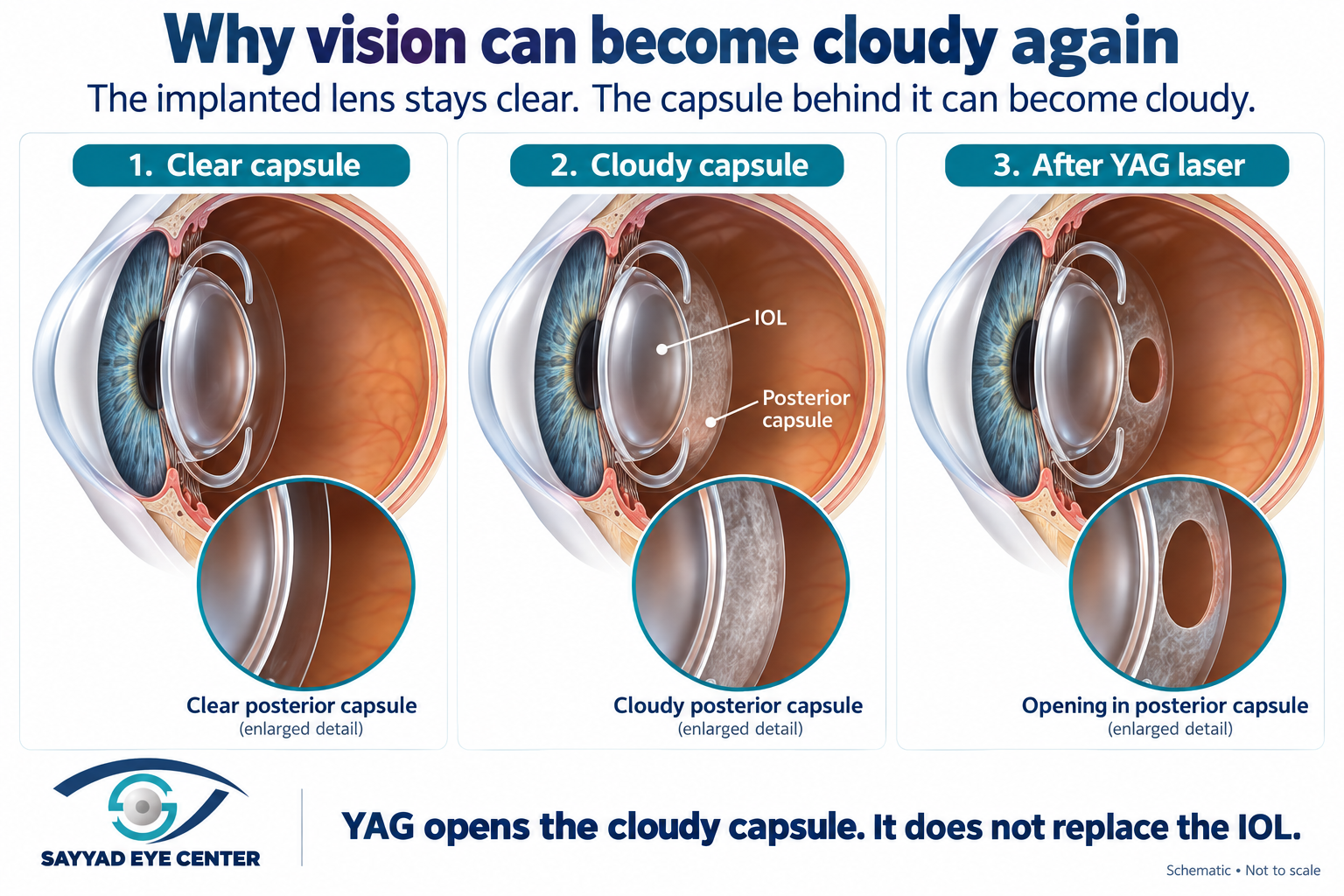
If your vision became clearer after cataract surgery but later turned cloudy again, you may wonder whether the cataract has returned. The original cataract cannot grow back. However, the thin capsule behind your artificial lens can become cloudy. This is called posterior capsule opacification, or PCO, sometimes described as a secondary cataract.
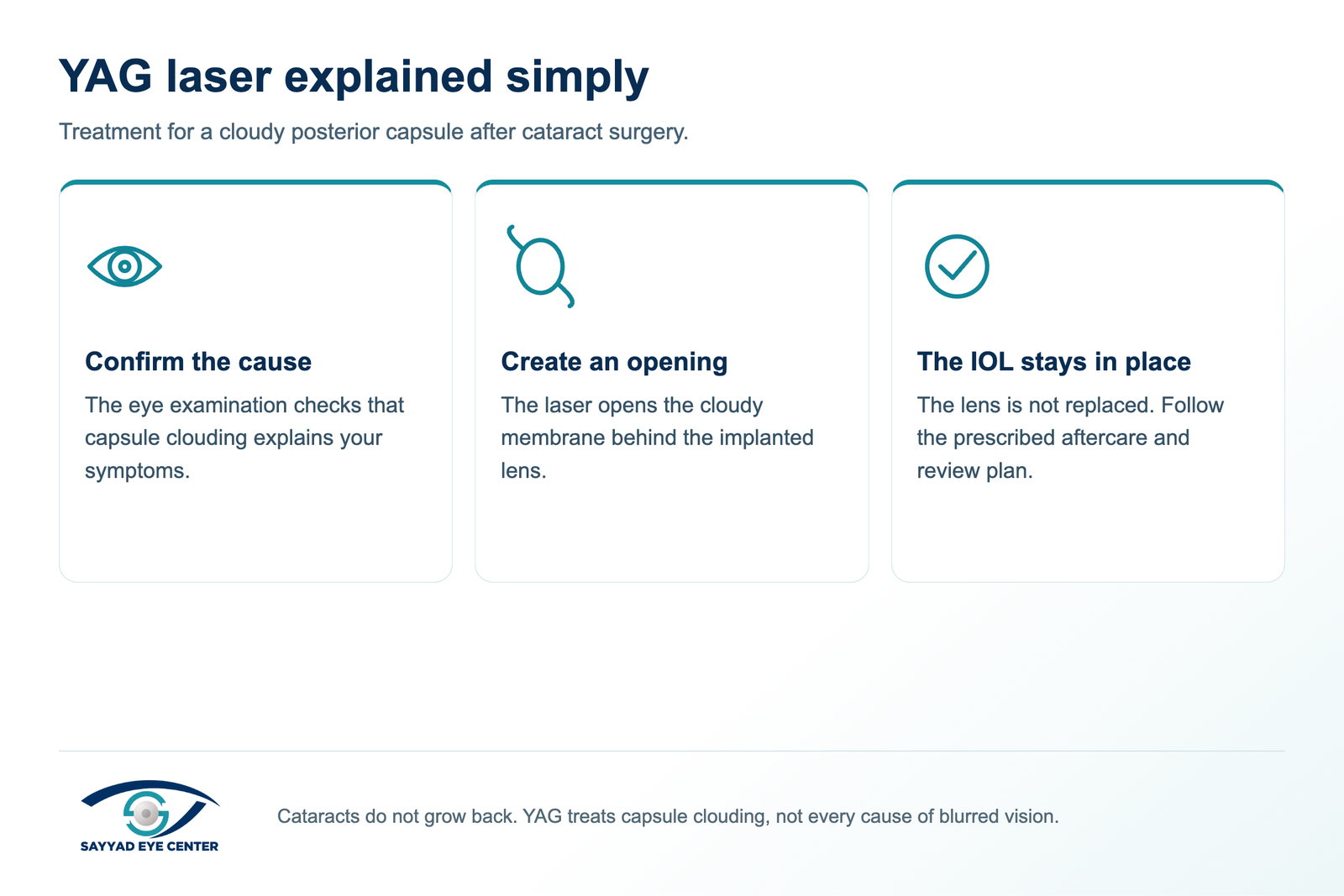
When this clouding affects vision, a short outpatient procedure called YAG laser capsulotomy can often improve clarity without another cataract operation. An examination first confirms that the capsule is responsible.
The lens and its capsule are different
During cataract surgery, the cloudy natural lens is removed. Much of its thin outer capsule is usually kept to support the replacement intraocular lens. Think of the artificial lens as a clear window and the posterior capsule as a transparent layer behind it. If that layer becomes cloudy, light is scattered even though the implant itself may still be clear.
PCO results from changes in remaining lens cells on the capsule. It is not a sign of poor hygiene, and it does not automatically mean that surgery was performed incorrectly.
How posterior capsule opacification can feel
You may notice gradual haze, increased glare, reduced contrast or difficulty reading after a period of clearer vision. Bright lights may seem more troublesome. PCO can appear months or years after surgery, and sometimes earlier. Symptoms and timing vary; a diagnosis cannot be made simply because vision became blurred after a cataract operation.
Why we examine the eye before recommending laser
The doctor checks vision, the glasses prescription when useful, the artificial lens, capsule and retina. Eye pressure and the ocular surface also matter. A macular OCT scan may be appropriate if symptoms suggest retinal swelling or another macular problem.
Dry eye, residual astigmatism, retinal disease and lens related light effects may resemble PCO. A small amount of capsule clouding that does not explain your symptoms may not need treatment. If you are considering an intraocular lens exchange, discuss this before YAG because opening the capsule can make a later exchange more complex.
When YAG laser is worthwhile
YAG posterior capsulotomy is usually considered when capsule clouding reduces useful vision, causes significant glare or prevents an adequate view of the back of the eye. If vision and daily activities are satisfactory, observation may be reasonable. No eye drop or exercise has been shown to clear established PCO in place of the laser opening.
The expected improvement depends on the rest of the eye. Treatment cannot restore vision lost to unrelated retinal or optic nerve disease, and it does not automatically remove the need for glasses.
What happens during the appointment
Bring your cataract surgery and lens details, current drops and any history of glaucoma or retinal problems. The eye may be dilated and is numbed with drops. You sit at a laser instrument similar to a slit lamp, and the doctor may place a special contact lens on the eye to focus treatment. Brief laser pulses make an opening in the cloudy posterior capsule.
The implant is normally left in place; this is not a repeat cataract operation. The laser part often takes only a few minutes, but assessment, dilation and pressure checks can make the visit longer. Arrange transport because dilation and temporary blur can affect driving.
Recovery and everyday activities
Some patients notice clearer vision soon after treatment. For others, clarity improves over the following days as dilation wears off and temporary effects settle. The amount of improvement depends on whether PCO was the main cause and on the health of the rest of the eye.
Most patients return to ordinary daily activities quickly. Routine YAG generally does not require the same recovery restrictions as cataract surgery. Use any prescribed drops according to your written instructions and attend the planned follow up. Some patients need treatment or checks for eye pressure, particularly if they have glaucoma.
Resume driving once dilation has worn off, your vision is clear and comfortable, and you meet the applicable vision requirements. Follow any specific restrictions given for your eye.
Benefits and risks in perspective
For appropriately selected patients, YAG is an effective and commonly used way to clear the visual pathway. Most procedures are straightforward. Temporary pressure rise or inflammation can occur; less commonly, macular swelling, damage to the lens surface or a retinal tear or detachment may occur. Your doctor considers glaucoma, high myopia and retinal history when discussing individual risk.
Seek urgent assessment for a sudden shower of floaters, flashes, a curtain or shadow, worsening sight or significant pain. A small number of floaters may settle after treatment, but you should not try to distinguish a harmless change from a retinal problem without advice when symptoms are new or increasing.
Will it need to be repeated
The opening usually remains clear, and most adults need treatment only once in the treated area. Occasionally the opening needs enlargement or further treatment. If blur returns, arrange another examination rather than assuming that the capsule is responsible again.
Planning care if you live abroad
Send your operation and lens details when arranging a visit, but allow for an examination before committing to a treatment. Keep time for any pressure review or follow up the doctor recommends. If vision changes suddenly while you are overseas, seek care locally rather than delaying assessment until your next trip to Egypt.
Frequently asked questions
Do I need an artificial lens implanted during cataract surgery
For almost all adults, yes. A cataract is your natural lens becoming cloudy. During surgery, we remove that cloudy lens and usually replace it with a clear artificial lens called an intraocular lens, or IOL.
The IOL replaces the focusing power of your natural lens, helping focus light onto the retina so you can see clearly. It is a standard part of modern cataract surgery, rather than an optional cosmetic addition.
Different IOLs offer different focusing options. Even a standard monofocal lens performs this essential role. In uncommon situations, implantation may be delayed or another approach needed because of the condition of the eye.
Is a secondary cataract the same as the original cataract returning
No. The natural lens has been removed. The clouding affects the thin capsule behind the artificial lens.
Is YAG laser painful
Most patients tolerate it comfortably with numbing drops. You may notice bright lights or hear clicking sounds during treatment.
Does YAG clean or replace the artificial lens
No. It creates an opening in the cloudy capsule behind the lens. The IOL implanted during cataract surgery remains in place during YAG treatment.
Will I need another cataract operation
PCO is usually treated with YAG laser rather than another cataract operation.
Will I still need glasses afterward
Possibly. YAG clears the capsule but does not change your implanted lens design or automatically eliminate a remaining glasses prescription.
Can YAG treat halos or glare
It can help when capsule clouding causes these symptoms. Halos or glare caused by dry eye, the lens design or another condition may need a different approach.
Do I need treatment immediately after PCO is diagnosed
Not necessarily. The decision depends on how much it affects your vision and daily activities. Mild PCO may not need treatment.
Can I have YAG if my cataract surgery was performed elsewhere
Yes, following an examination to confirm that it is appropriate. Bring your previous reports and lens details if available.
Contact the centre
For a planned consultation or follow up, contact Sayyad Eye Center on +20 100 008 8168. Confirm whether your visit is in Mohandeseen or New Cairo. Patients living abroad should arrange follow up before travel. This routine contact route is not a substitute for emergency eye care.
Medical review
Medically reviewed by Dr Fouad El Sayyad
American Board certified ophthalmologist
Fellowship in Cornea, External Eye Disease and Refractive Surgery
Washington University in St Louis, USA
References
AAO Posterior capsulotomy patient information
https://store.aao.org/media/resources/051204/051204-posterior-capsulotomy-rf1.pdf
AAO What are cataracts
https://aao.org/eye-health/diseases/what-are-cataracts
AAO Cataract in the Adult Eye Preferred Practice Pattern
https://www.aaojournal.org/article/S0161-6420%2821%2900750-8/fulltext
AAO Choosing an intraocular lens for cataract surgery
https://aao.org/eye-health/tips-prevention/best-artificial-lens-implant-iol-cataract-surgery