Blurry vision after cataract surgery
Blurry vision after cataract surgery can have several causes. Learn what your symptoms may mean, how they are assessed and when to seek urgent eye care.

Vision often improves over the days following cataract surgery, but it may not be perfectly clear immediately. Early healing, dry eye or a remaining glasses prescription can affect clarity. Many causes are temporary or treatable.
The most useful clues are when the blur began, whether it is improving, and whether other symptoms accompany it. An examination identifies the cause and the appropriate treatment.
When blurred vision needs urgent attention
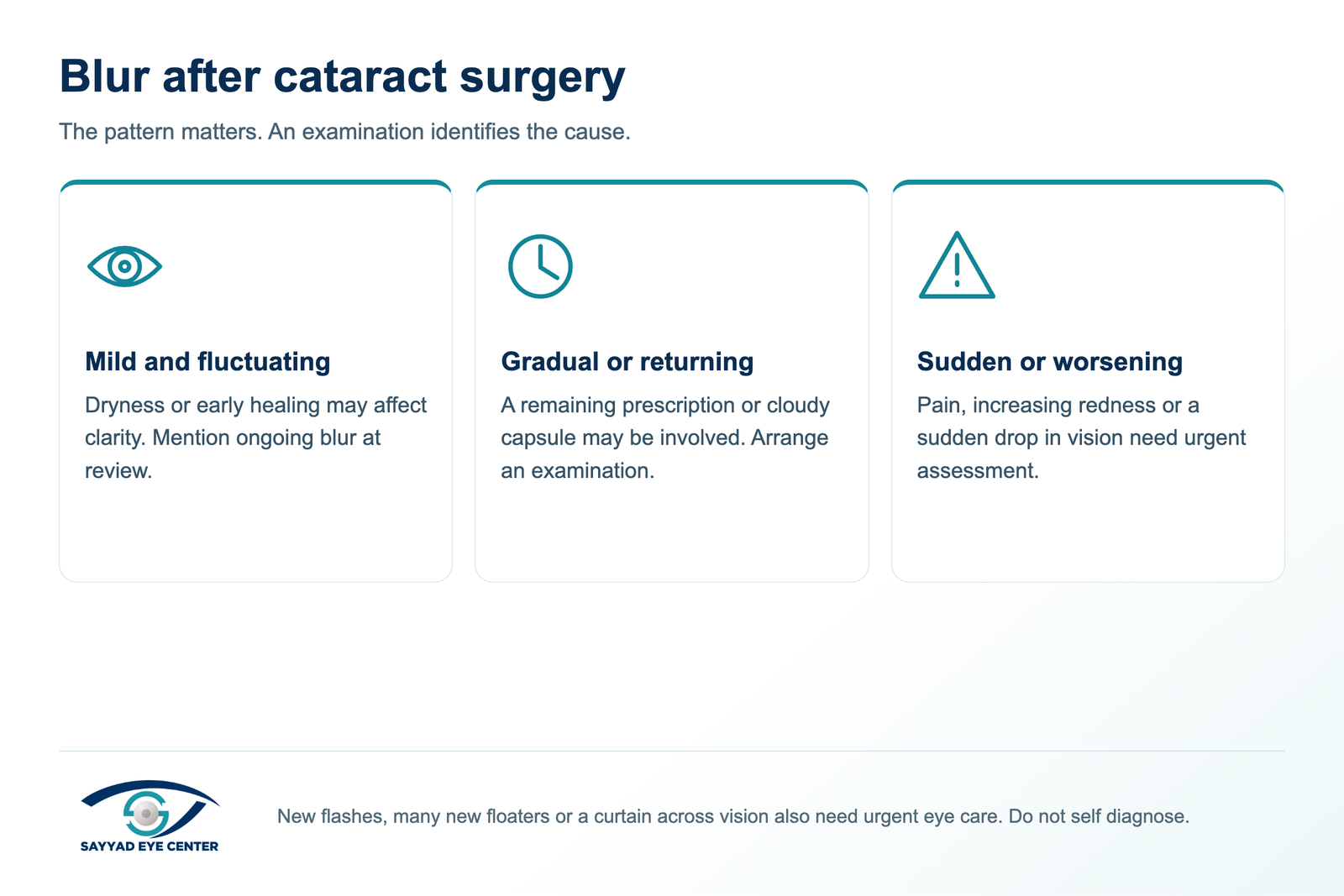
Seek urgent eye assessment if you experience a sudden or significant reduction in vision; severe or increasing eye pain; increasing redness together with reduced vision; new flashes, a sudden increase in floaters, or a curtain or shadow across your vision; or eye pain accompanied by a marked headache, nausea or vomiting.
Serious complications are uncommon, but prompt assessment matters. Do not wait for your next scheduled appointment or an online reply if these symptoms occur.
Blur during the first hours or days
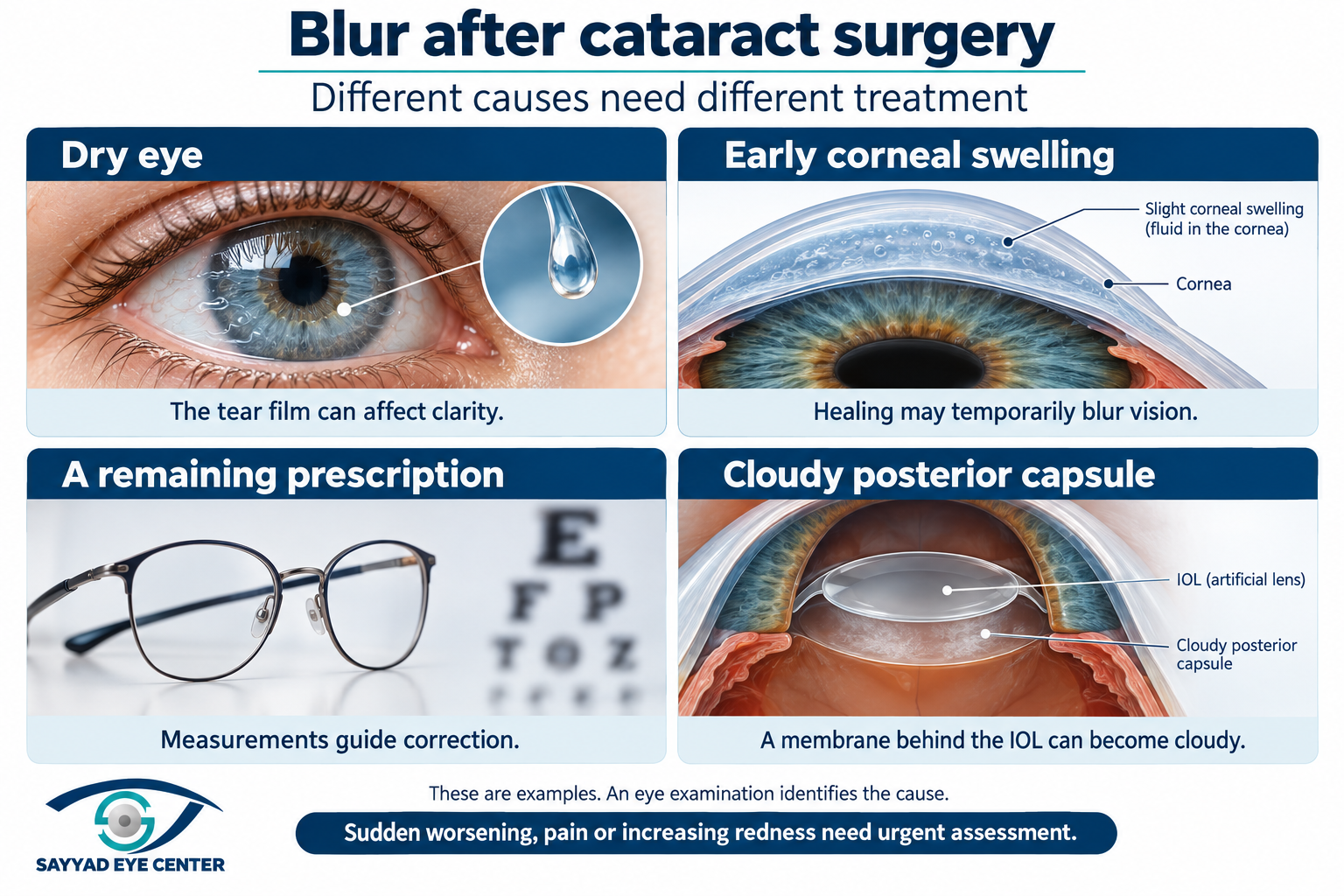
Dilating drops and temporary swelling of the cornea, the clear front surface of the eye,can make vision hazy soon after surgery.
Recovery may take longer after removal of a dense cataract or if the cornea already has an underlying condition. Mild watering, grittiness and light sensitivity may also occur.
Vision should generally move towards improvement. At postoperative checks, we assess the cornea, inflammation, eye pressure and the position of the implanted lens.
Vision that clears after blinking then becomes blurry again
This pattern can suggest an unstable tear film or dry eye. Symptoms may be more noticeable when reading, using a phone or sitting in air conditioning.
Dry eye can affect vision even without pronounced burning or discomfort. Treatment may include lubricating drops and management of the eyelids or other surface problems.
Improvement after blinking is a useful clue, but it does not establish the diagnosis by itself.
Clear distance vision but difficulty reading
Your vision after surgery depends partly on the lens selected and the focus planned before the operation.
A monofocal lens set for distance usually requires reading glasses. This can be the intended result rather than a problem with the surgery.
If one eye was deliberately focused for nearer tasks, its distance vision may be less sharp when tested alone.
EDOF lenses extend the range of focus, particularly towards intermediate distances, while trifocal lenses provide a broader range that includes near vision. Neither guarantees complete independence from glasses.
The important comparison is with your agreed visual plan, rather than expecting every lens to perform identically.
A remaining glasses prescription
Some patients have residual short sightedness, long sightedness or astigmatism after surgery. A glasses test helps establish how much this contributes to the blur.
The examination also checks the ocular surface, corneal shape and lens position. With a toric lens, its alignment may be relevant.
Depending on the findings, glasses or another treatment may improve vision. Decisions about laser enhancement or lens adjustment should follow a clear diagnosis and assessment of stability.
Vision that improves then becomes blurry again
Blur returning during the following weeks can sometimes be caused by swelling in the macula, the central area of the retina responsible for detailed vision. This is called macular oedema.
You may notice reduced central sharpness or straight lines appearing distorted. Diabetes and pre existing retinal conditions can increase the likelihood of certain macular problems.
A macular OCT scan provides detailed images of the retinal layers and can identify swelling. Treatment depends on the cause and severity; it may involve anti inflammatory drops or additional retinal treatment.
A change after initial improvement deserves assessment rather than being assumed to be normal recovery.
Cloudy vision months or years later
The original cataract cannot grow back after the natural lens has been removed.
However, the thin capsule supporting the artificial lens can become cloudy. This is called posterior capsule opacification, or PCO, sometimes referred to as a secondary cataract.
PCO can cause gradual haziness, glare or reduced contrast after an initially clear result.
If examination confirms that PCO is affecting vision, a short outpatient YAG laser capsulotomy can create an opening in the cloudy capsule. The implanted lens remains in place.
YAG treats capsule clouding; it does not treat every cause of postoperative blur.
Halos glare and dark crescents
Some patients notice optical effects called dysphotopsias. Positive dysphotopsia means halos, glare, streaks or arcs of light. Negative dysphotopsia means a dark crescent or curved shadow at the outer edge of vision.
These effects can relate to how light interacts with the implanted lens. They often become less noticeable with time, but persistent or troublesome symptoms should be discussed at follow up.
An examination helps distinguish lens related effects from other causes. A new or spreading shadow, a curtain across vision, new flashes or a sudden increase in floaters should not be assumed to be ordinary lens adaptation.
Other eye conditions can affect the final clarity
Cataract surgery removes the cloudy lens, but it cannot reverse established damage to the retina or optic nerve.
Conditions such as glaucoma, macular degeneration or diabetic retinal disease may limit the final vision, even when the cataract operation has gone well. Identifying these conditions helps set realistic expectations and direct further care.
What we check at your appointment
Tell us when and where the operation was performed and which eye was treated; whether vision became clear at any point; whether the blur is constant or comes and goes; whether it affects distance, reading or both; and whether you have pain, redness, distortion, glare, flashes or floaters.
Bring your current drops, previous reports and implanted lens details if available, especially if surgery was performed elsewhere.
Assessment usually includes vision testing, a glasses test where useful, eye pressure measurement and examination with a slit lamp. A dilated examination allows assessment of the retina.
Additional tests, such as macular OCT or corneal imaging, are selected according to the findings. Not every patient needs every test.
Treatment depends on the cause
The appropriate treatment might be lubrication, updated glasses, adjustment of anti inflammatory treatment, management of a retinal condition or YAG laser for confirmed PCO.
Do not stop prescribed drops, restart an old steroid bottle or arrange laser treatment without establishing the cause.
If you live abroad and develop sudden or worsening symptoms, seek assessment locally rather than waiting for your next visit to Cairo.
Frequently asked questions
Do I need an artificial lens implanted during cataract surgery
For almost all adults, yes. A cataract is your natural lens becoming cloudy. During surgery, we remove that cloudy lens and usually replace it with a clear artificial lens called an intraocular lens, or IOL.
The IOL replaces the focusing power of your natural lens, helping focus light onto the retina so you can see clearly. It is a standard part of modern cataract surgery, rather than an optional cosmetic addition.
Different IOLs offer different focusing options. Even a standard monofocal lens performs this essential role. In uncommon situations, implantation may be delayed or another approach needed because of the condition of the eye.
Does blurry vision mean my cataract surgery failed
No. Temporary healing changes and several treatable conditions can affect vision. The examination determines the explanation.
Does it mean the implanted lens is wrong
Not necessarily. Dry eye, corneal swelling, capsule clouding and retinal conditions can cause similar symptoms. The lens power and position are assessed alongside the rest of the eye.
Can dry eye cause blur without much discomfort
Yes. An unstable tear film can reduce clarity even when burning or grittiness is mild.
Why is one eye clearer than the other
The eyes may heal at different speeds or have different underlying conditions. Sometimes they have intentionally different focusing targets. A substantial or worsening difference needs assessment.
Can glasses help
Yes, if a remaining prescription contributes to the blur. Glasses will not correct every cause, which is why the examination matters.
Do I need YAG laser
Only if examination shows that capsule clouding is responsible and treatment is appropriate. YAG is not a general solution for dry eye, residual prescription or retinal disease.
How long should I wait
Seek urgent care for the warning signs listed above. Mild early blur that is steadily improving can be discussed at your scheduled postoperative review. Arrange an earlier assessment if it worsens or is not improving as expected.
Contact the centre
For a planned consultation or follow up, contact Sayyad Eye Center on +20 100 008 8168. Confirm whether your visit is in Mohandeseen or New Cairo. Patients living abroad should arrange follow up before travel. This routine contact route is not a substitute for emergency eye care.
Medical review
Medically reviewed by Dr Fouad El Sayyad
American Board certified ophthalmologist
Fellowship in Cornea, External Eye Disease and Refractive Surgery
Washington University in St Louis, USA
References
AAO Cataract surgery side effects
https://aao.org/eye-health/tips-prevention/side-effects-cataract-surgery-complications-cope
AAO Cataract in the Adult Eye Preferred Practice Pattern
https://www.aaojournal.org/article/S0161-6420%2821%2900750-8/fulltext
AAO journal Cystoid macular edema after cataract surgery
https://www.aaojournal.org/article/S0161-6420%2823%2900396-2/fulltext
AAO Posterior capsulotomy patient information
https://store.aao.org/media/resources/051204/051204-posterior-capsulotomy-rf1.pdf
AAO Choosing an intraocular lens for cataract surgery
https://aao.org/eye-health/tips-prevention/best-artificial-lens-implant-iol-cataract-surgery