Dry eyes: why your eyes burn, water or feel blurry
Burning, watering or changing vision? Learn what causes dry eyes, which treatments help, and why a healthy eye surface matters before and after cataract or laser surgery.

Your eyes may feel fine in the morning, then start burning halfway through the working day. Reading becomes less comfortable. You blink a few times and the words sharpen again. Or your eyes keep watering, even though you have been told they are dry.
Dry eye can explain all of these symptoms. It happens when the tears do not keep the eye surface comfortably and consistently lubricated. Treatment works best when we understand why that is happening, rather than simply trying a different bottle of drops each time.
How can an eye be dry if it keeps watering?
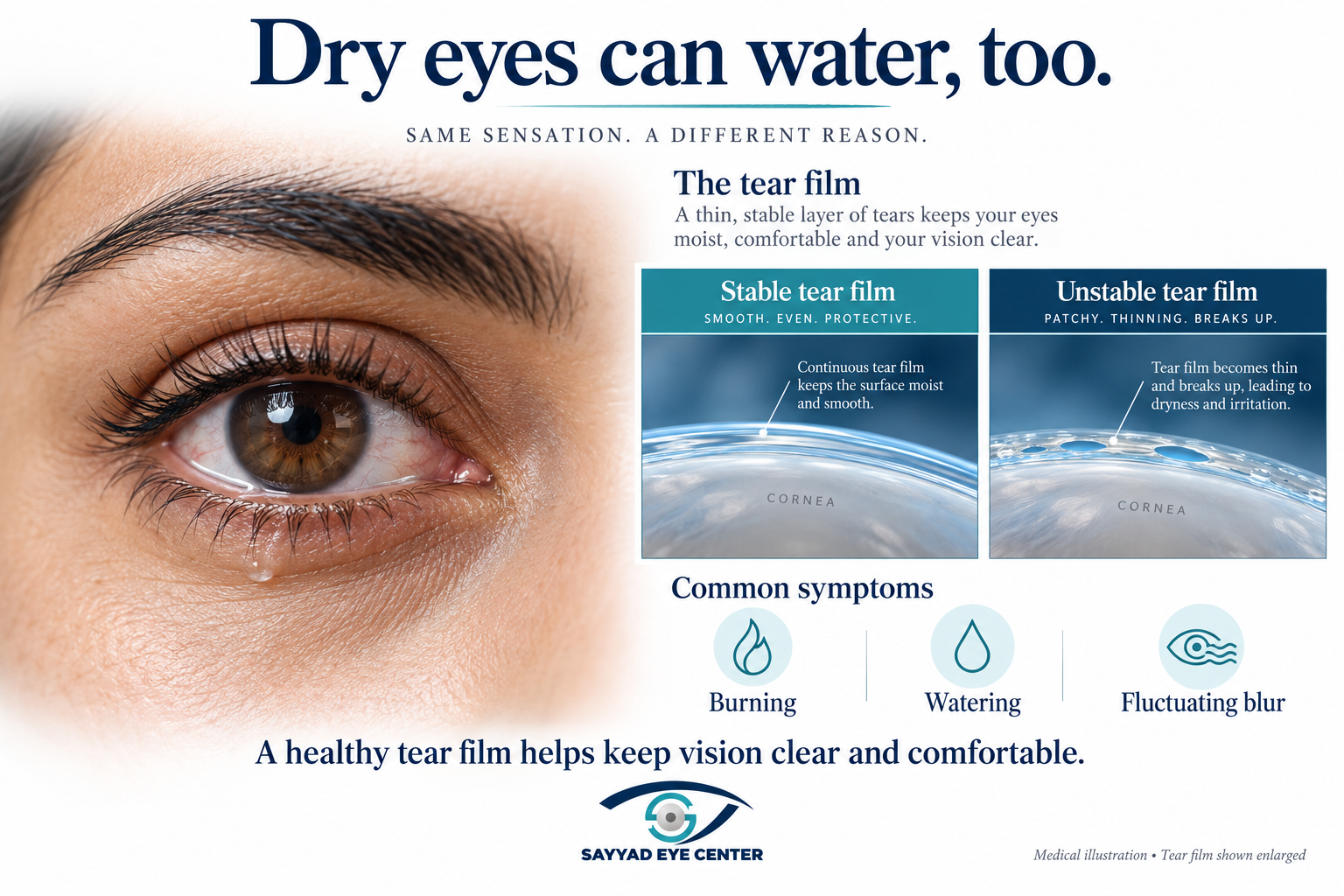
Every blink spreads a thin film of tears across the cornea, the clear front surface of the eye. That film helps protect the surface and keeps vision clear. Its oily component slows evaporation.
If the film breaks up too quickly, the surface becomes irritated. The eye may respond with a flood of reflex tears. Those tears can run down your cheek without correcting the underlying problem. So watering does not rule out dry eye.
What does dry eye feel like?
Burning, stinging, grittiness and tired eyes are common. Contact lenses may become uncomfortable. Vision can fluctuate, particularly with reading, screens, wind or air conditioning. Some people describe an eyelash in the eye when there is nothing there.
Blur that briefly improves after blinking can suggest a tear-film problem. It is a clue, not a diagnosis: persistent blur still needs an examination. Symptoms also do not always reflect how dry the surface looks, which is one reason we examine the eyes rather than judge from discomfort alone.
Why does it happen?
Some eyes produce too little watery tear fluid. Others lose tears too quickly because the oil glands along the eyelids are not working well. This is called meibomian gland dysfunction. Many people have a mixture of both.
Long periods on a phone or computer can reduce complete blinking. Air conditioning, wind, smoke and contact lenses may add to the irritation. Age, hormonal changes, eyelid inflammation, certain medicines and conditions such as Sjögren syndrome can also contribute. Tell us about your regular medicines and any dry mouth or joint symptoms. Do not stop prescribed medication yourself.
What will we check at your visit?
We ask when your symptoms occur, what makes them worse and which drops you already use. We examine your vision, eyelids, oil glands and corneal surface. A small amount of diagnostic dye can show dry areas and how quickly the tear film breaks up. Tear-production testing or other measurements may help in selected cases; not everyone needs the same tests.
Bring your drops or photographs of their labels. Mention previous eye surgery and contact-lens use, even if the symptoms started much later.
What helps dry eyes?
Lubricating drops and everyday changes
Artificial tears are often a useful starting point. Preservative-free drops are especially helpful when drops are needed frequently or the surface is sensitive. Gels and ointments last longer but can blur vision, so they are often better suited to bedtime when appropriate.
Take regular screen breaks and make a conscious effort to blink fully. Redirect fans and air-conditioning vents away from your face. Avoid smoke and eye rubbing. These changes help reduce irritation; they do not replace treatment when the surface is inflamed.
Treating the eyelids and oil glands
If blocked oil glands are part of the problem, comfortably warm compresses and gentle lid care may help. The aim is gentle warmth, not heat or pressure on the eyeball. Follow the method recommended after your examination. After recent eye surgery, wait until your postoperative plan allows compresses, massage or lid cleaning.
Selected patients may benefit from gland treatments in the clinic, including controlled heating and expression or intense pulsed light. These are options for particular forms of gland dysfunction, not a necessary treatment for every dry eye. Suitability, availability, benefits and cost should be discussed before choosing them.
When ordinary lubricants are not enough
Prescription anti-inflammatory treatment, such as cyclosporine (for example, Restasis), can help suitable patients. It works gradually rather than like an instant soothing drop. A short course of steroid drops is sometimes used under supervision; it is not something to start or repeat yourself.
Other options include punctal plugs to retain tears. More severe disease may need specialist treatments such as serum drops or scleral lenses. The plan depends on the cause, the condition of the surface and your response to simpler treatment. There is no single best drop for everyone.
Why treat dry eyes before cataract surgery?
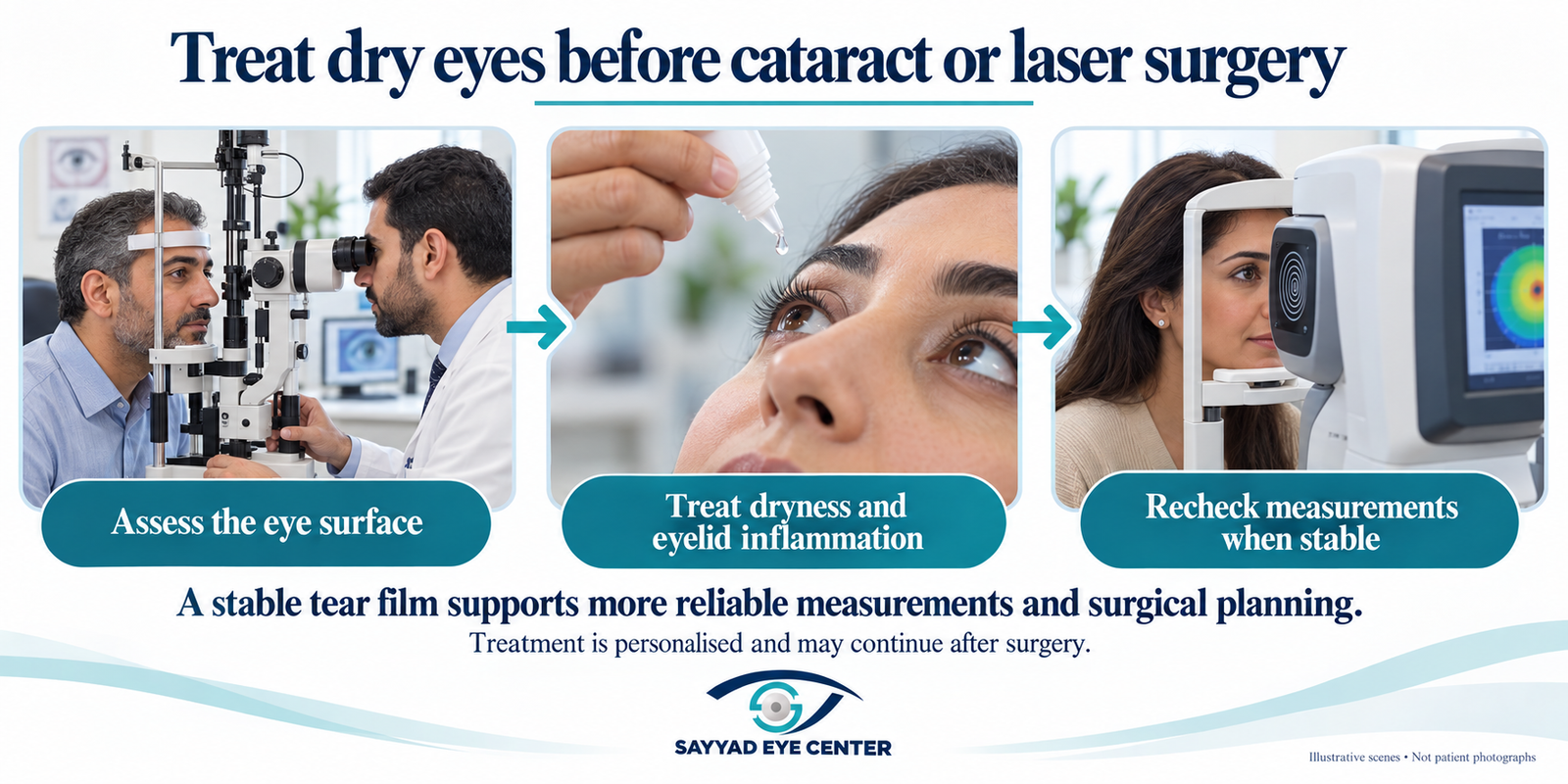
Cataract surgery replaces the cloudy lens inside the eye, but light still has to pass through the tear film and cornea first. An irregular, dry surface can affect the measurements used to choose the lens power and plan astigmatism correction.
We may treat the surface and repeat measurements before making the final lens decision. This matters with every lens, particularly when considering toric, EDOF or trifocal options. A good lens cannot compensate for an unstable tear film.
You may feel little discomfort and still need treatment. If we recommend settling the surface first, that preparation is part of planning for clear, comfortable vision. It does not necessarily mean that cataract surgery is unsuitable for you.
Why treat dry eyes before LASIK or other laser surgery?
The surface should be healthy and stable before measurements and laser treatment. Significant active dryness can make planning less reliable and recovery less comfortable. If the corneal surface is irritated or damaged, it needs treatment before proceeding.
Having dry eye does not automatically rule out laser correction. We assess its severity, treat the cause and reassess suitability. LASIK, SMILE Pro and PRK all need careful surface assessment; choosing a different technique does not remove the need to manage dryness. Some patients need a longer preparation period, and occasionally laser surgery is not advisable.
What about dryness after surgery?
Dryness can appear or become more noticeable after cataract or laser surgery. Temporary changes in the corneal nerves, surface inflammation and postoperative drops can contribute. Burning and variable sharpness may settle as the eye recovers, but the pace differs between patients. Some need ongoing treatment.
Use the prescribed postoperative plan and lubricants as directed. Leave at least five minutes between different eye drops. Do not stop your surgical drops or add steroid drops yourself. New or worsening blur should be assessed rather than automatically blamed on dryness.
When should you seek help?
Arrange an appointment if symptoms keep returning, interfere with work or reading, or are not improving with your current treatment. Seek urgent assessment for significant pain, marked light sensitivity, reduced vision, an injury, or a red painful eye while wearing contact lenses. After surgery, increasing pain, redness or a drop in vision needs prompt review.
Frequently asked questions
Can dry eye be cured permanently?
Many people get good control and feel much more comfortable. Some causes improve, while others need ongoing care. Treatment can be adjusted as the surface settles; needing maintenance does not mean that treatment has failed.
Will drinking more water solve it?
Avoiding dehydration is sensible, but drinking extra water alone will not correct blocked oil glands or surface inflammation.
Should I take omega-3 supplements?
They are not a guaranteed treatment. Research has been mixed, and a major trial found no additional benefit over placebo for typical moderate to severe dry eye. Discuss supplements rather than taking high doses yourself.
How long before surgery should I start treatment?
There is no fixed number of days that suits everyone. Some surfaces settle quickly; others need several weeks or longer. The decision depends on the examination and repeat measurements, not just whether the eye feels better on one particular morning.
Can I use drops that make the eyes look whiter?
Redness-relief drops do not address the cause of dry eye. Avoid relying on them to cover recurring redness. Choose treatment for the surface problem itself.
Related articles
Contact the centre
For a planned consultation or follow up, contact Sayyad Eye Center on +20 100 008 8168. Confirm whether your visit is in Mohandeseen or New Cairo. Bring your current drops and mention any planned cataract or laser surgery. This routine contact route is not a substitute for emergency eye care.
Medical review
Medically reviewed by Dr Fouad El Sayyad
American Board certified ophthalmologist
Fellowship in Cornea, External Eye Disease and Refractive Surgery
Washington University in St Louis, USA
References
European Society of Cataract and Refractive Surgeons — ESCRS Recommendations for Cataract Surgery
European Society of Cataract and Refractive Surgeons — ESCRS Recommendations for Refractive Surgery
American Academy of Ophthalmology — What Is Dry Eye? Symptoms, Causes and Treatment
RESTASIS — cyclosporine ophthalmic emulsion 0.05%, official product information