ICL Lens Implant Surgery
Considering ICL lens surgery in Cairo? Learn who may qualify, its benefits, how it differs from LASIK, and recovery, and arrange an eye assessment.
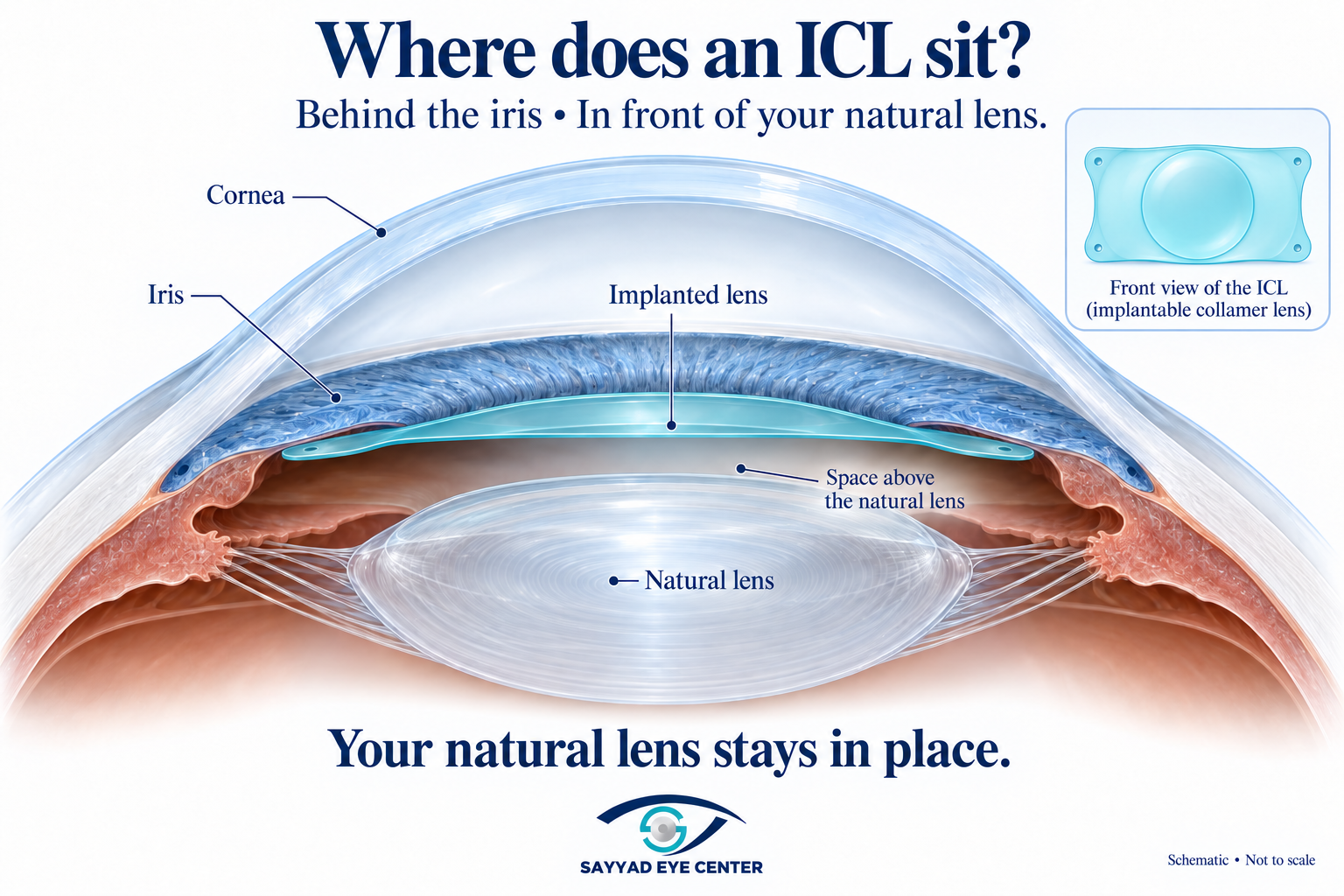
ICL surgery places a thin corrective lens inside the eye, behind the iris and in front of the natural lens. It can reduce dependence on glasses or contact lenses, particularly for some patients with high short-sightedness or eyes that are unsuitable for corneal laser treatment. Suitability depends on a detailed examination, not your prescription alone.
The benefits of ICL
For suitable eyes, ICL offers clearer unaided distance vision and less reliance on glasses or daily contact lenses. It can be particularly useful for high prescriptions or when laser correction is unsuitable. It preserves corneal tissue and keeps the natural lens in place; a toric implant can also treat astigmatism. The expected improvement depends on your eye health.
What is an ICL lens
ICL stands for Implantable Collamer Lens. It is a type of phakic intraocular lens: “phakic” means your natural lens remains in place. The implant stays inside the eye and is not removed or cleaned each day like a contact lens. A toric version can also correct suitable astigmatism.
ICL is different from cataract surgery or refractive lens exchange, which remove and replace the natural lens. Retaining your natural lens preserves its remaining ability to focus, but does not stop its normal aging.
How does ICL compare with SMILE Pro and LASIK
ICL
How it corrects vision: Adds a corrective lens inside the eye.
Key consideration: No corneal tissue is removed to reshape the prescription, but this is surgery inside the eye.
SMILE Pro
How it corrects vision: Removes a small piece of corneal tissue through a small opening.
Key consideration: Requires suitable corneal measurements and does not create a LASIK-style flap.
LASIK
How it corrects vision: Reshapes corneal tissue beneath a flap.
Key consideration: Requires suitable corneal measurements; the flap is part of the treatment decision.
There is no single best procedure for every patient. A careful assessment should lead to honest advice about the benefits, limitations and alternatives for your eyes. Your doctor should take time to answer your questions, including whether continuing with glasses is a reasonable choice.
Who may be suitable for ICL
ICL may be considered for selected adults with a stable prescription, especially when the correction required or corneal measurements make laser treatment less appropriate. Some patients with moderate prescriptions may also qualify. The approved age and prescription ranges depend on the lens model and local labeling.
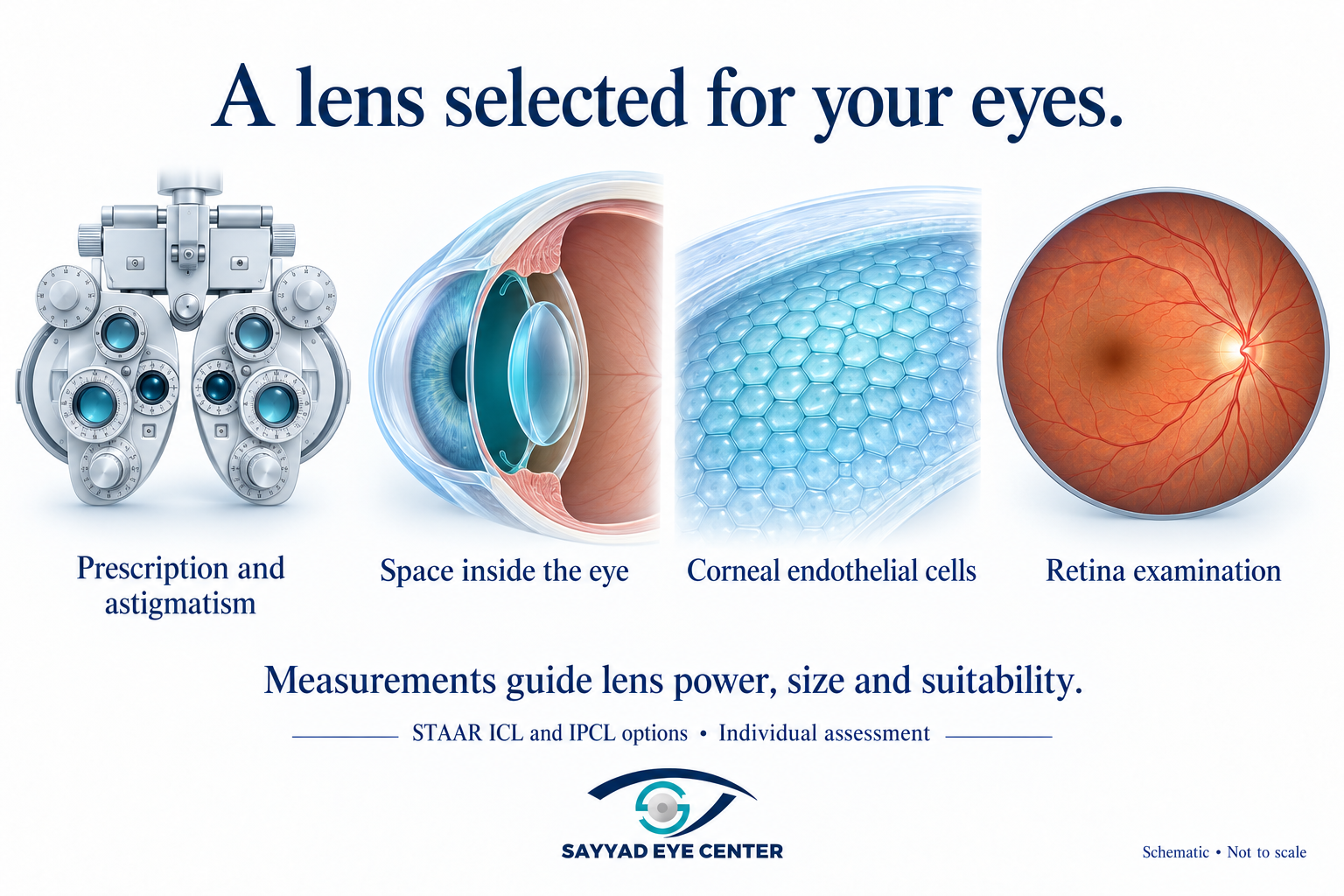
There must be enough space inside the front of the eye and a healthy layer of cells on the inner surface of the cornea. These endothelial cells help keep the cornea clear. Having a thin cornea alone does not establish that an implant will be safe.
Unstable vision, insufficient space, low endothelial cell counts, cataract, uncontrolled eye pressure or active eye disease may change the recommendation. Pregnancy or breastfeeding can require postponement. Tell your doctor about medicines, medical conditions and previous eye treatment.
Standard and toric lenses and the options we use
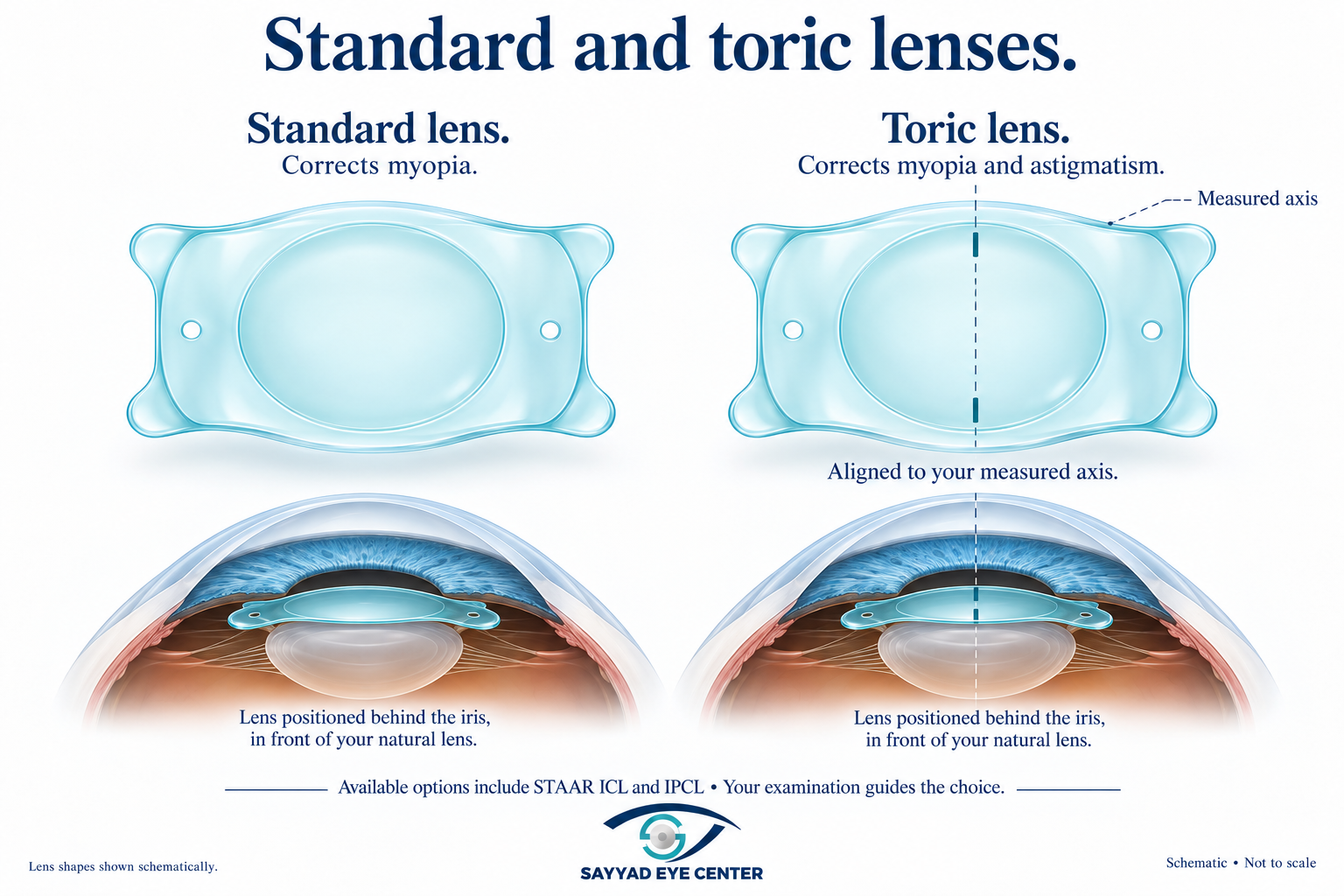
Standard spherical and toric lenses
Standard spherical lenses correct the spherical prescription, such as short-sightedness. Toric lenses also correct suitable regular astigmatism, the focusing error caused by different optical powers in different directions. Both STAAR ICL and IPCL have spherical and toric options. Your measurements determine whether the toric version is useful; not everyone needs it.
STAAR ICL and Care Group IPCL
Dr Fouad El Sayyad uses two implantable phakic lens options: STAAR Surgical ICL and Care Group IPCL. Both sit behind the iris while keeping the natural lens in place. ICL means Implantable Collamer Lens and refers to STAAR’s Collamer lens. IPCL means Implantable Phakic Contact Lens and uses a different material and design. They belong to the same broad treatment category but are distinct products.
STAAR ICL has a long international clinical history, including use in Europe and the United States. The EVO/EVO+ ICL and toric models received US FDA approval in 2022 for specified indications; the ICL family also has an established European CE-marking history. Approval applies to the particular model and indication.
IPCL has published clinical experience in Asia, including India, and its product information reports European CE marking.
Both options have a record of clinical use and published outcomes. Their evidence bases and regulatory histories are different, so reputation alone does not decide the choice. Dr Fouad will explain the recommended lens, its suitability for your eye, the expected benefits and the follow-up plan.
Lens choice FAQs
What is the difference between regular and toric lenses
A regular spherical lens corrects the spherical prescription. A toric lens adds astigmatism correction and must be positioned at the planned angle. The choice depends on your astigmatism and examination, not on one type being better for everyone.
Which implantable lenses does Dr Fouad use
Dr Fouad uses STAAR ICL and Care Group IPCL, selecting the lens and spherical or toric design according to each eye. IPCL is a separate phakic lens product, not another brand of Collamer ICL.
Are STAAR ICL and IPCL approved internationally
STAAR EVO ICL and toric models have US FDA approval for specified indications, and the ICL family has European CE-marking history. IPCL has published clinical experience in Asia, including India, and its product information reports European CE marking. Your doctor will explain the lens model recommended for your eyes.
Assessment treatment and recovery
What tests are needed before ICL surgery
The assessment checks more than the power of the implant. It should include:
• An accurate prescription and a review of how stable it has been.
• Measurements of the space inside the eye and dimensions used to choose lens size.
• An endothelial cell count, eye-pressure measurement and examination of the natural lens.
• Corneal scans, tear-film assessment and a retinal examination, especially with high myopia.
Ask your doctor what the tests show, which lens is proposed and why its size and power suit your eye. Bring previous prescriptions and reports, and ask when to stop contact lenses before measurements.
What happens during the procedure
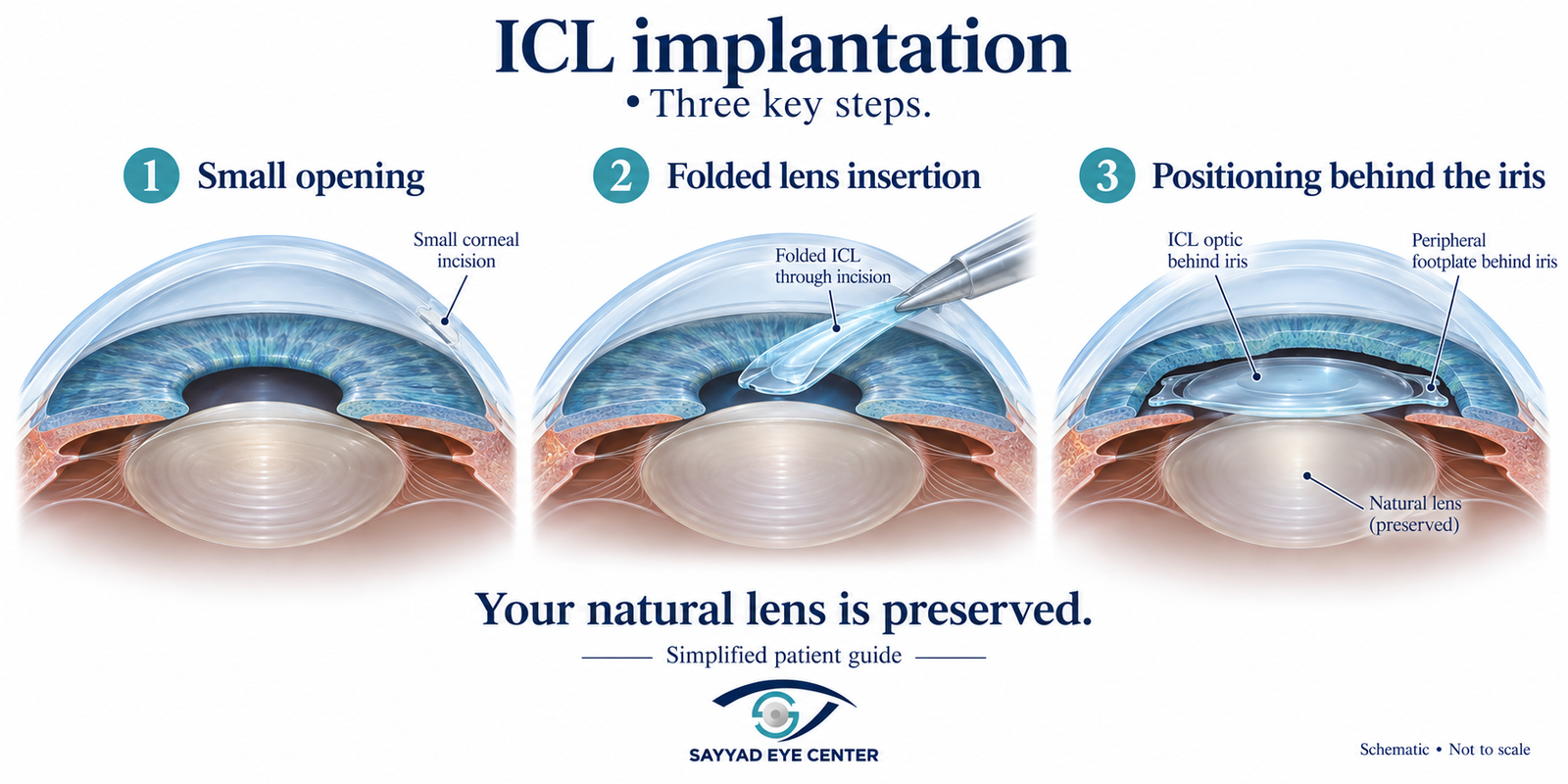
The eye is numbed, and the surgeon places the folded lens through a small incision, positioning it behind the iris. A toric implant must also be correctly aligned. Eye pressure and implant position need checking after surgery. Your team will explain the anesthesia plan and whether the eyes will be treated together or separately.
What is recovery like
Vision may improve early, but clarity and comfort can fluctuate during healing. Mild irritation, light sensitivity or halos can occur. Arrange transport home and avoid driving until your surgeon confirms that your vision is suitable. Return to work, exercise and travel according to your own follow-up findings.
Use prescribed drops exactly as instructed, avoid rubbing your eyes and follow the advice on washing, makeup, swimming and sport. Do not stop drops or miss an early check simply because your vision seems clear.
Why follow up matters even when vision is good
Early reviews check pressure, inflammation and the position of the implant. Your doctor also assesses the “vault”: the space between the ICL and the natural lens. Ongoing visits monitor eye pressure, the cornea and its endothelial cells, the implant and the natural lens. Keep the follow-up schedule your surgeon recommends.
What are the possible risks
Like any surgery, ICL has possible risks. Serious complications are rare, but careful assessment and follow-up remain important. Glare, halos or a remaining prescription can occur. Other possible problems include raised eye pressure, cataract formation, inflammation, infection or changes in corneal endothelial cells; occasionally the lens needs repositioning or exchange. Your doctor will explain which risks matter for your eyes and how they are monitored.
High myopia itself increases the risk of retinal tears and detachment, whether or not you have vision-correction surgery. ICL corrects the prescription but does not remove this underlying risk, so retinal checks remain important. New flashes, a sudden increase in floaters or a curtain over your vision need prompt assessment.
After surgery, contact your surgical team urgently for worsening pain, a sudden drop in vision, marked redness, or a painful eye with headache or nausea. If you cannot reach the team, seek urgent eye care rather than waiting for a routine appointment.
Frequently asked questions about ICL
Is ICL only for very high prescriptions
No. It is often considered for high short-sightedness, but selected patients with other suitable prescriptions may benefit. Measurements, eye health, visual goals and the approved lens range matter more than a single prescription number.
Can I have ICL if I have keratoconus
Keratoconus needs specialist assessment. An ICL does not strengthen the cornea or stop the disease progressing. It may help a selected stable eye with part of its prescription, but cannot reliably remove all distortion from an irregular cornea. It is not a substitute for treatment to control progression.
Can an ICL be removed
A surgeon can remove or exchange an ICL if needed. However, that requires another operation and carries risks. “Removable” does not mean that surgery is completely reversible or that the eye is guaranteed to return to its previous condition.
Will ICL cause dry eye
ICL does not reshape the cornea with a laser, so it avoids that particular source of surface-nerve disruption. Dryness or irritation can still occur. Discuss existing symptoms before surgery so your doctor can assess the surface of your eye and plan treatment if needed.
Will I still need reading glasses
Possibly. Standard distance-correcting ICL treatment does not prevent presbyopia, the age-related loss of near focus. You may need reading glasses as you get older, even with clear distance vision. Discuss near-vision needs before choosing treatment.
Is ICL the same as a lens used in cataract surgery
No. ICL is added while the natural lens remains. Cataract surgery replaces a cloudy natural lens with an artificial lens. If you later develop cataract, your surgeon will plan how to manage the ICL as part of cataract treatment.
Can I travel to Egypt for ICL surgery
Yes, you can arrange an assessment when visiting Egypt, but do not book a fixed surgical itinerary before your suitability is established. Allow time for lens planning or ordering, treatment and follow-up. Agree your return date and a plan for care abroad with your surgeon.
What should I ask before deciding
Ask why ICL is recommended, which model will be used, what alternatives you have, what risks matter most for you and how follow-up will work. Request a written quotation covering the lens, treatment, tests and follow-up. A decision should follow a clear discussion, not pressure to choose a procedure.
Arrange an ICL assessment in Cairo
At Sayyad Eye Center, Dr Fouad El Sayyad assesses your prescription, eye anatomy and visual priorities to advise whether ICL or another option is appropriate. Contact the team to arrange your assessment and confirm the examination and surgical locations.
Medical review
Medical review: Dr Fouad El Sayyad, Consultant Cornea, Cataract and Refractive Surgeon; American Board Certified in Ophthalmology; Fellowship in Cornea, External Eye Disease and Refractive Surgery, Washington University in St. Louis, USA.
This article supports your consultation and does not replace an individual examination. Sources are listed at the end of the article.
References
STAAR Surgical official sources
EVO ICL product information https://evo.staar.com/
Patient information booklet https://patientinfo.staar.com/pfm/live-site-pfms/PIB-0002_Rev_02_Patient%20Information%20Booklet.pdf
EVO ICL FDA approval announcement https://investors.staar.com/news-and-events/press-releases/2022/03-28-2022-092935988
STAAR Surgical product history https://investors.staar.com/resources/staar-surgical-timeline
IPCL official product website
IPCL lens information https://ipcliol.com/about/
IPCL safety and reported regulatory status https://ipcliol.com/safety/
IPCL patient FAQs https://ipcliol.com/faq/
American Academy of Ophthalmology patient resources
Presbyopia https://www.aao.org/eye-health/diseases/what-is-presbyopia
Retinal detachment https://www.aao.org/eye-health/diseases/detached-torn-retina
Keratoconus https://www.aao.org/eye-health/diseases/what-is-keratoconus
Sources checked on 5 October 2026. Publish this reference list at the end of each language version, without inline reference numbers.