SMILE Pro Femto LASIK or PRK
Compare SMILE Pro, Femto LASIK and PRK: technique, recovery, dry eye and suitability. Understand how your examination guides the choice at Sayyad Eye Center.

Reducing your dependence on glasses can make everyday life easier, from driving and exercising to travelling and working. SMILE Pro, Femto LASIK and PRK can all provide excellent vision in appropriately selected patients.
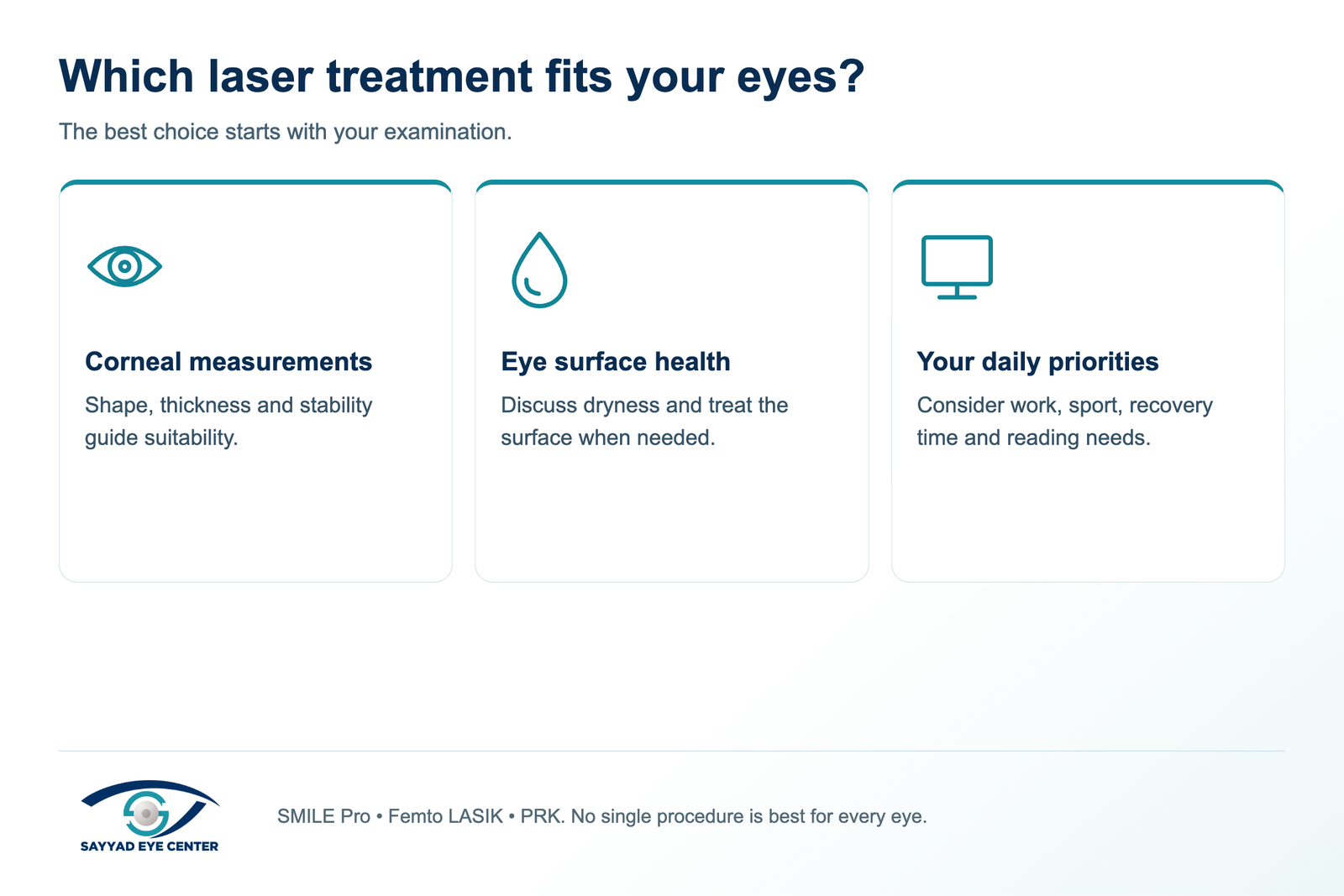
The right choice depends on your prescription, corneal measurements, eye surface and lifestyle. Your consultation should give you a clear explanation of the options and enough time to have your questions answered.
What is the difference
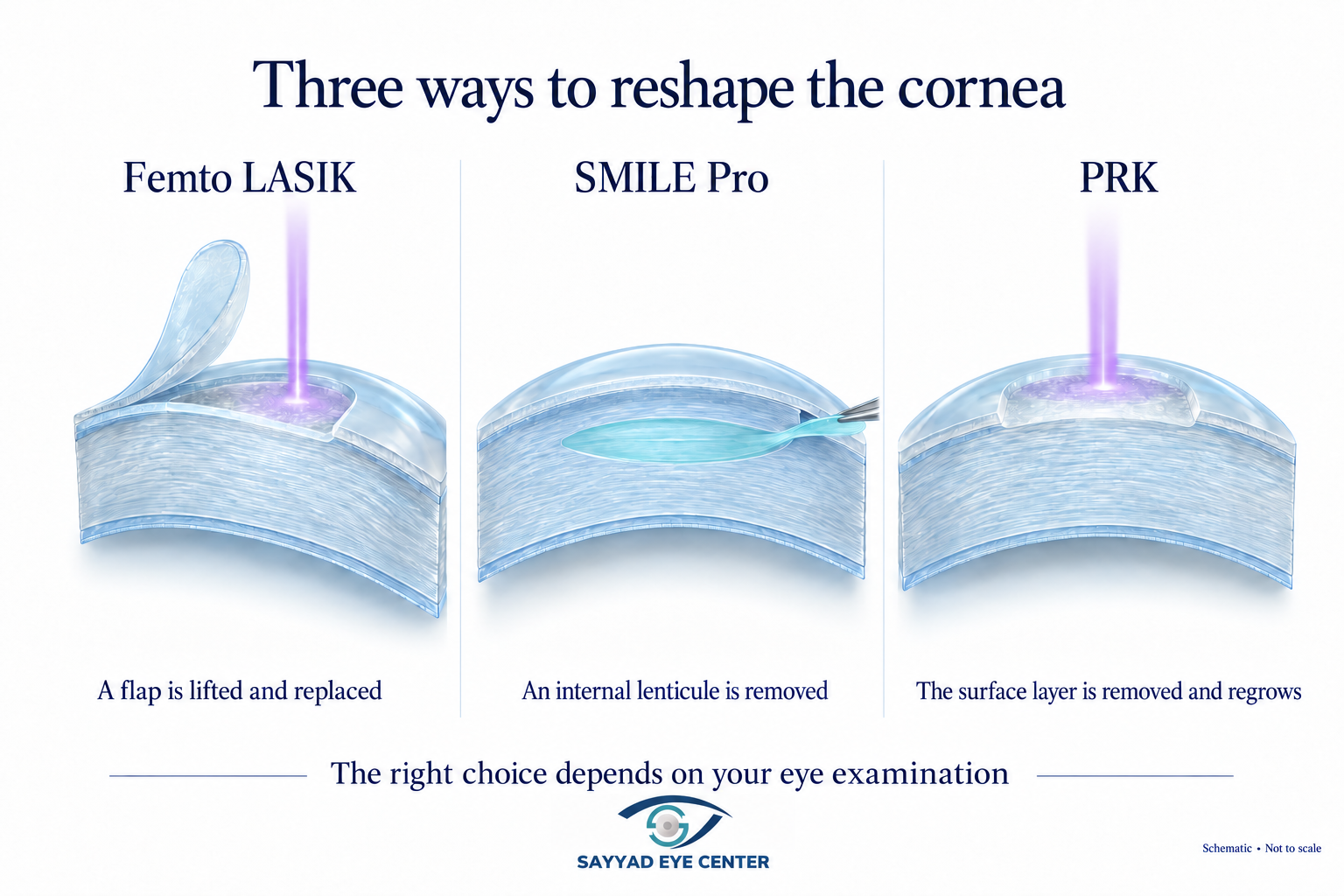
All three procedures reshape the cornea, the clear front surface of your eye, to improve how light focuses.
Technique
SMILE Pro: Tissue removed through a small incision
Femto LASIK: Laser reshaping beneath a flap
PRK: Laser reshaping after removal of surface cells
Corneal flap
SMILE Pro: No
Femto LASIK: Yes
PRK: No
Early recovery
SMILE Pro: Usually quick; clarity continues improving
Femto LASIK: Usually quick
PRK: More gradual as the surface heals
Early comfort
SMILE Pro: Usually mild discomfort
Femto LASIK: Usually mild discomfort
PRK: More discomfort in the first few days
Main consideration
SMILE Pro: Suitability for lenticule extraction
Femto LASIK: Suitability for a flap and planned correction
PRK: Suitability for surface treatment and longer recovery
SMILE Pro correction through a small incision
SMILE Pro uses a femtosecond laser to create a thin piece of tissue called a lenticule inside the cornea. The surgeon removes it through a small incision, changing the corneal shape without creating a LASIK flap.
At Sayyad Eye Center, we use the ZEISS VISUMAX 800 for SMILE Pro.
For suitable patients with short sight and astigmatism, its main attractions include a small incision, no flap and a generally comfortable early recovery. Vision often improves quickly, although fine detail can continue improving over the following days and weeks.
Femto LASIK rapid visual recovery
Femto LASIK combines two laser steps. A femtosecond laser creates a thin corneal flap. The surgeon lifts this flap, uses an excimer laser to reshape the tissue underneath and then returns the flap to its position.
It can treat short sight, long sight and astigmatism within the treatment limits of the laser platform and the individual eye.
Rapid functional vision is one of its main benefits. Many patients find it convenient when returning to work, although vision can fluctuate during early healing. Protecting the eye from rubbing and injury is important.
PRK an established option without a flap
PRK treats the cornea from its surface. The surface cells are removed, and an excimer laser reshapes the underlying tissue. A temporary bandage contact lens protects the eye while those cells grow back.
PRK does not create a flap and remains a valuable option for selected patients. TransPRK belongs to the same family of surface treatments, with the laser also removing the surface cells.
The main tradeoff is recovery. Discomfort is usually greater during the first few days, and clear, stable vision takes longer to develop.
A thinner cornea does not automatically make PRK the right choice. Corneal shape, the planned amount of treatment and the overall examination still determine whether laser correction is suitable.
Which procedure causes less dryness
Dryness should be discussed before surgery, particularly if you already experience burning, fluctuating vision or difficulty wearing contact lenses.
Evidence generally supports less early dryness after SMILE compared with Femto LASIK, although individual experiences vary. SMILE Pro does not eliminate the possibility of dryness, and PRK can also temporarily affect the eye surface.
Treating existing dry eye before surgery can improve comfort and help make your measurements more reliable.
What do we assess before recommending surgery
Your consultation includes a discussion of your vision, medical history, prescription stability and expectations, together with an eye examination.
Important measurements include your glasses prescription and how stable it has been; corneal thickness, shape and regularity; corneal topography and tomography; tear film and eye surface health; and other findings that may affect the quality of your vision.
At our centre, MS 39 imaging can provide detailed information about corneal shape and optical quality when indicated.
Bring your current glasses and any available previous prescriptions. Tell us about dry eye, contact lens use, previous eye treatment and your work or sporting activities.
How much time should I allow for recovery
SMILE Pro and Femto LASIK generally offer a quicker return to ordinary activities than PRK. Some patients feel ready for desk work within the first few days, but recovery varies.
After PRK, allow more time for surface healing and fluctuating vision. Improvement continues over the following weeks.
Comfortable reading or working at a computer does not necessarily mean that your vision is ready for demanding tasks such as night driving. Plan your recovery around what your work actually involves.
Patients travelling from abroad should arrange their early follow up appointments before booking their return journey.
What if I am over forty
Laser correction for distance does not stop the natural loss of near focusing that develops with age. You may still need reading glasses, even with excellent distance vision.
Discuss reading, computer use and distance vision before choosing treatment. Selected patients may benefit from an approach such as PRESBYOND Laser Blended Vision, following assessment and testing of how they tolerate the planned balance between the eyes.
Benefits and realistic expectations
The aim is clearer vision with less dependence on glasses or contact lenses.
As with any surgery, there are risks. Temporary dryness, fluctuating vision, glare and halos can occur during recovery. Serious complications are uncommon, but careful screening, accurate planning and appropriate follow up remain essential.
Your doctor should explain the benefits and the risks relevant to your own eyes. Honest advice may mean recommending a different procedure, treating dryness first or deciding that surgery is not the best option.
Frequently asked questions
Is SMILE Pro always better than Femto LASIK or PRK
No single procedure is best for every eye. SMILE Pro is an excellent option for suitable patients, while Femto LASIK or PRK may better match another patient’s measurements and visual needs.
Is PRK the same as Femto LASIK
No. PRK treats the cornea from the surface without creating a flap. Femto LASIK reshapes tissue underneath a flap created with a femtosecond laser.
Which procedure is best if I play contact sports
A procedure without a flap may be attractive when eye injury is a concern. Your corneal assessment still comes first, and protective eyewear remains important when returning to sport.
Can I have laser correction if my cornea is thin
Sometimes, but thickness alone cannot answer this question. Some eyes are suitable for surface treatment, while others are better served by glasses, contact lenses or an implantable lens.
Will I never need glasses again
Many patients achieve substantial freedom from glasses for everyday activities. However, reading needs, natural changes in the eye or a remaining prescription can mean glasses are still useful.
Can I have further treatment if some prescription remains
Additional correction is possible in selected cases. The decision depends on stable measurements, corneal health and the original procedure. It should be assessed individually rather than assumed in advance.
Contact the centre
For a planned consultation or follow up, contact Sayyad Eye Center on +20 100 008 8168. Confirm whether your visit is in Mohandeseen or New Cairo. Patients living abroad should arrange follow up before travel. This routine contact route is not a substitute for emergency eye care.
Medical review
Dr Fouad El Sayyad
American Board certified ophthalmologist
Fellowship in Cornea, External Eye Disease and Refractive Surgery
Washington University in St Louis, USA
References
ZEISS Comparison of laser vision correction methods
https://www.zeiss.com/meditec-patient/us/laser-vision-correction/treatment-comparison.html
ZEISS SMILE and SMILE Pro patient information
https://www.zeiss.com/vision-care/en/eye-surgery/vision-correction-surgery/smile-laser-eye-surgery.html
AAO LASIK patient information
https://aao.org/eye-health/treatments/lasik
AAO PRK patient information
https://aao.org/eye-health/treatments/photorefractive-keratectomy-prk