Steroid eye drops: why you should not use them without supervision
Steroid eye drops can be valuable when prescribed correctly. Learn why self-treatment is risky, what monitoring involves and when to seek eye care.
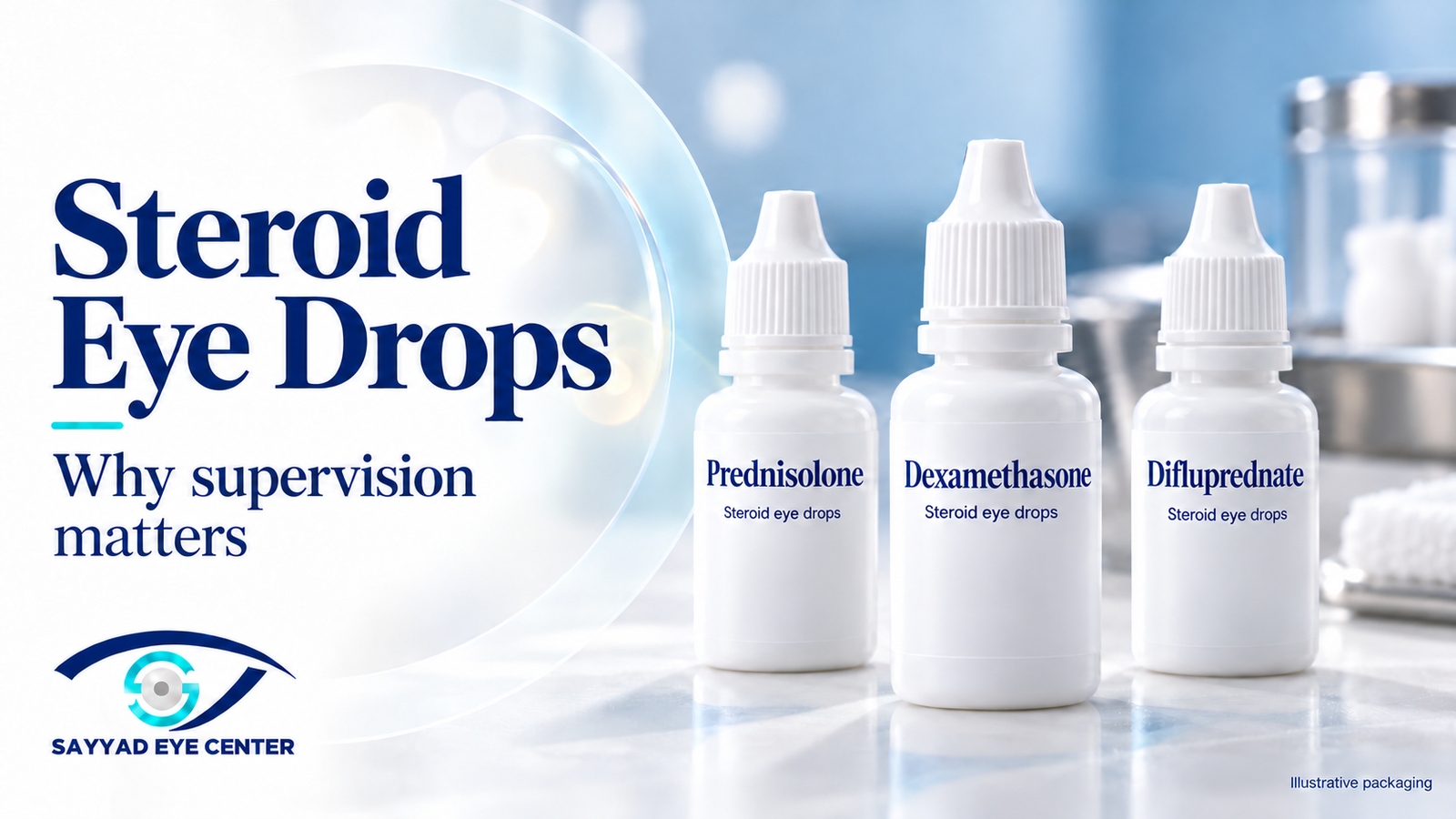
A drop clears the redness quickly, so you keep it in the cupboard and use it whenever the eye becomes irritated. It may even be described as an antibiotic drop. But if it also contains a steroid, repeating it without an examination can hide the real problem and create another one.
Steroid eye drops are valuable medicines. We use them after operations and for specific inflammatory conditions because controlling inflammation can protect vision. The safe approach is the right diagnosis, a clear treatment plan and follow-up, not avoiding every steroid or using one whenever the eye looks red.
How do I know whether my drop contains a steroid?
Check the active ingredients, not just the brand name. Examples include dexamethasone, prednisolone, fluorometholone and loteprednol. Some bottles combine a steroid with an antibiotic. The antibiotic does not remove the steroid’s risks or make the bottle suitable for every infection.
If the label is unclear, bring the bottle or a photograph to your appointment. Include ointments and any creams used around the eyelids. Tell us how often you use each product and for how long, including courses you started yourself.
Why can a drop that makes the eye feel better be a problem?
A steroid reduces inflammation. That can make redness and discomfort settle before the underlying cause has been identified. A red eye might be due to allergy, dry eye, infection, a corneal injury or inflammation deeper inside the eye. These problems need different treatment.
The fact that a bottle worked during a previous episode does not establish the diagnosis this time. Repeatedly treating the appearance can delay the examination that would explain why the redness keeps coming back.
The main risks of unsupervised use
Eye pressure can rise without obvious symptoms
Some people respond to steroids with a rise in pressure inside the eye. If pressure remains elevated, it can damage the optic nerve and lead to glaucoma. The eye may still feel comfortable, so symptoms cannot replace pressure measurement.
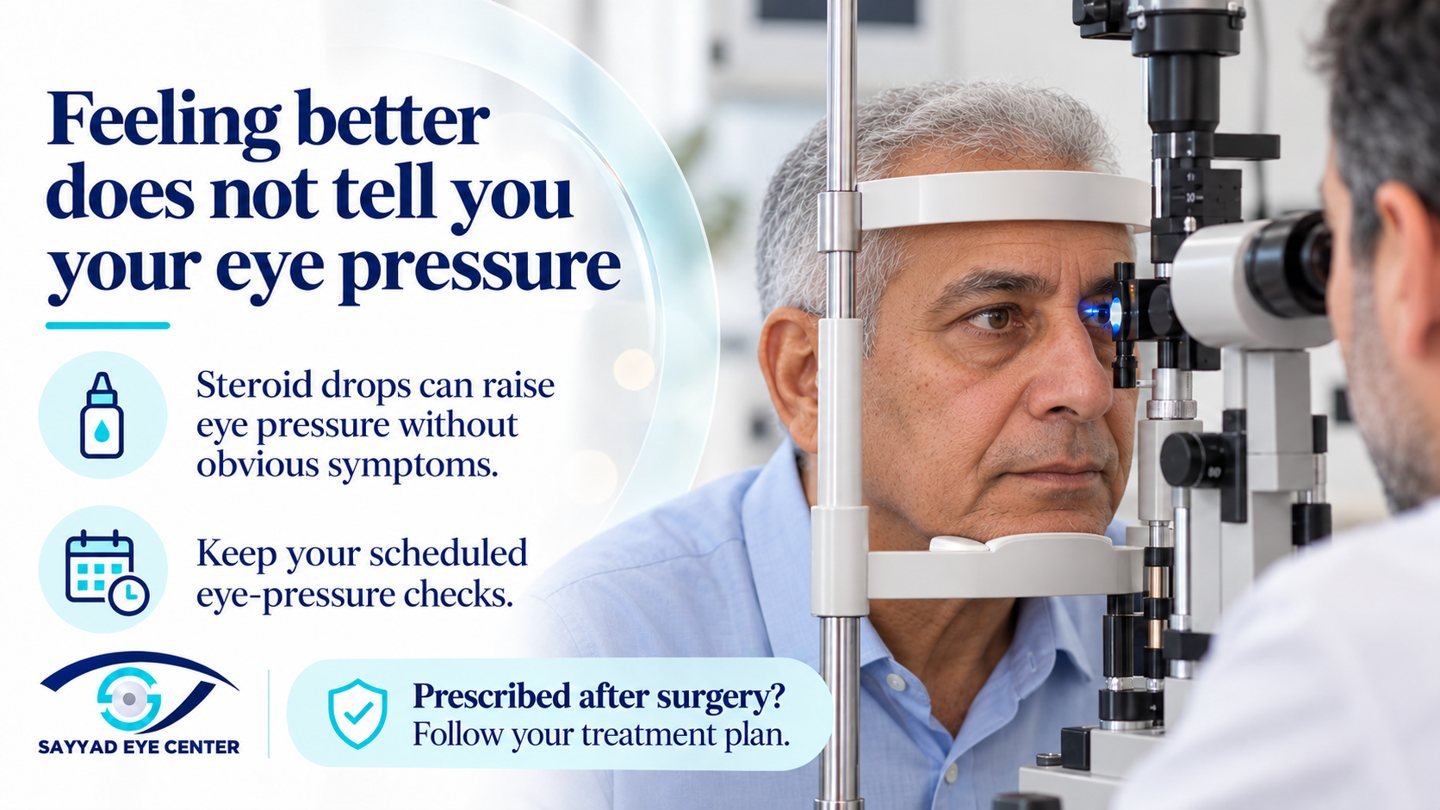
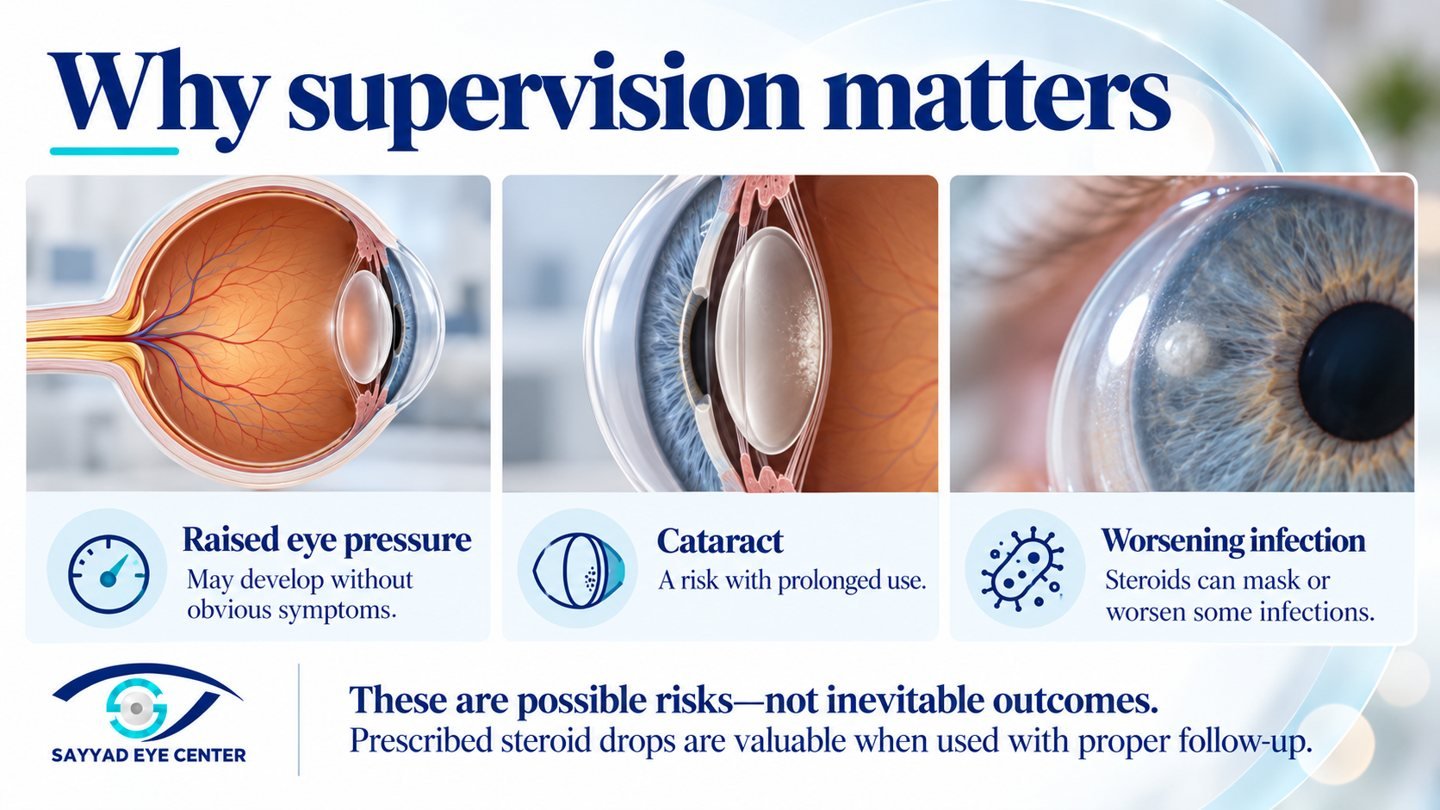
The response varies with the medicine, strength, frequency, duration and individual susceptibility. Existing glaucoma, a previous pressure response and a family history of glaucoma are particularly important to mention. Children also need careful supervision. There is no universal number of days that makes self-treatment safe for everyone.
Some infections can worsen or become harder to recognize
Steroids can aggravate certain untreated infections, including herpes affecting the corneal surface and fungal infection. In selected infections, an ophthalmologist may use a steroid alongside specific treatment at an appropriate stage. That decision follows an examination; it is not a reason to combine leftover drops at home.
A contact-lens wearer with a painful red eye needs prompt assessment. Do not assume it is allergy and cover the symptoms with a steroid combination.
Healing and the natural lens can be affected
Steroids can slow surface healing in some circumstances. In an already thin or diseased cornea, complications may be serious. Prolonged or repeated exposure can also contribute to a particular form of cataract. These risks are reasons to monitor treatment, not predictions that every prescribed course will harm your eyes.
Why are steroids prescribed after cataract or laser surgery?
Inflammation is part of the response to surgery. A planned course of drops can help control it. Other conditions, such as uveitis or a corneal graft, may require longer treatment under supervision. The intended benefit and the follow-up plan matter more than the word “steroid” on its own.
Continue your prescribed postoperative plan. Do not stop an important treatment simply because you read about possible side effects, and do not continue beyond the written course because some liquid remains. If the instructions are unclear, have the plan clarified rather than inventing a taper.
What does safe monitoring involve?
The examination may include vision, the corneal surface and pressure measurement. Longer treatment or an abnormal pressure reading may require further optic nerve assessment. The timing depends on your eye and the medication; improvement in redness does not cancel the need for follow-up.
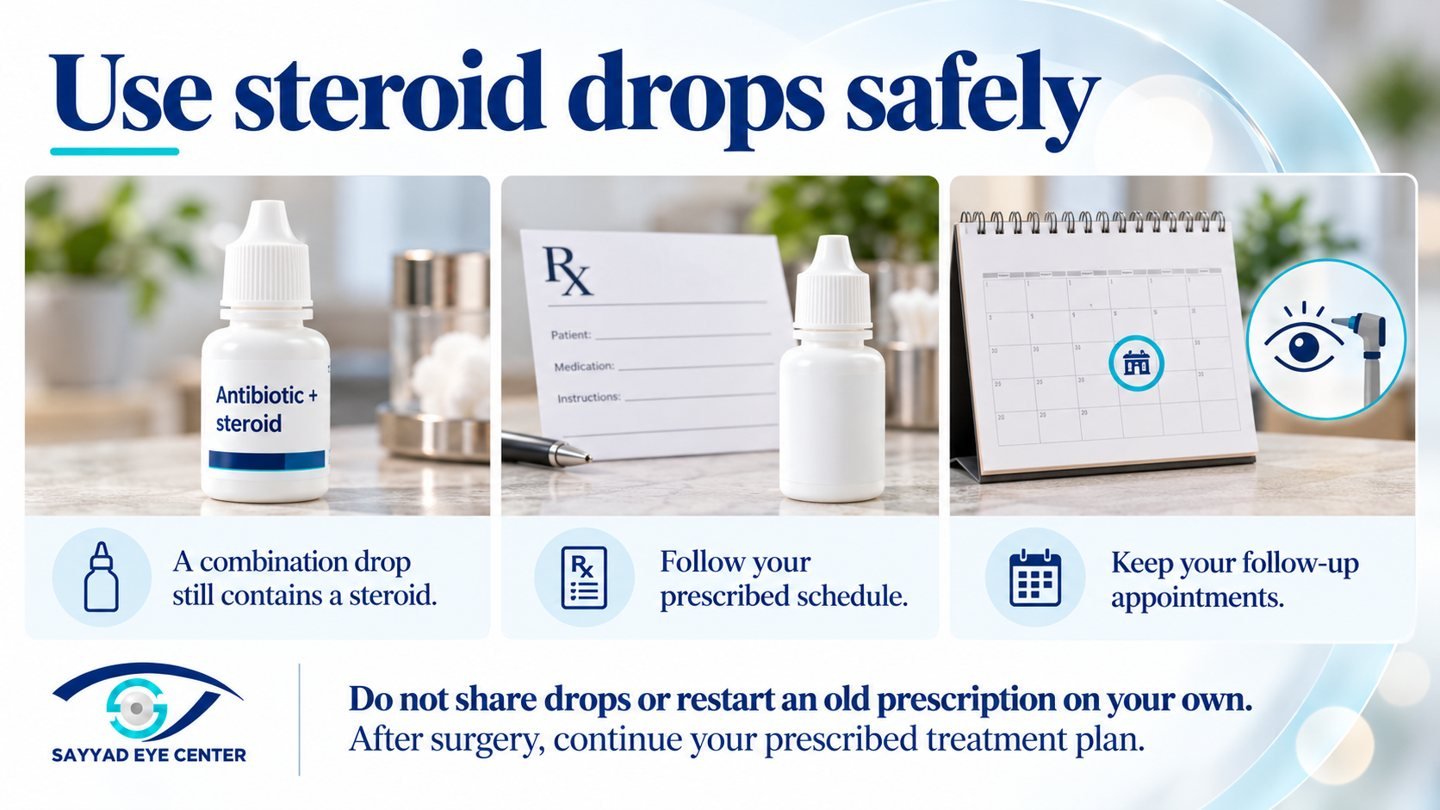
Ask four practical questions: What are we treating? Which eye and how many drops? When should the dose change or stop? When is the next examination? Keep the written plan with the bottle. Do not share drops, touch the tip to the eye or use a bottle beyond its stated expiry or opening limit.
What if I have already been using a steroid without advice?
Arrange an eye examination and bring the bottle. Be honest about the frequency and duration; the purpose is to help, not to criticize. Do not increase the dose or restart another old course while waiting. If you have used it regularly for a prolonged period, obtain prompt advice about how to change or stop it instead of making your own schedule.
Seek same-day care for pain, marked light sensitivity, worsening redness or reduced vision, especially after recent surgery or with contact lenses. Sudden severe pain or a rapid fall in vision needs immediate care. Do not wait for the next routine appointment.
Frequently asked questions
Is a “mild” steroid safe to use whenever I need it?
No. Some preparations have a lower tendency to raise pressure, but lower risk does not mean no risk. The diagnosis and duration still matter.
Does an antibiotic-and-steroid bottle treat every red eye?
No. It does not cover every infection, and a steroid may be unsuitable for the actual cause. The combination needs the same attention to diagnosis and monitoring.
Must every steroid course be reduced gradually?
Not every short course needs tapering. Other conditions require a gradual reduction to prevent inflammation returning. Follow the schedule for your diagnosis; there is no single taper for every patient.
If my pressure rises, is the damage permanent?
A pressure rise is not automatically glaucoma. It may improve after treatment is adjusted, sometimes with pressure-lowering medicine. Established optic nerve damage cannot simply be reversed, which is why early detection matters.
Can I use last year’s postoperative drops for itching?
No. A previous prescription was for a particular eye problem at a particular time. Itching deserves an appropriate assessment and treatment plan, rather than recycling a surgical prescription.
Related articles
Contact the centre
For a planned consultation or follow-up, contact Sayyad Eye Center on +20 100 008 8168. Confirm whether your visit is in Mohandeseen or New Cairo. Bring your medicines and previous reports. For urgent warning symptoms, use an eye emergency service if the centre is unavailable; do not wait for a message reply.
References
Pred Forte 1% eye drops. UK Summary of Product Characteristics, electronic Medicines Compendium.
American Academy of Ophthalmology. 10 Cataract Surgery Side Effects, and How to Cope.
Medical review
Medically reviewed by Dr Fouad El Sayyad
American Board certified ophthalmologist
Fellowship in Cornea, External Eye Disease and Refractive Surgery
Washington University in St Louis, USA